Hua Hin is Thailand's former royal seaside resort, about 200 km south of Bangkok. Here you'll find what to see, from the wooden railway station to the night markets, along with two major nature excursions. You'll also learn when to go, how to get there from Bangkok and how much time to plan.
Hua Hin in brief: a royal resort on the gulf
Hua Hin is a seaside resort on the Gulf of Thailand, about 200 kilometers south of Bangkok[1]. Once a simple fishing village, the town took off in the 1920s, when King Rama VII had a summer residence built there[1]. In 1929, he completed the Klai Kangwon summer palace, whose name means "far from worries"[2].
The railway made the resort. Construction of the Railway Hotel began in 1921, and its opening the following year coincided with the creation of the Royal Hua Hin Golf Course, the kingdom's first golf course[2]. The town has kept a peaceful character: the atmosphere is described as calm and family-friendly[1], far from the buzz of Phuket or Pattaya[2]. Families from Bangkok come here on weekends, without the backpacker party scene[3].
What to see in town: historic station, palaces and beach
The railway station is the town's emblem. Its Victorian-style wooden architecture, in bright red and yellow, makes it one of the most remarkable in Thailand[1]. It once housed a royal pavilion used to host the king and his court[1]. A new modern station opened nearby in December 2023, but the old one is preserved as a historic monument[1].
As for palaces, Klai Kangwon consists of villas facing the sea and is still used by the Thai royal family[1][3]. Farther north, Mrigadayavan Palace, built in 1924 for King Rama VI, is a group of gilded teak pavilions on stilts, linked by walkways and designed to catch the sea breeze[1].
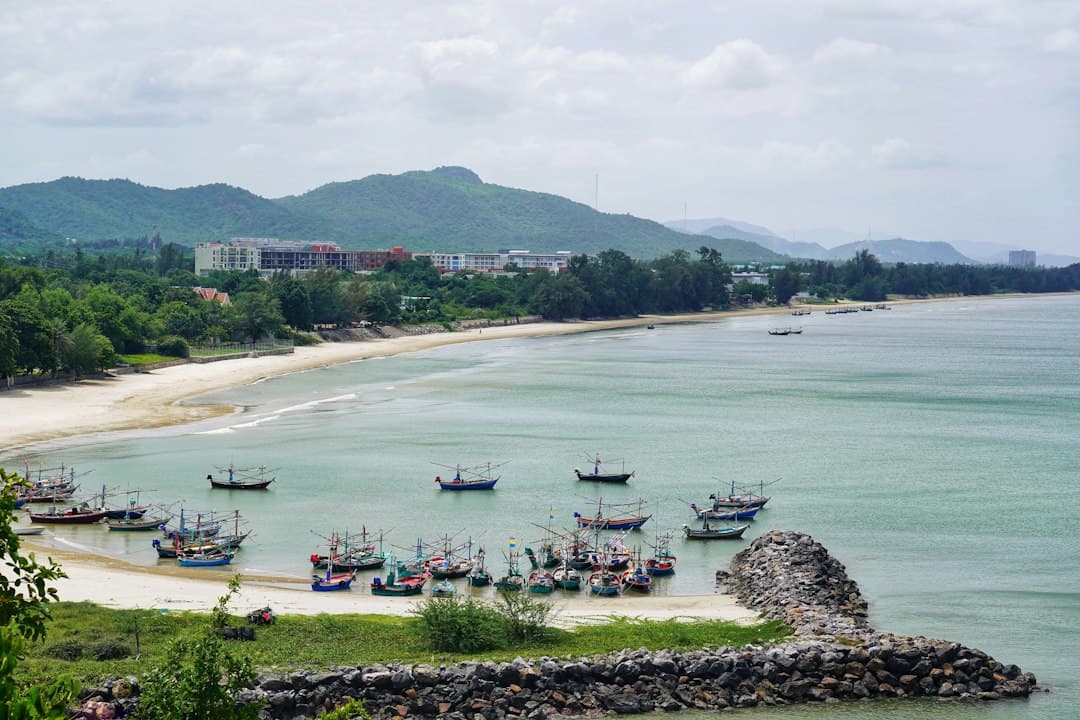
The beach stretches for about seven kilometers, from the fishermen's pier to Khao Takiab[3]. The sand can be walked along its entire length[3]. Families appreciate its shallow waters[2].
Temples and viewpoints: Khao Takiab, Wat Huay Mongkol, Khao Hin Lek Fai
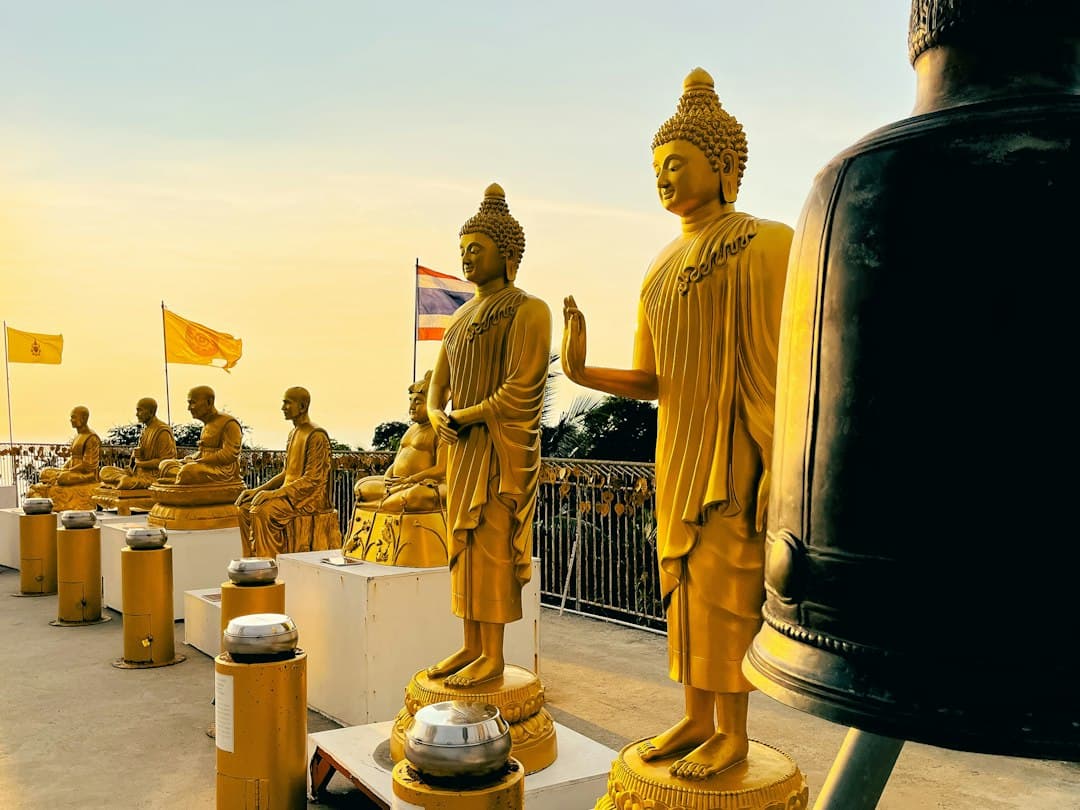
For a panoramic view of the town and the bay, climb the Khao Takiab hill at the southern end of the beach: you'll find a Buddhist temple and a large standing Buddha[1]. The monkeys here are well acquainted with bags: keep food and belongings out of their sight[4].
Wat Huay Mongkol, nearby, is known for the imposing statue of the monk Luang Pu Thuat[2]. It is a place of worship, so visit with discretion, as at any temple.
For sunrise, the 162-meter-high Khao Hin Lek Fai hill is about three kilometers west of the center[4].
Night markets and gulf cuisine
Hua Hin comes alive at dusk. The markets fill with freshly caught fish, crabs, shrimp and shellfish, steamed or grilled in front of visitors[2].
- Hua Hin Night Market: known for its fresh seafood stalls[1]. Grilled food, roti and souvenirs on Dechanuchit Road, every evening from 6 pm, about 400 m from the station[3].
- Cicada Market: open on weekends, it brings together artists, artisans and designers in a relaxed atmosphere[2]. It offers handicrafts, art galleries and performances[1], with hours from 4 pm to 11 pm, live music at 7 pm and street performers at 7:45 pm and 9 pm[4].
- Tamarind Market: next to Cicada, it is devoted mainly to food[1].
Nature excursions: Phraya Nakhon Cave and Kaeng Krachan National Park
South of the city, Khao Sam Roi Yot National Park protects mangroves, limestone hills, and the famous Phraya Nakhon Cave, a royal pavilion set inside a collapsed sinkhole and lit by a natural opening[3]. You reach it by boat from Laem Sala Beach, then climb a steep trail on foot to the cave, 430 meters higher[5]. Aim for the morning, between 10:00 and 11:30 am, when the sun pours through the ceiling and lights up the pavilion[5]. Avoid weekends: the park is very busy on Saturdays, Sundays, and Thai public holidays[5].
Inland, Kaeng Krachan National Park is the largest in the country, covering 2,915 km², and has been a UNESCO World Heritage forest since 2021[4]. It is home to wild elephants and well-preserved nature. It closes in August, September, and October, at the height of the rainy season[6].
As an option, Phetchaburi, a province neighboring Hua Hin, is worth choosing for its royal buildings, its temple art, and its palm sugar cuisine[7].
Leisure and Lifestyle: Golf, Wellness, Wine, Festivals
- Golf: about a dozen international-standard courses are spread across the region[2].
- Wellness: Chiva-Som Hua Hin Resort is a world-renowned reference for holistic retreats, and most major hotels offer full spas[2].
- Wine: Monsoon Valley Vineyard produces notably Shiraz and Colombard, best enjoyed in the hills[2].
- Music: the Hua Hin Jazz Festival takes place at the end of May and the beginning of June, on the beach[2].
Where to Stay, How to Get Around, How Long to Plan For
Three areas stand out. The city center offers the night market and the beach within walking distance; Khao Takiab, quieter, has beachfront accommodation; the Khao Tao area, slightly off the beaten path, suits those looking for tranquility and nature[5].
Hua Hin has no metro, no BTS, and no urban transit network[8]. Green songthaews, pickup trucks with two benches in the back, are the most economical option: flag one down on the roadside, and it will run along Phetkasem Road between the center and Khao Takiab[8]. You can also rely on tuk-tuks, motorbike taxis, or Grab, which operates here with few drivers[4]. The city is flat and well suited to cycling[4].
For length of stay, four nights in a single base lets you combine the city with one major excursion[7].
Best Time to Go
The dry season, from November to April, is ideal[5]. October is the rainiest month: it's best to avoid it[5]. From May to September, the city is calmer and prices are more attractive, with occasional showers that rarely last long[5]. Located on the Gulf coast, Hua Hin largely escapes the Andaman monsoon[3].
Getting There from Bangkok
Hua Hin is about 200 km and roughly three hours' drive south of Bangkok[8]. Hua Hin Airport has no flights from Bangkok[3]; almost everyone goes through Bangkok and continues by road[9].
- Train: about 15 trains per day in each direction, with journeys of 3 to 4.5 hours depending on the number of stops[8]. The train stops at Hua Hin station, on the southern line[8]. According to the guide consulted, it is the most pleasant way to arrive[10].
- Bus and minivan: from Sai Tai Mai, the southern bus terminal in Bangkok, minivans depart roughly every half hour, for a journey of about three hours[8].
- From Suvarnabhumi Airport: the Roong Reuang coach leaves from level 1, gate 8[6]; it costs 361 baht at the counter and takes about four hours[10]. It stops at the RRC bus terminal, about 7 km north of the clock tower: plan a Grab ride of around fifteen minutes to reach the center[10].
Pitfalls and Things to Watch Out For
- Rental scooters: in tourist areas, they are often unregistered and cannot legally be used on public roads[11].
- Traffic: Thailand has a high number of road accidents, especially involving motorcycles[11]. In Hua Hin, traffic can be heavy on the main roads, so caution is essential[5].
- Swimming: be careful offshore, especially during monsoon season, as people have drowned in strong currents[11]. Obey signs and flags, particularly red ones[11].
- Khao Takiab monkeys: keep food out of sight[4].
Checklist Before You Leave
- Choose your season: November to April for the dry season, avoiding October.
- Book the train or coach from the airport first, then choose just one full-day excursion.
- Plan four nights in a single base, either downtown or in Khao Takiab.
- For Phraya Nakhon Cave, go in the morning and avoid weekends; bring good shoes and water.
- Add one night if you want to visit both Phetchaburi and Khao Sam Roi Yot.
This article covers the essentials for deciding on a stay: entry hours and fees, the precise choice of neighborhood, and day-by-day planning require a closer look before you leave.
Keep exploring
- Thailand: the must-sees, region by region
- Khao Sok National Park: Ancient Jungle, Cheow Lan Lake and a Night on the Water
- Phuket Beyond Patong: Old Town, Temples, Beaches and Viewpoints
- Pai: What to See and Do in the Valley, from Chiang Mai to Mae Hong Son
Sources
- 1.^ abcdefghijklroutard.com — Visit Hua Hin: plan your stay and trip to Hua Hin | Routard.com: “Hua Hin, a seaside resort on the Gulf of Thailand, stands out for its peaceful, family-friendly atmosphere, about 200 kilometers south of Bangkok.” ; “Once a simple fishing village, the town took off in the 1920s when King Rama VII had a summer residence built there.” ; “Hua Hin railway station is one of the town's emblems. Built in the early 20th century, its Victorian-style wooden architecture in bright red and yellow makes it one of the most remarkable in Thailand.” https://www.routard.com/fr/guide/asie/thailande/golfe-de-thailande/hua-hin (accessed November 9, 2026)
- 2.^ abcdefghijktourismethai.fr — Hua Hin, royal elegance on the Gulf of Thailand - Tourism Authority of Thailand: “Then, in 1929, King Rama VII completed the construction of the Klai Kangwon summer palace, whose name means far from worries.” ; “As early as 1921, work on the Railway Hotel marked a new stage in the birth of Hua Hin. Its opening the following year coincided with the creation of the Royal Hua Hin Golf Course, the kingdom's first golf course, commissioned by King Rama VI.” ; “Far from the bustle of Phuket or Pattaya, Hua Hin has for more than a century cultivated a gentle seaside way of life.” https://tourismethai.fr/actualites/hua-hin-lelegance-royale-au-bord-du-golfe-de-thailande/ (accessed November 9, 2026)
- 3.^ abcdefghvisitthailandtoday.com — Best of Hua Hin (2026) — Hotels, Food & Sights: “This is where Bangkok families come for the weekend, which keeps the quality high without the backpacker party scene.” ; “Royal residence since the 1920s: Klai Kangwon Palace is still used by the Thai monarchy.” ; “Seven kilometers of shallow sand you can walk along, from the Hua Hin fishing pier to Khao Takiab, about three hours from Bangkok by train.” https://www.visitthailandtoday.com/destinations/hua-hin (accessed November 9, 2026)
Show 8 more sourcesShow less
- 4.^ abcdefgbootsnall.com — Hua Hin Travel Guide | BootsnAll: “Keep food out of sight, because the monkeys up there know what a bag means.” ; “Get up for sunrise on Khao Hin Lek Fai, the 162-meter hill about 3 kilometers west of the center.” ; “Cicada Market is open from 4 pm to 11 pm, with handmade goods, art installations, live music at 7 pm, and street performers at 7:45 pm and 9 pm.” https://www.bootsnall.com/thailand/hua-hin (accessed November 9, 2026)
- 5.^ abcdefghevaneos.fr — Trip to Hua Hin and custom itineraries (Thailand) | Evaneos: “To get there: 10 minutes by boat from Laem Sala Beach, then a 20 to 30 minute climb on a steep trail to reach the cave, 430 meters higher.” ; “The cave is best visited in the morning between 10 am and 11:30 am, when sunlight streams through the natural opening in the ceiling and lights up the chamber from the vault.” ; “Avoid weekends: the park is very busy on Saturdays, Sundays and Thai public holidays, with locals and travelers alike.” https://www.evaneos.fr/thailande/voyage/etape/4951-hua-hin/ (accessed November 9, 2026)
- 6.^ abthailande-et-asie.com — Things to Do in Hua Hin and the Surrounding Area: “Kaeng Krachan, like Khao Yai National Park, is home to wild elephants and well-preserved nature (it closes in August, September and October, at the height of the rainy season).” ; “If you arrive at Suvarnabhumi, Roong Reuang Coach runs a direct bus from Level 1, Gate 8.” https://thailande-et-asie.com/en/hua-hin-quoi-faire-voir-environs (accessed November 9, 2026)
- 7.^ abasiavela.com — Hua Hin travel guide: where to stay and the best day trips: “Choose Phetchaburi for its royal buildings, temple art and palm sugar cuisine.” ; “Book four nights in a single base: downtown Hua Hin for the station, the beach and the night market, or Nong Kae and Khao Takiab for a beach and market stay.” ; “Add a fifth night to visit both Phetchaburi and Khao Sam Roi Yot.” https://asiavela.com/en/thailand/hua-hin/ (accessed November 9, 2026)
- 8.^ abcdefbaanlyy.com — Getting Around Hua Hin - Songthaews, Tuk-Tuks, Scooters, Grab: “No. Hua Hin has no metro, no BTS, and no urban transit network.” ; “Hua Hin's green songthaews, pickup trucks fitted with two benches, are the cheapest way to get around. The main line runs along Phetkasem Road through town to Khao Takiab; flag one down, climb in the back, and pay the driver when you get off.” ; “Hua Hin is about 200 km and roughly three hours south of Bangkok.” https://baanlyy.com/thailand/hua-hin/getting-around (accessed November 9, 2026)
- 9.^baanlyy.com — Airport to Hua Hin Transfer — Suvarnabhumi (BKK) & Don Mueang (: “Hua Hin has its own small airport, but almost everyone arrives via Bangkok and heads south by road.” https://baanlyy.com/thailand/hua-hin/airport-transfer (accessed November 9, 2026)
- 10.^ abcvisitthailandtoday.com — Bangkok to Hua Hin (2026): Every Train, Van, Airport Bus & Taxi : “The train wins on arrival.” ; “Roong Reuang’s coaches leave from the ground floor (level 1) near gate 8, eleven times a day between 6:30 am and 6:30 pm, cost 361 baht at the counter and take about four hours, in a 24-seat VIP coach with a toilet and a break.” ; “The catch is where they stop: the RRC bus station on Phetkasem Road, next to Hua Hin airport, about 7 km north of the clock tower; plan a 15-minute Grab into town.” https://www.visitthailandtoday.com/guides/bangkok-to-hua-hin (accessed November 9, 2026)
- 11.^ abcdgov.uk — Safety and security - Thailand travel advice - GOV.UK : “Rental motorbikes and scooters in tourist areas are often unregistered and cannot legally be used on public roads.” ; “Thailand has a high number of road traffic accidents, particularly involving motorcycles.” ; “Be cautious when swimming off the coast, especially during monsoon season. People have drowned in strong currents.” https://www.gov.uk/foreign-travel-advice/thailand/safety-and-security (accessed November 9, 2026)