There is no "best" online bank for every digital nomad: it all depends on what you expect from your account. This article helps you choose based on your needs, understand what deposit protection covers depending on the institution's status, learn what changes when you open an account abroad without living there, and spot the most common pitfalls. You'll be able to build a combination of accounts that fits your way of life.
Choose Based on Your Needs, Not on a Ranking
A main account, a travel card, and a multicurrency account don't play the same role: a single tool rarely covers everything. Start by listing what you need to do (receive client payments, pay for daily expenses, withdraw cash, hold several currencies), then choose the institution, or combination of institutions, that meets each of these needs.
Be wary of rankings: there is no official ranking, and those published by banks are marketing communications. A bank may claim, for example, that it "stands out as an unavoidable player in the banking sector"[1]: read that as a sales pitch, not an independent verdict.
Before you leave, check each institution's fee schedule for card payment fees, withdrawal fees, exchange fees, and limits. These, far more than the bank's name, will weigh on your budget.
Bank, Neobank, Payment Institution: What the Status Changes
Deposit protection applies to any bank authorized by the Autorité de contrôle prudentiel et de résolution (ACPR, the French prudential supervisor), even when it operates as an online bank without branches[2]. However, payment institutions and electronic money institutions, which do not have the status of a bank or credit institution, are not members of the FGDR, the French deposit guarantee fund[2].
These institutions are not without protection: in case of bankruptcy, customers may benefit either from special insurance taken out by the payment institution, or from the transfer of funds to a segregated account opened at a bank[2]. So when you open an account with a neobank, check its status, meaning the nature of the license it has received[2].
Another point to know: if you are a customer of a neobank licensed in another European country, the guarantee of that home country applies, not the FGDR's[2]. This is the case for some players present in France thanks to the European passport, such as N26 Bank or Revolut[3].
Finally, an online bank may simply be a commercial brand created within an institution that operates under another name. Find out which institution actually runs the service: the guarantee of up to €100,000 applies only once per institution operating under several brands[4].
What Deposit Protection Covers (and What It Doesn't)
When a bank is unable to guarantee the availability of its customers' deposits, the FGDR compensates them up to €100,000 per customer and per institution, within 7 business days[5]. Current accounts, savings accounts, and savings plans are covered[6].
The ceiling can be raised to €500,000 for a "temporary exceptional deposit," meaning a sum coming, for example, from an inheritance or the sale of a property[2].
Accounts denominated in the official currency of a state (U.S. dollar, pound sterling, yen, etc.) are covered in the same way as the euro[7]. However, cryptocurrencies are not covered by deposit protection[7], nor is electronic money held on, or on payment cards issued by, a payment institution or electronic money institution[7].
Opening an Account Abroad as a Non-Resident
Opening a local account before settling in is often complicated, if not impossible. Three examples:
- Brazil: opening an account as a non-resident almost always requires a CPF (tax identification number) and proof of a local address; without a resident visa or residence permit, most banks refuse, and digital banks (Nubank, C6 Bank, Banco Inter) also require a CPF and a Brazilian address[8].
- Colombia: opening is possible with a resident or work visa and a cédula de extranjería, the identity card for foreigners[9].
- Morocco: non-resident foreigners can open accounts in non-convertible dirhams, limited to funds for domestic use, with a passport and proof of residence abroad[10].
A local bank account is therefore usually set up after you settle in, not before. Until then, keep your home accounts and an international payment method.
Withdrawal and Foreign Exchange Fees Abroad
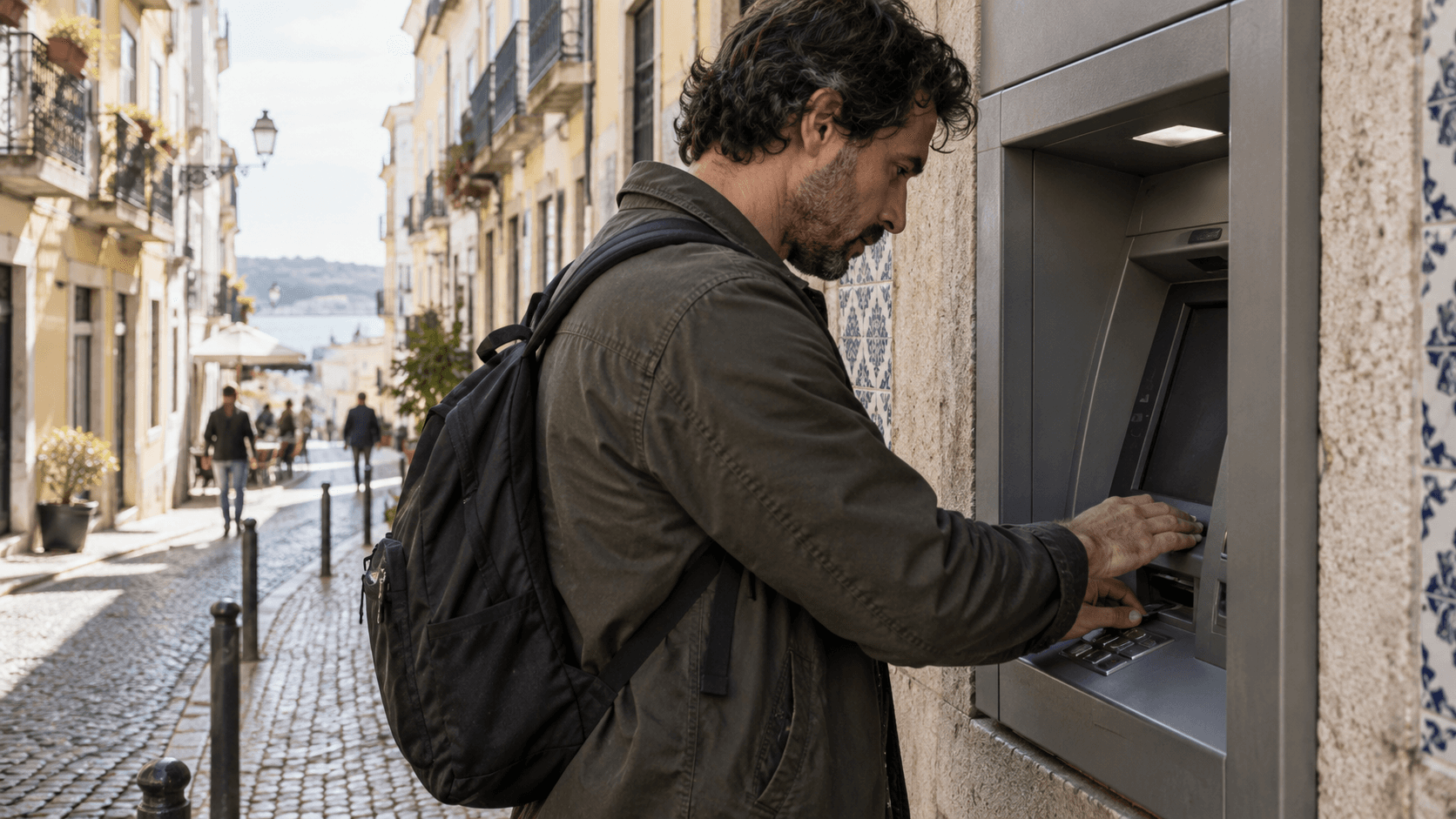
Withdrawal fees vary widely from one country to another. In the Philippines, for example, ATMs typically charge 200 to 250 pesos (about $3.50 to $4.50) per withdrawal for foreign Visa or Mastercard cards, with a per-transaction limit usually between 10,000 and 20,000 pesos[11]. With a limit that low, withdrawing a large sum means paying those fees several times over.
Before you leave, look separately at card payment fees, withdrawal fees, the exchange rate applied, and the number of free withdrawals, if any. Also keep in mind that the local ATM operator's fees can be added on top of your own bank's fees.
Taxes on Income Earned: What Your Choice of Account Does Not Change
Choosing a bank does not exempt you from establishing where you are a tax resident, and that status, not the account, determines how your income is taxed. Two examples show that the same amount of income can be treated differently depending on your country of residence.
- Thailand: since January 1, 2024, tax residents are taxable on foreign-source income brought into Thailand, regardless of the year in which that income was earned[12].
- Panama: the system is strictly territorial; foreign-source income is not taxable, even for tax residents[13].
Taxation requires a review of your personal situation: these examples do not replace the advice of a professional.
Traps, Scams, and Points of Vigilance
- Confusing a payment or e-money institution with a bank: it is not a member of the FGDR (French deposit guarantee fund), and the protection of your funds is different[2].
- Opening multiple accounts at the same bank under several brands: the €100,000 guarantee ceiling applies only once per institution[4].
- Phishing: the fraudster poses as a well-known organization (bank, government agency, phone carrier) and sends a message that is often alarming, or that promises a refund or a gain, to get you to click a link and enter your details[14]. Never share your banking details (card code, login credentials, passwords) by email or over the phone[14].
- Fake websites: the address shown in your browser must match the site exactly; a single different character likely indicates a fraudulent site[14].
- Card theft abroad: block your card immediately. Some banks require you to call a special phone number for this, so find out before you leave[15].
- Welcome bonuses: one of them requires, for example, an initial deposit of at least €300, at least one transaction per card each month for three months, and a banking mobility arrangement[16]. If the account is closed within 24 months of opening, the bank reserves the right to reclaim all bonuses paid[16].
Building Your Account Setup: Key Takeaways
- Keep a primary account at a licensed bank, covered by the deposit guarantee.
- Do not keep more money than necessary in a payment or e-money account: its funds are not covered by the FGDR[7].
- Regularly inform your bank of any change in name, postal address, email, and phone number[4]: you will remain reachable in case of compensation.
- Compare the official fee schedules (payments, withdrawals, exchange, limits) before choosing a travel card.
- Do not count on a local account abroad before you settle in: it is set up once you are on site.
This article gives you the essential benchmarks for choosing your accounts. It does not compare the offers of the different online banks: rates, limits and conditions should be checked on their official fee schedules at the time you make your choice. For a concrete example of setting up as a digital nomad, read our guide on Barcelona.
Sources
- 1.^boursobank.com — Rankings, comparisons and bank listings – BoursoBank: “BoursoBank establishes itself as an unavoidable player in the banking sector.” https://www.boursobank.com/classements-palmares-trophees/ (accessed October 24, 2026)
- 2.^ abcdefglafinancepourtous.com — Are online banks covered by the deposit guarantee? - La finance pour tous: “The deposit guarantee system applies to any bank approved by the Autorité de contrôle prudentiel et de résolution (ACPR), even when it operates as an online bank, without a branch network.” ; “Payment institutions (such as Nickel) and electronic money institutions, which do not have the status of a bank or credit institution, are not members of the FGDR.” ; “However, in the event of these institutions failing, customers may benefit from protection schemes for their deposits: either through special insurance taken out by the payment institution, or through the transfer of funds to a segregated account opened at a bank.” https://www.lafinancepourtous.com/outils/questions-reponses/garantie-bancaire/ (accessed October 24, 2026)
- 3.^acpr.banque-france.fr — No. 96: Study on the business models of online banks and neobanks | Autorité de contrôle prudentiel et de résolution: “Others are present in France through the European passport (N26 Bank, Revolut).” https://acpr.banque-france.fr/fr/publications-et-statistiques/publications/ndeg-96-etude-sur-les-modeles-daffaires-des-banques-en-ligne-et-des-neobanques (accessed October 24, 2026)
Show 13 more sourcesShow less
- 4.^ abcgarantiedesdepots.fr — FAQ: Questions and answers on the deposit guarantee: “The deposit guarantee of up to €100,000 per customer and per institution applies only once within a single bank operating under several commercial brands.” ; “We recommend that you regularly inform your bank advisor of any change of name, postal address, email and phone number, for yourself and for any persons under your care.” https://www.garantiedesdepots.fr/fr/questions-frequentes (accessed October 24, 2026)
- 5.^tresor.economie.gouv.fr — Deposit and securities guarantee | Directorate General of the Treasury: “When a bank is unable to guarantee the availability of its customers' deposits, the Fonds de garantie des dépôts et de résolution (FGDR) compensates them up to €100,000 per customer and per institution, within 7 business days.” https://www.tresor.economie.gouv.fr/banque-assurance-finance/garantie-des-depots-et-des-titres (accessed October 24, 2026)
- 6.^garantiedesdepots.fr — Protecting your bank assets: the FGDR guarantees: “Sums deposited in your current accounts, savings accounts and savings plans are covered by the deposit guarantee up to €100,000 per customer and per institution.” https://www.garantiedesdepots.fr/fr/connaitre-vos-garanties (accessed October 24, 2026)
- 7.^ abcdgarantiedesdepots.fr — The guarantee for accounts in the event of a bank failure: “All sums deposited in accounts and savings accounts falling within the scope of the deposit guarantee are covered as long as they are denominated in euros or in the official currency of a state (US dollar, pound sterling, yen, etc.).” ; “Cryptocurrencies are not covered by the FGDR deposit guarantee.” ; “Cash held on electronic media and on payment cards issued by a payment institution or an electronic money institution is not covered by the FGDR deposit guarantee either.” https://www.garantiedesdepots.fr/fr/connaitre-mes-garanties/je-detiens-des-comptes-et-des-livrets-bancaires-quelles-sont-mes-garanties (accessed October 24, 2026)
- 8.^Mira Knowledge — Opening a bank account in Brazil as a non-resident is difficult: you almost always need a CPF and proof of local address. Without a resident visa or residence permit, most banks refuse, and digital banks (Nubank, C6 Bank, Banco Inter) also require a CPF and a Brazilian address. Verified on 06/11/2026: reference source gov.br. https://www.gov.br/receitafederal/pt-br (accessed June 11, 2026)
- 9.^Mira Knowledge — A foreigner can open a bank account in Colombia with a resident or work visa and a cédula de extranjería (identity card for foreigners). Verified on 06/11/2026: reference source superfinanciera.gov.co. https://www.superfinanciera.gov.co/ (accessed June 11, 2026)
- 10.^Mira Knowledge — Non-resident foreigners can open accounts in non-convertible dirhams, limited to funds for domestic use; a passport and proof of address abroad are required. Verified on 06/11/2026: official source bkam.ma. https://www.bkam.ma/en/Regulation-and-supervision/Exchange-control (accessed June 11, 2026)
- 11.^Mira Knowledge — In the Philippines, ATMs typically charge 200 to 250 pesos (about $3.50 to $4.50) per withdrawal for foreign Visa or Mastercard cards, with a per-transaction limit typically of 10,000 to 20,000 pesos. Verified on 06/11/2026: official source bsp.gov.ph. https://www.bsp.gov.ph/SitePages/Default.aspx (accessed June 11, 2026)
- 12.^Mira Knowledge — Since January 1, 2024, Thai tax residents are taxable on foreign-source income remitted to Thailand, regardless of the year in which that income was earned. Verified on 06/11/2026: 2 consistent sources (taxsummaries.pwc.com, rd.go.th). https://taxsummaries.pwc.com/thailand/individual/taxes-on-personal-income (accessed June 11, 2026)
- 13.^Mira Knowledge — Panama applies a strictly territorial tax system: foreign-source income is not taxable, even for tax residents. Verified on 06/11/2026: 2 consistent sources (dgi.mef.gob.pa, taxsummaries.pwc.com). https://dgi.mef.gob.pa/ (accessed June 11, 2026)
- 14.^ abcinc-conso.fr — What to Do If You Fall Victim to Phishing? | National Consumer Institute (INC): “To lower your guard, the scammer poses as a known organization or company (a bank, a government agency, a phone operator…) and sends you a fake message. This message is often alarming or claims that you are about to receive a refund or a prize.” ; “Never share your banking details (card security code, login credentials, passwords…) by email or over the phone.” ; “The website address displayed in your browser must match the official site exactly: a single different character is a sure sign of a fraudulent site.” https://www.inc-conso.fr/content/que-faire-en-cas-de-phishing-ou-dhameconnage (accessed October 24, 2026)
- 15.^service-public.fr — Theft of his credit card | Service Public: “Some banks may require you to call a special phone number to cancel your card. Check before you leave for abroad.” https://www.service-public.fr/particuliers/vosdroits/F35460/0_2?lang=en (accessed October 24, 2026)
- 16.^ abboursobank.com — BoursoBank (formerly Boursorama Banque) - 100% Online Bank - the cheapest for 18 years: “The offer is subject to an initial deposit of at least €300, followed by at least one card transaction each month during the three months after the account is opened, and a EasyMove bank transfer.” ; “If the account is closed within 24 months of its effective opening, at the client's initiative or at the bank's initiative in the event of the client's reprehensible behavior, the bank reserves the right to deduct from the associated account the total amount of all sign-up bonuses the client received.” https://www.boursobank.com/ (accessed October 24, 2026)