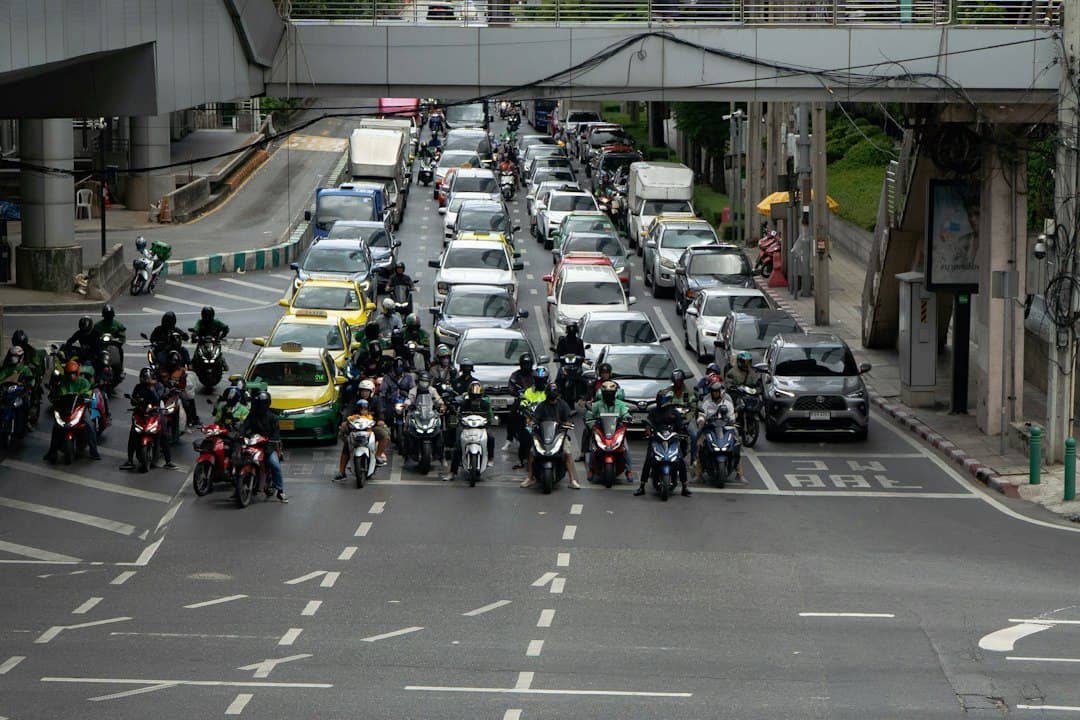
If you stay in Thailand for a long time, an International Driving Permit is no longer enough: it's better to aim for a Thai driver's license. This article explains which residence status it requires, which documents to bring, which tests to take and what it costs. It also covers the online entry requirement, tax residency, private healthcare and the official resources to know once you're on the ground.
Driving in Thailand: International Driving Permit or Thai driver's license
A short-term visitor can drive with an International Driving Permit (IDP) combined with their national license[1]. This option is aimed at tourists: it is designed as a short-term stopgap[2]. Once you settle in, the logical next step is the Thai driver's license, issued by the Department of Land Transport (DLT)[2].
Watch out for the type of vehicle: a car license does not cover motorcycles or scooters, whatever their engine size. A separate license is required, with its own practical test[3].
Getting or converting your Thai driver's license: residence status and documents
The process relies on a residence certificate proving that you live in Thailand. In practice, you need a long-stay status: non-immigrant visa, work permit, retirement or marriage extension, education visa, DTV, LTR or equivalent[3]. A tourist under visa exemption or on a tourist visa generally does not pass the eligibility check at the counter[3].
The residence certificate comes from Thai immigration or from a letter from your embassy confirming your address[3]. Practices vary from one office to another: some accept a certificate issued to a tourist, others require a non-immigrant visa. DTV holders report mixed results for the same reason[2].
To put together your file, prepare originals and photocopies of your documents[1]:
- your passport and visa, with photocopies[1];
- proof of residence (residence certificate)[1];
- a medical certificate[1];
- passport-format ID photos[1];
- for a conversion, your foreign license, along with a certified translation if it is not in English[1].
If you already hold a valid foreign license and an International Driving Permit, you can convert it[3]. Without a foreign license, the process starts from scratch and adds a driving test[3].
Tests, validity and official fees
Conversion waives the driving test, but not the rest: aptitude tests (color vision, depth perception, reaction time), the DLT online training video and a 50-question written exam, where 45 correct answers are needed to pass[3]. The written exam is now mandatory for all foreign candidates, including those who hold a foreign license or an International Driving Permit[1].
Depending on the office, a practical test may also be required: candidates for a conversion are increasingly being asked to take one[1].
The first license is temporary and valid for 2 years, then replaced by a 5-year license. Some offices issue the 5-year license directly during a conversion; this varies by agency[3]. Ask on site rather than assuming.
Official fees are roughly 205 to 255 baht for the 2-year license and 505 baht for the 5-year one, plus 100 to 200 baht for the medical certificate[3].
Renewing your license
You can renew a 5-year license within a window of a few months before expiry, and even up to one year after expiry without retaking the driving test[2]. Each renewal requires an up-to-date medical certificate and a valid residence certificate, and your visa must still justify a long stay[2].
Online renewal is planned for some drivers, but an in-person visit remains the norm for most foreigners[2].
Pitfalls and points to watch
- A tourist visa or visa exemption is generally not enough to obtain the license: you risk an unnecessary trip[3].
- Requirements differ from one office to another: confirm the documents required with the DLT office, or via DLT Smart Queue, before you go. Rules and fees change[3].
- The residence certificate does not last the same length everywhere. In Pattaya, one reader reports it requires two photos and is valid for only 30 days; in Buriram, theirs had neither a photo nor an expiry date[1].
- Going through an agency costs considerably more than the official fees: one reader in Pattaya paid 4,000 baht all-inclusive[1].
- Appointments can be booked far in advance: the same reader had to go through their agent just to get an appointment, and the office was fully booked 6 to 8 weeks ahead[1].
- Without an appointment, you can be turned away: one reader who arrived empty-handed was asked to come back two weeks later[1].
Entering the Country and Tax Residency
Since May 1, 2025, every non-Thai national must complete the Thailand Digital Arrival Card (TDAC) online before entering the country, whether by air, land, or sea[4]. It can be submitted up to 72 hours before arrival, it is free of charge, and you may be denied entry without it[4].
You become a Thai tax resident if you spend 180 days or more in Thailand within a calendar year[4]. Tax residents are taxed on income earned in Thailand and worldwide; non-residents are taxed only on income earned locally[5].
Since 2024, foreign-source income that a tax resident brings into Thailand may be subject to Thai income tax. Previously, it could be brought in tax-free if it remained abroad until the following year[4]. According to another page, foreign income received after January 1, 2024 is taxable, unless exempt[5]. The details depend on when the income was received[4].
Tax matters should not be taken lightly: rely on the information, rates, and forms published by the Revenue Department, Thailand's tax authority[5], and, for your personal situation, on an English-speaking professional[5].

Private Healthcare and Insurance
Private hospitals, found in many regions of the country, offer expats high-quality care[4]. As for insurance, certain long-stay visa categories, including the retirement visa, require minimum health coverage[4].
If you plan to rely on Thailand's social security system, know that the quality of care depends largely on the hospital you are assigned to, waiting times can be long, and some medical costs may remain your responsibility[4].

Official Local Resources
The website of the French Embassy in Thailand offers a page titled "Living or Coming to Thailand": security risks, stay formalities, and health advice[6]. If you hold French nationality, you can also register with Fil d'Ariane so you can be reached in a crisis[6]. The site also publishes an indicative, non-exhaustive list of the country's main hospitals[6]. If you hold another nationality, contact your own country's embassy.
Key Takeaways: The Order of Steps
- Complete the TDAC before arrival.
- Obtain a long-stay visa, then the residence certificate.
- Have the medical certificate issued, valid for submitting your application.
- Book an appointment with the DLT office, or via DLT Smart Queue, and confirm the required documents there.
- Pass the fitness tests, the online video, and the written exam (and the practical test if your office requires it).
- Keep documents useful for your tax file throughout the year: spending 180 days or more in Thailand within a calendar year makes you a tax resident, and the details depend on your situation.
- This article covers the essentials: to truly settle in, you will need to go further into the tax details of your situation, the choice of health insurance, and the documents required by your DLT office.
Sources
- 1.^ abcdefghijklmthethailandlife.com — Thai Driving License 2026: Guide for Foreigners : “No, tourists can drive with a valid international permit and their national license.” ; “Bring the following originals and photocopies to your local Department of Land Transport (DLT) office:” ; “You will need your passport and visa, proof of residence, a medical certificate, passport-size photos, your foreign license (with certified translation), and the completed DLT application forms.” https://www.thethailandlife.com/learning-to-drive-in-thailand (accessed October 25, 2026)
- 2.^ abcdefthailandstuff.com — Thai driving licence for foreigners: cost and process | Thailand Stuff : “A foreigner can legally drive in Thailand for a while with a valid international permit alongside their national license, but this is a short-term solution meant for tourists.” ; “Once you are a resident, the logical step is to obtain a Thai driving license for foreigners, issued by the Department of Land Transport.” ; “Some DLT offices accept a residence certificate issued to a tourist, while others require a non-immigrant visa. Holders of the new Destination Thailand Visa (DTV) report mixed results for the same reason.” https://thailandstuff.com/guides/thai-driving-licence-for-foreigners (accessed October 25, 2026)
- 3.^ abcdefghijkoutthailand.com — Thai Driving License for Foreigners: 2026 Guide : “A car license does not cover motorcycles or scooters, regardless of engine size: it is a separate license, with its own practical test.” ; “In general, no. The DLT process relies on a residence certificate proving you live in Thailand, which in practice means a non-immigrant visa, a work permit, a retirement or marriage extension, a student visa, a DTV, an LTR, or a similar long-stay status.” ; “Visitors on a tourist visa or visa-exemption stamp generally do not pass the eligibility check at the counter.” https://outthailand.com/guide/thai-driving-license-for-foreigners/ (accessed October 25, 2026)
Show 3 more sourcesShow less
- 4.^ abcdefghthailandstarterkit.com — S’installer en Thaïlande : le guide complet pour vivre ici en 2026 : “Since May 1, 2025, every non-Thai national must complete the Thailand Digital Arrival Card (TDAC) online before entering the country by air, land, or sea.” ; “It can be submitted up to 72 hours before arrival and is in addition to the visa or exemption you travel with. It is free, and entry can be refused without it.” ; “You become a Thai tax resident if you spend 180 days or more in Thailand in a calendar year.” https://www.thailandstarterkit.com/fr/famille/s-installer-en-thailande/ (accessed October 25, 2026)
- 5.^ abcdexpatica.com — How to file your income tax in Thailand in 2026 | Expatica : “Tax residents pay income tax on all income earned in Thailand and worldwide.” ; “People who live in Thailand for fewer than 180 days per calendar year are considered non-residents and are taxed only on income earned during their presence in Thailand.” ; “This means that foreign income earned by tax residents after January 1, 2024, is taxable, unless exempt.” https://www.expatica.com/th/finance/taxes/thailand-income-tax-2172836/ (accessed October 25, 2026)
- 6.^ abcth.diplomatie.gouv.fr — Vivre ou venir en Thaïlande | La France en Thaïlande : “Check security risks, residence formalities, and health advice before your departure.” ; “Traveling to Thailand or another country? Get the right reflexes by registering on the Fil d’Ariane.” ; “Main hospitals in Thailand (indicative, non-exhaustive list).” https://th.diplomatie.gouv.fr/fr/vivre-venir (accessed October 25, 2026)