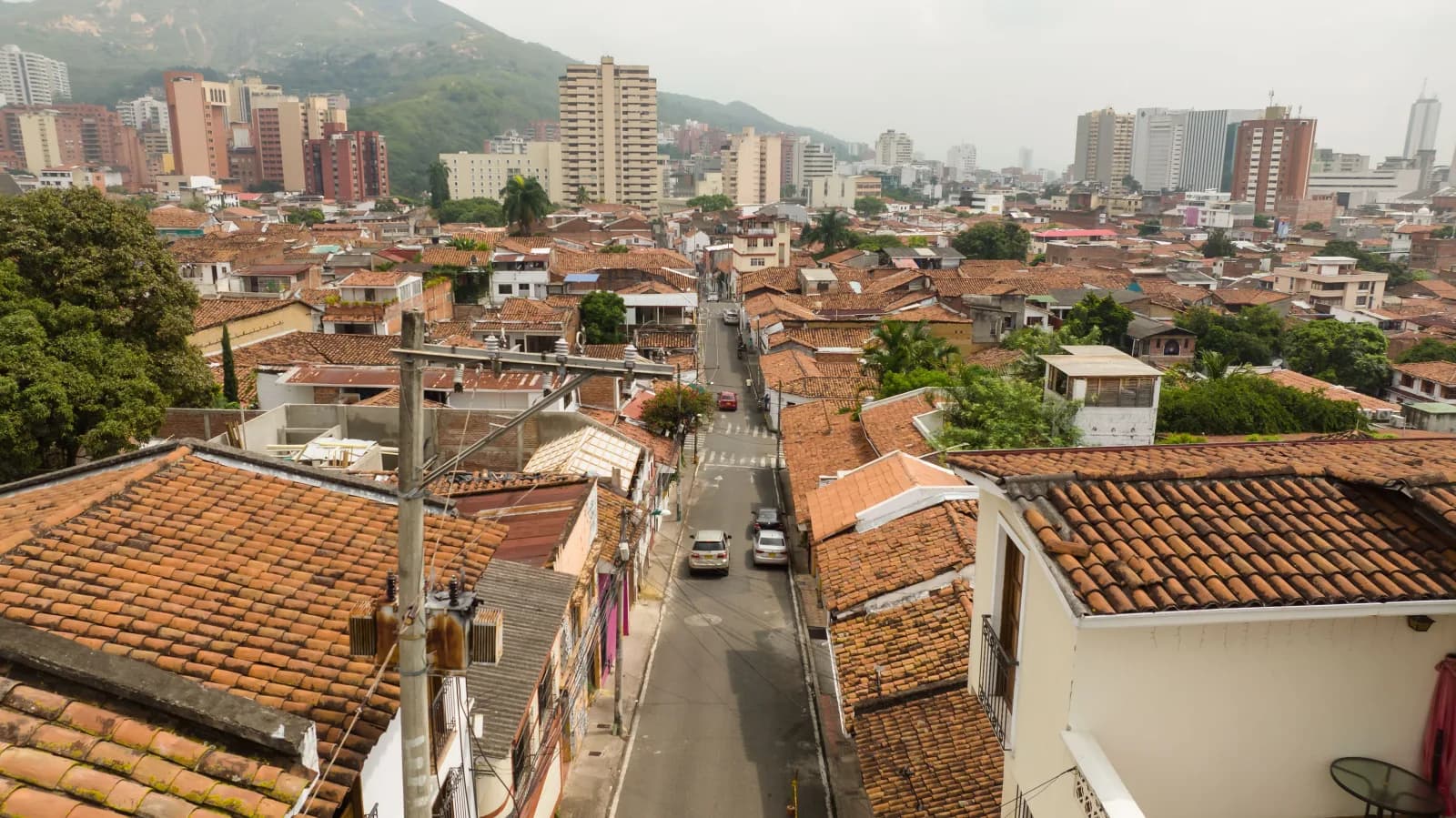
Settling in Colombia while working remotely means choosing the right stay regime, understanding what your visa allows, and knowing when you become a tax resident. This article gives you the main conditions, rough orders of magnitude, and pitfalls to avoid, from planning your move to actually settling in. It stays focused on the essentials on purpose: each step deserves a closer look based on your own situation.
The essentials at a glance
- Holders of a French passport can enter without a visa for up to 90 days, with a return ticket[1].
- The digital nomad visa (visa V) is for people who work remotely for clients or employers abroad[2].
- You must prove, with bank statements, an income of at least 3 monthly minimum wages over the last 3 months[3].
- The visa is granted for two years at most[4].
- It does not allow any paid activity for a person or company based in Colombia[5].
- Beyond 183 days of presence within 365 consecutive days, you generally become a Colombian tax resident[6].
- Health insurance covering Colombia is mandatory for this visa[7].
- If your visa exceeds three months, apply for your cédula de extranjería within 15 days[8].
- Don't sign a long-term lease from abroad: rent a furnished place first[9].
Choosing your stay regime: visa-free entry or digital nomad visa
Holders of a French passport can enter Colombia without a visa[1]. You must show a return ticket or a ticket to a third country, and complete the online Check-Mig form before boarding[1][2]. The stay is 90 days at most, extendable on site by another 90 days, within the double limit of 180 continuous days and 180 days in the calendar year[1]. This regime suits exploring the country, not settling in.
Warning: a tourist entry does not allow any paid work, including remote work for a foreign employer[8].
To settle in, the visa V “Nómadas digitales” is aimed at foreigners doing remote work or telework for companies in other countries, and at entrepreneurs who want to set up a digital or ICT project of interest to the country[5]. It can be requested for the principal holder's dependents[3]. It is valid for two years at most[4].
Requirements and file for the digital nomad visa V
The central requirement is financial: you must demonstrate, with bank statements, income equal to at least three legal monthly minimum wages over the last three months[3]. The 2026 minimum wage is set at COP 1,750,905, which puts the monthly threshold at COP 5,252,715[8]. The threshold follows the annual adjustment of the minimum wage: check the amount in force when you apply[10].
The file also includes health coverage. Resolution 5477 makes comprehensive health insurance mandatory for most long-stay visas, including the digital nomad visa. The policy must cover hospitalization, emergencies and medical repatriation, and remain active for the entire duration of the visa[7]. Entrepreneurs add a letter explaining their project, along with the financial and human resources needed[5].
The application is made online on the website of the Cancillería, Colombia's Ministry of Foreign Affairs. Plan at least 30 minutes to complete it[4]. Notifications arrive by email; avoid giving an institutional address or a third party's address[4]. You do not need to go to the Bogotá visa office unless summoned by a notification sent by email[4].
Working status: employee of a foreign company or freelancer
The digital nomad visa allows remote work for clients or employers abroad, without being paid by a Colombian company[2]. Whether you are an employee or a freelancer, the rule is the same: you cannot carry out any paid activity for companies or individuals based in Colombia[5].
Remote workers who provide their services to companies based outside Colombia do not fall under the standard work visa, but under the digital nomad visa (type V)[11]. Working for a Colombian employer requires a different visa: the system then relies largely on sponsorship by a Colombian employer, and changing employers means submitting a complete new application[11]. The details on status for working remotely are covered in a dedicated article.
Taxes and Tax Residency
Colombian tax residency is triggered by a presence of more than 183 calendar days, continuous or not, within any period of 365 consecutive days[6]. Both the arrival and departure days count toward the total[2]. If your stay spans two tax years, residency takes effect from the second one[6].
The visa changes nothing in this calculation: a remote work visa tells you nothing about your taxes, and this is the most common mistake[10]. In fact, there is no specific tax regime for digital nomads in Colombia: they are subject to the ordinary national taxes[12].
Once you are a resident, you are taxed on your worldwide income; non-residents are taxed only on their Colombian-source income[6]. The income tax schedule is progressive, ranging from 0% to 39%[13].
On the French side, keeping a home or family in France may be enough to remain a French tax resident[10]. A tax treaty between France and Colombia has been in effect since January 1, 2023[2]. Taxation has serious consequences: have your situation confirmed by a tax advisor specializing in international mobility[14].
Health and Insurance: Visa Insurance, EPS, Private Medicine
Visa insurance and the public system are two different things. To obtain the visa, you must show proof of comprehensive insurance[7]. Once in Colombia, holders of a legal residence visa and a cédula de extranjería can enroll in the public EPS system[7].
The public system can involve long waiting times for certain specialist consultations; many expats and locals choose private health insurance for faster services and more coverage options[13].
As for vaccines, none are mandatory to enter Colombia from Europe[7]. Yellow fever, however, is strongly recommended, and sometimes required, for tropical and forested regions such as Amazonas, Caquetá, Guainía, and Putumayo; it should be administered at least ten days before traveling to these areas[7]. It is not required in Bogotá, Medellín, Cali, or Cartagena[7]. Check with your doctor that your vaccinations are up to date before you leave[1].
Arrival Steps: Cédula de Extranjería, RUT, Bank Account, Phone
If your visa covers more than three months, you must register it with Migración Colombia and obtain a cédula de extranjería within 15 days of your entry, or within 15 days of approval if you are already in the country[8]. Don't let this deadline pass: non-compliance can lead to fines of up to seven times the monthly minimum wage[11].
This foreigner's identity card is issued to principal visa holders or beneficiaries of a visa valid for more than three months[15]. It is needed, among other things, to sign a long-term lease or subscribe to a residential internet plan[8].
To open a local bank account, you must present your cédula, proof of income and, sometimes, a minimum deposit[13]. While waiting for your cédula, fully digital banks such as Nequi or Nu Colombia let you open an account instantly[16]. eSIMs work in Colombia, so you don't have to look for a local SIM card when you arrive[10].
Housing: Where to Look, Furnished Rentals, Leases and Guarantors
The common-sense advice: don't sign a long-term lease remotely, before you have even seen the city[9]. Rent a furnished place first, for example a short-term monthly rental, while you arrive, scout neighborhoods and understand the market[9]. Coliving, which is booming in Medellín and Bogotá, and the apartaestudio, the Colombian studio apartment, suit newcomers well and avoid the hassle of a guarantor[9].
The lease is usually for one year, renewable, and the rent is often exclusive of administración, the building maintenance fees, which must be added[9]. The security deposit is generally one month's rent[13].
The real obstacle for a foreigner is the codeudor, a Colombian guarantor who owns property, a requirement from many agencies[9]. Alternatives: rental insurance (fianza), several months paid in advance, or private rentals and furnished places, which most often do without one[9].

Cost of Living by City
Here are rough figures from practical guides, to be cross-checked before you build your budget. A single person can live comfortably on $1,000 to $1,500 USD per month, rent included, in Medellín, or $700 to $1,000 USD in smaller cities[17]. A one-bedroom furnished apartment in the expat-favored neighborhoods of Medellín (El Poblado, Laureles) rents for $400 to $800 USD per month[17].
The gap is wide between local rents and furnished rentals aimed at foreigners: a locally rented apartment in Laureles can cost half the price of the same furnished rental listed on Airbnb-style platforms[18]. A menú del día lunch (soup, main dish and juice) costs about $4 USD[18].
Internet, eSIM and Coworking
In major cities, fiber from Claro and Tigo delivers 200 to 500 Mbps for $20 to $30 USD per month, and most furnished rentals in Medellín and Bogotá include it[18]. Prepaid mobile data is affordable and widely available in large metropolitan areas[19].
Quality varies by neighborhood and building: evaluate internet at the neighborhood level, not just the city level[19]. Test the speed before you rent, and plan a backup: a prepaid SIM with hotspot enabled before your first workday[19]. Also keep a backup coworking space for critical deadline days[19].

Cities and Regions: Medellín, Bogotá, Caribbean Coast
Medellín attracts remote workers and digital nomads with its steady, mild climate and its tech ecosystem[6]. El Poblado suits an "easy" expat experience, while Laureles offers a more local vibe[20].
Bogotá, perched at 2,600 meters, has cool temperatures year-round, around 14 °C; Medellín, at 1,500 meters, enjoys near-constant warmth[21]. Bogotá offers the broadest and most international rental market, with the highest rents in its sought-after residential neighborhoods[6].
On the Caribbean coast, Cartagena and Santa Marta offer a relaxed tropical lifestyle[21], with temperatures of 28 to 35 °C[21]. Cali remains more affordable, while Cartagena has a tighter real estate market driven by tourism[6]. Smaller cities such as Bucaramanga, Pereira and Santa Marta are 30 to 50% cheaper than Medellín or Bogotá[17].

Transportation: Overview and Return
Domestic flights connect the major cities, and an intercity bus network serves virtually every city and village[22]. In town, Bogotá has TransMilenio, which requires the Tu Llave card, rechargeable and available at the stations[22]. Medellín relies on the metro and the Metrocable, and Cali on the MIO[23][22].
Uber, DiDi and InDriver operate in a legal gray zone but are considered safer than street taxis[23]. Details on getting around are covered in the article "Getting Around Colombia".
Language, Integration and Community
The official language is Spanish, and conversational proficiency is nearly essential for administrative procedures, daily interactions and local integration[21]. Outside large companies and tourist areas, English is still not widely spoken[21]. The Alliances Françaises in Bogotá, Medellín and Cali offer Spanish courses tailored to newcomers[21].
A regular coworking routine, language classes and language exchanges help you build a network. Avoid taking part in political demonstrations, which can escalate, and publicly commenting on domestic politics[21]. For a foreigner, taking part in local political activities, rallies or demonstrations is in fact illegal[24].
Pitfalls, Scams and Points of Caution
Visa and Work
- The digital nomad visa does not allow any paid activity with a person or company based in Colombia[3].
- A stay without a visa is capped at 180 days per calendar year, extensions included[1].
Paperwork and Income
- A mistake in the online form leads to the application being rejected and the fees paid being lost: check every detail[4].
- Each month submitted must meet the threshold on its own; an average over several months is not accepted[10].
- The threshold changes with the minimum wage: the decree setting it for 2026 was suspended in February, then the suspension was lifted in July, while the annulment lawsuit continues[2].
Taxes
- Beyond 183 days, you generally become a Colombian tax resident, digital nomad visa or not[10].
- Also check your home tax residence: keeping a home in France can keep you a French tax resident[10].
Housing
- Administration fees are often added on top of the rent[9].
- Many apartments are rented without an equipped kitchen[9]; unfurnished units are often delivered without even light fixtures or taps[20].
Safety
Dating apps are often used by criminals to spot and lure foreigners traveling alone: once trust is established, the victim is drugged with scopolamine or another incapacitating substance, then robbed or abducted, and these drugging incidents have led to fatal overdoses[24].
Use ATMs located inside banks, shopping centers, or other public places, and only during business hours[24]. Keep your phone out of sight on the street and use Uber or DiDi at night[18]; do not resist a robbery[18].
Check travel advisories from your country before you leave (in France, the Colombia page on France Diplomatie, which also offers registration for the Ariane thread[1]), as well as Hello Mira alerts.
Steps, in order: from plan to settling in
- Check your eligibility and gather your bank statements for the last 3 months along with health insurance that covers Colombia.
- File your online application with the Cancillería, reviewing every detail before you pay.
- Complete Check-Mig before your flight and book a furnished place for the first month.
- Register your visa and apply for the cédula de extranjería within 15 days.
- Open a bank account, starting with a digital one if the cédula is delayed.
- Choose a neighborhood, test the internet speed, then look for a more long-term rental.
- Count your days in the country to track the tax residence threshold.
Frequently Asked Questions
Can you work remotely on a simple tourist stamp?
Sources disagree: one states that no form of paid work is permitted on a simple tourist entry, including remote work for a foreign employer[8]; another mentions, for nationals of countries exempt from short-stay visas, a regime provided under Article 46 of Resolution 5477, without payment from a Colombian company[2]. Do not work remotely without a visa until you have checked with Migración Colombia exactly what your entry permits, since sources disagree on this point[2].
Does the digital nomad visa lead to permanent residency?
No: to settle long term, you then need to switch to an M visa[10].
Can my spouse come with me?
Yes, applications are possible for the main applicant's dependents[3]. The spouse files their application after the main applicant has obtained the visa[2].
How long does it take to get the cédula?
Timelines vary by period. One source mentions two to four weeks after visa approval[7]; check the current timeline with Migración Colombia.
Is a French bank card enough?
For daily expenses, a digital account such as Nequi or Nu Colombia can help out before you get your cédula[16]. See the section on arrival procedures.
Go Further
This article gives you the essentials to decide and avoid mistakes. It does not detail the visa and arrival steps one by one, the budget line by line, or how to choose a neighborhood: these points require going further before you settle in for real. For taxes, rely on a tax advisor and on the Colombian tax authority, the DIAN.
Sources
- 1.^ abcdefgco.diplomatie.gouv.fr — Entry and stay conditions in Colombia | France in Colombia: “Holders of a French passport may enter Colombian territory without a visa under the following conditions.” ; “The short-stay period may be extended on site by 90 additional days through the Permiso Temporal de Permanencia (PTP) para prórroga de permanencia procedure, within the dual limit of 180 continuous days and 180 days within the calendar year.” ; “Present proof of exit from the territory within 90 days (a return ticket to France or a ticket to a third country is mandatory).” https://co.diplomatie.gouv.fr/fr/vivre-venir/conditions-dentree-et-de-sejour-en-colombie (accessed October 18, 2026)
- 2.^ abcdefghiconjointsexpatries.com — Living in Colombia: visas, cost and spouse employment: “You must also complete the online Check-Mig form before boarding.” ; “You must prove, with bank statements, an income of at least 3 minimum salaries per month over the last 3 months.” ; “The digital nomad visa allows remote work for foreign clients, without being paid by a Colombian company.” https://conjointsexpatries.com/vivre-en-colombie/ (accessed October 18, 2026)
- 3.^ abcdecancilleria.gov.co — Digital Nomad Visa V | Cancillería: “Beneficiaries: the application is permitted for the beneficiaries of the main holder.” ; “Demonstrate, through bank statements, minimum income equivalent to three legal monthly minimum wages in force over the last 3 months.” ; “Restrictions: this visa does not allow you to work or to carry out a paid activity with a legal entity or individual domiciled in national territory.” https://www.cancilleria.gov.co/node/26950 (accessed October 18, 2026)
Show 21 more sourcesShow less
- 4.^ abcdefminjusticia.gov.co — Pages - Visa-nómada-digital.aspx: “The validity of the digital nomad visa will be granted for a period not exceeding two years.” ; “Plan for at least thirty minutes when applying for the visa online, as you must complete all the requested information.” ; “When filling in the online forms, check that you have entered the data correctly: in case of error, the visa application is rejected and you will lose the amounts paid.” https://www.minjusticia.gov.co/programas-co/LegalApp/Paginas/Forms/DispForm.aspx?ID=834 (accessed October 18, 2026)
- 5.^ abcdminjusticia.gov.co — Ministry of Justice and Law: “Foreigners who provide remote work or telework services to companies in other countries.” ; “Entrepreneurs who wish to set up a digital or ICT project of interest to the country in Colombia.” ; “For entrepreneurs, a letter explaining the project, the financial and human resources required.” https://www.minjusticia.gov.co/programas-co/LegalApp/Paginas/Visa-n%C3%B3mada-digital.aspx (accessed October 18, 2026)
- 6.^ abcdefgapp.expatriation.io — Living and working in Colombia: Bogotá and Medellín guide · EXPATRIATION.IO: “Colombian tax residence is triggered by a presence of more than 183 calendar days, continuous or non-continuous, over any period of 365 consecutive days.” ; “When this presence spans two tax years, residence takes effect from the second year.” ; “Once tax residence is established, taxation covers worldwide income and assets.” https://app.expatriation.io/fr/culture/countries/colombia (accessed October 18, 2026)
- 7.^ abcdefghexpat.com — Healthcare system in Colombia: insurance, hospitals and care - Colombia Guide - Expat.com: “Resolution 5477 of the Colombian Ministry of Foreign Affairs makes comprehensive health insurance mandatory for most long-stay visas, including digital nomad, retirement and investment visas.” ; “The policy must cover hospitalization, emergencies and medical repatriation, and remain active for the entire duration of the visa.” ; “Expatriates holding a legal residence visa and a cédula de extranjería may enroll in the public EPS system.” https://www.expat.com/fr/guide/amerique-du-sud/colombie/17140-sante-et-assurances-en-colombie.html (accessed October 18, 2026)
- 8.^ abcdefhello-mira.com — Remote work in Colombia: digital nomad visa, income and taxes | Hello Mira: “No form of paid work is permitted under a tourist entry, including remote work for a foreign employer.” ; “Based on the minimum wage set in February 2026 at COP 1,750,905, the minimum monthly income required comes to COP 5,252,715 (about $1,424).” ; “Once in Colombia, if your visa covers more than three months, you must register it with Migración Colombia and obtain a cédula de extranjería within 15 days of your entry, or within 15 days of approval if you are already on site.” (accessed October 18, 2026)
- 9.^ abcdefghivivreencolombie.fr — Finding housing in Colombia: renting an apartment (guide): “Common sense advice: do not sign a long-term lease remotely, before you have even seen the city.” ; “The right approach is to first rent furnished (a short-term rental, such as an Airbnb by the month) while you arrive, scout neighborhoods and understand the market.” ; “Coliving, booming in Medellín and Bogotá, offers fully furnished spaces with services and community.” https://vivreencolombie.fr/vivre/se-loger (accessed October 18, 2026)
- 10.^ abcdefghxn--lexpatri-i1a.fr — Remote Work in Colombia: Visa, Taxes, Connectivity: “Monthly income of at least 3 Colombian minimum salaries, roughly 5,250,000 pesos per month in 2026. The threshold follows the annual adjustment of the minimum wage: check the amount in force at the time of your application.”; “Each month presented must reach the threshold on its own; an average across several months is not accepted.”; “A remote work visa tells you nothing about your taxes, and that is the most common mistake.” https://xn--lexpatri-i1a.fr/destinations/colombie/teletravail (accessed October 18, 2026)
- 11.^ abcexpat.com — Working in Colombia: Visas, Procedures and Rights - Colombia Guide - Expat.com: “Remote workers who provide services to companies established outside Colombia do not fall under the standard work visa: they must apply for the digital nomad visa (type V).”; “The basic principle is sponsorship by an employer: an identified Colombian entity must back the application, and the work authorization is strictly tied to that employer and the declared position.”; “Failing to register the visa within the 15-day deadline exposes the holder to fines of up to seven times the monthly minimum wage.” https://www.expat.com/fr/guide/amerique-du-sud/colombie/37880-visa-de-travail-en-colombie.html (accessed October 18, 2026)
- 12.^normograma.dian.gov.co — DIAN Legal Compilation - DIAN Ruling 9079 of 2023: “In Colombia, there is no specific tax regime for digital nomads, who are therefore subject to the various national taxes.” https://normograma.dian.gov.co/dian/compilacion/docs/oficio_dian_9079_2023.htm (accessed October 18, 2026)
- 13.^ abcddeel.com — Living in Colombia: The Complete Guide | Deel: “Many expats and locals choose private health insurance for faster services and more coverage options.”; “However, this option can still involve long waiting times for certain procedures or specialist consultations.”; “To open a bank account in Colombia, you need to present a cédula de extranjería, proof of income and, sometimes, a minimum deposit.” https://www.deel.com/fr/blog/vivre-en-colombie/ (accessed October 18, 2026)
- 14.^living-abroad.org — Digital Nomad Taxes by Country (2026): “Taxation is the area with the heaviest consequences: confirm with a tax specialist in international mobility before you act.” https://www.living-abroad.org/fr/impots/ (accessed October 18, 2026)
- 15.^cancilleria.gov.co — Ministry of Foreign Affairs - Normogram [RESOLUTION 5477 of 2022 Ministry of Foreign Affairs]: “Cédula de extranjería: identification document issued by Migración Colombia, granted to foreigners who are principal holders or beneficiaries of a visa valid for more than three months.” https://www.cancilleria.gov.co/sites/default/files/Normograma/docs/resolucion_minrelaciones_5477_2022.htm (accessed October 18, 2026)
- 16.^ abevisa-card.com — Complete Expat Guide Colombia 2026: Live, Work & Retire in Colombia: “Start with Nequi or Nu Colombia (fully digital, instant account) while you wait for your cédula.” https://www.evisa-card.com/fr/expat-guide-colombia (accessed October 18, 2026)
- 17.^ abclottalingo.com — Moving to Colombia in 2026: Visas, Cost of Living and Complete Guide | LottaLingo: “A single person can live comfortably on 1,000 to 1,500 USD per month, rent included, in Medellín, or 700 to 1,000 USD in smaller cities.”; “Rents in the Medellín neighborhoods popular with expats (El Poblado, Laureles) range from 400 to 800 USD per month for a furnished one-bedroom apartment.”; “Smaller cities such as Bucaramanga, Pereira and Santa Marta are 30 to 50% cheaper.” https://lottalingo.com/fr/research/country-guides/colombia (accessed October 18, 2026)
- 18.^ abcdedigimad.ai — Colombia — Country Guide | Digimad: “A menú del día lunch (soup, main course and juice) costs 4 USD across the country.”; “An apartment in Laureles rented locally can cost half the Airbnb price of the same building.”; “Claro and Tigo fiber delivers 200 to 500 Mbps for 20 to 30 USD per month in major cities, and most furnished rentals in Medellín and Bogotá include it.” https://digimad.ai/fr/destinations/colombia (accessed October 18, 2026)
- 19.^ abcdnomadinternet.netlify.app — Colombia Internet Guide for Digital Nomads | Nomad Internet: “Assess internet and safety at the neighborhood level, not just the city level.”; “Prepaid mobile service is affordable and widely available in the major metro areas.”; “Activate a prepaid SIM with tethering before your first workday.” https://nomadinternet.netlify.app/fr/colombia/ (accessed October 18, 2026)
- 20.^ abexpat.com — Expat Guide to Colombia: What You Need to Know Before Moving - Expat.com: “Warning: unfurnished units are often delivered without even light fixtures or faucets, so plan for an initial investment.”; “El Poblado suits an easy expat experience, Laureles a more local atmosphere.” https://www.expat.com/fr/guide/amerique-du-sud/colombie/ (accessed October 18, 2026)
- 21.^ abcdefgexpat.com — Moving to Colombia: Everything You Need to Know Before You Go - Colombia Guide - Expat.com: “Bogotá, perched at 2,600 meters, has cool temperatures year-round around 14 °C; Medellín, at 1,500 meters, enjoys near-permanent mild weather; coastal cities range between 28 and 35 °C.”; “The Caribbean coast, with Cartagena and Santa Marta, offers a relaxed tropical lifestyle.”; “Conversational Spanish is almost essential to handle administrative procedures, daily interactions and local integration.” https://www.expat.com/fr/guide/amerique-du-sud/colombie/37658-vivre-en-colombie.html (accessed October 18, 2026)
- 22.^ abccolombia.travel — Transport and Mobility in Colombia | Colombia Travel: “For those who enjoy road trips, Colombia has a network of intercity buses that connects almost every city and village.” ; “To use it, you need the Tu Llave card, which you can top up and use across the whole network. It’s available at the stations.” ; “In Cali, the MIO system covers much of the city with articulated buses and cable car lines.” https://colombia.travel/fr/informations-pratiques/transport-mobilite-colombie (accessed October 18, 2026)
- 23.^ abvoyagehacks.com — Getting Around Colombia: Flights, Buses and Urban Transport: “Uber, DiDi and InDriver sit in a legal gray zone, but they’re considered safer than street taxis.” ; “In Medellín, the metro and Metrocable cost about 3,430 to 3,820 COP with a Cívica card.” https://voyagehacks.com/fr/destinations/americas/colombia/colombia-getting-around/ (accessed October 18, 2026)
- 24.^ abctravel.gc.ca — Colombia Travel Advice: “Online dating apps are often used by criminals to spot and lure foreigners traveling alone who want to meet locals.” ; “Once trust is established, the victim is drugged with scopolamine or another incapacitating substance, then robbed or kidnapped. Drugging victims has led to overdoses and deaths.” ; “Only use ATMs located in banks, shopping centers and other public places, during opening hours.” https://travel.gc.ca/destinations/colombia (accessed October 18, 2026)