Santiago de Compostela is a city of stone, squares and markets, built around a famous pilgrimage site. This article helps you choose what to see around the cathedral, how to explore the old town on foot, where to taste Galician specialties and how to get to the center from the airport. It ends with a few simple habits for a relaxed visit.
A City Born from a Pilgrimage
Santiago de Compostela is one of the most famous pilgrimage destinations in northwest Spain, and that is what explains the city: it grew up around the tomb of Saint James. Destroyed at the end of the 10th century, it was entirely rebuilt in the following century[1].
The result is a set of Romanesque, Gothic and Baroque monuments. The old town of Santiago is among the most beautiful urban districts in the world, according to UNESCO, which inscribed it on the World Heritage List. The oldest monuments are grouped around the tomb of Saint James and the cathedral[1].
This is not a frozen backdrop: the old town is a place where people live, where residents and businesses coexist with tourism[1]. Keep that in mind as you wander, you are in a neighborhood that runs on everyday life.
To See, To Experience
The Cathedral
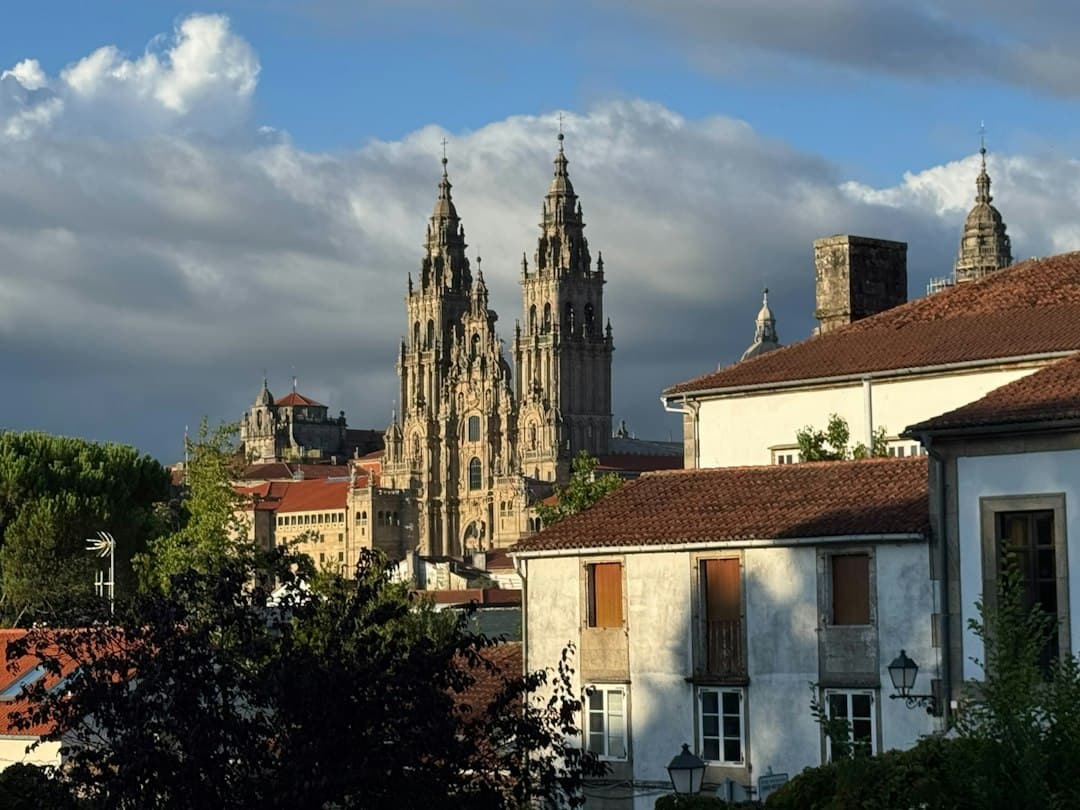
Built between 1075 and 1211, the cathedral blends Romanesque, Gothic and Baroque styles[2]. Originally Romanesque, it aimed to be the largest Christian temple of its time[3]. The following centuries added a royal pantheon, cloisters, altarpieces and sculptures, until the 17th and 18th centuries, when Baroque architecture transformed it into the look we know today[3].
Inside, you go down to see the crypt of the apostle, then the various chapels; before leaving, don't miss the Pórtico da Gloria[4]. This masterpiece of Romanesque art features many religious figures, and you should book your museum entry ticket in advance to guarantee access[2]. The cathedral museum completes the visit by telling the history of the site[5].
The Obradoiro and the Rooftops
The city's true symbol is the cathedral's Baroque western facade, which forms one side of the Praza do Obradoiro[1]. The square is lined with notable buildings: the former royal hospital in plateresque style, and the neoclassical Pazo de Raxoi, which houses the city hall[4]. You will also find the Pazo de Xelmirez, the cathedral's former episcopal palace[2].
For another view, access to the cathedral rooftops offers a panorama over the entire city[6]. Book this visit in advance[7].
The Old Town on Foot
Once you have seen the buildings of the Obradoiro, head into the narrow cobbled streets: you will pass squares, palaces, manor houses, fountains and churches[2]. The most remarkable squares are Cervantes, Platerías and Quintana[2].
The Praza da Quintana is divided into the “Quintana of the Living” and the “Quintana of the Dead,” and it is full of pilgrim legends[6]. The Praza de Cervantes and the Rúa do Vilar are also worth a stop: you can admire the Baroque architecture and small shops selling crafts and local products[6].
As for streets, remember the Rúa do Franco, the Rúa Raíña, the Rúa do Vilar and the Rúa Nova, all lined with impressive buildings[2]. The Rúa Nova is home to the church of Santa María Salomé, the Teatro Principal and the Pazo del Marqués de Santa Cruz[2]. In the evening, the Rúa do Franco is known for its lively atmosphere, with tapas bars and traditional restaurants[5].
The historic center is compact and pedestrian-friendly: the city is best explored on foot[5].

Museums, Monasteries and Parks
- The Museo das Peregrinacións e de Santiago, located on the east side of the square, is an essential complement to a visit to the cathedral museum[3].
- The monastery of San Martiño Pinario is an overlooked Baroque gem[5].
- For Galician culture and everyday life through the ages, head to the former convent of Santo Domingo de Bonaval, just outside the historic center[2].
- The Alameda Park is a green break that offers a panoramic view of the cathedral[5].
Dining in Galicia
The Mercado de Abastos is a very colorful, typical market, best visited on a Thursday or Saturday[4]. Farmers from the surrounding area sell what they grow and make themselves, including very fresh fish, meats and fruit[4]. It is also the second most visited site in the city after the cathedral[5].
As for specialties, try the Galician-style octopus, the tetilla cheese, or the Saint James tart[5]. For octopus, a tip: the bars around the Mercado de Abastos are better than Rúa do Franco, which is very touristy. Look for places where locals stand at the counter with small plates[7].
Tapeo means tasting a variety of specialties in small portions. Pair it with a glass of Albariño or Ribeiro, two iconic Galician wines[6]. Tastings of Galician wines and cheeses are another way to discover the local food scene[6].
How much time to plan, how to get there
If you want to expand your trip, a 5-day itinerary is an option: cathedral and Alameda Park on day one, Praza do Obradoiro and the old town on day two, Mercado de Abastos and the Pilgrimage Museum on day three, then an excursion to the Costa da Morte and the Ensanche neighborhood[7].
Santiago-Rosalía de Castro Airport (SCQ) is 12 km from the center. Bus 6A reaches Praza de Galicia in 25 minutes, every 30 minutes, for €1[7]. Once there, plan to get around on foot.
Keep in mind during your visit
- Keep an eye on your belongings in crowded places: thieves use distraction techniques and often work in teams[8].
- Be wary of accommodation offers that seem too good to be true, such as a free room offered to a solo traveler: opt for hostels listed in reputable guides[9].
- Carry a photo ID with you: the police may ask for it, and ignoring a direct request from an officer can be considered "disobedience," a criminal offense[8].
To go further
- Spain: The Highlights, Region by Region
- Malaga and the Costa del Sol: What to See and Do, from the Alcazaba to the White Villages
- Ibiza: What to See and Do Beyond the Party, Between Heritage and Nature
- Granada and the Alhambra: What to See, What to Experience, and How to Plan
Sources
- 1.^ abcdwhc.unesco.org — Santiago de Compostela (Old Town) - UNESCO World Heritage Centre: “Destroyed at the end of the 10th century, the city was entirely rebuilt in the following century.”; “With its Romanesque, Gothic and Baroque monuments, the old town of Saint James is one of the most beautiful urban districts in the world. The oldest monuments are grouped around the tomb of Saint James and the cathedral.”; “The old town is a living, lively place, where residents and businesses coexist with tourism.” https://whc.unesco.org/en/list/347/ (accessed November 12, 2026)
- 2.^ abcdefghgaliciatravels.com — Things to See in Santiago de Compostela: “Built between 1075 and 1211 to be the resting place of the apostle Saint James, this cathedral blends Romanesque, Gothic and Baroque styles like no other, giving it an imposing and magnificent appearance.”; “To enjoy it, you must book your museum entry ticket in advance to guarantee your access.”; “The true jewel of the cathedral is the Portico of Glory, a masterpiece of Romanesque art featuring many religious figures.” https://galiciatravels.com/fr/choses-a-voir-a-saint-jacques/ (accessed November 12, 2026)
- 3.^ abcroutard.com — Visiting Santiago de Compostela (Saint-Jacques-de-Compostelle): plan your stay and trip to Santiago de Compostela (Saint-Jacques-de-Compostelle) | Routard.com: “Of Romanesque style, it aims to become the largest Christian temple of its era.” ; “Over the following centuries, embellishment work was continuously carried out: royal pantheon, cloisters, defensive tower, altarpieces, sculptures... And this continued into the 17th and 18th centuries, when Baroque architecture literally transformed the cathedral into the appearance we know today.” ; “Museo das Peregrinacións e de Santiago: located on the east side of the square, this museum, whose museography has been completely revised and enriched with the collection of the former museum of the same name in the Casa Gótica, is an essential complement to visiting the Cathedral Museum.” https://www.routard.com/fr/guide/europe/espagne/galice/santiago-de-compostela-saint-jacques-de-compostelle (accessed November 12, 2026)
Show 6 more sourcesShow less
- 4.^ abcdturismo.gal — Saint-Jacques-de-Compostelle - GALICIA: “We visit the crypt of the apostle, approach the saint who lies on the central canopy, then admire the various chapels.” ; “Before leaving the temple, we admire the majestic Pórtico da Gloria and head down to the Praza do Obradoiro, another spectacular architectural center: the Plateresque royal hospital (Hostal dos Reis Católicos); the Neoclassical Pazo de Raxoi, with its Versailles-like air, shared by the Saint-Jacques-de-Compostelle town hall and the …” ; “Next to it is the Mercado de Abastos, a very colorful typical market, best visited on Thursday or Saturday. Farmers from the surrounding area sell the produce they grow and prepare themselves. Very fresh fish is also sold there, as well as excellent meats and fruit.” https://www.turismo.gal/que-visitar/cidades/santiago-de-compostela?langId=fr_FR (accessed November 12, 2026)
- 5.^ abcdefgadvised-traveler.com — Saint-Jacques-de-Compostelle in 2026: what the city has changed, seen from the inside: “Don’t miss visiting the cathedral museum to learn more about the history of the place.” ; “Don’t leave without experiencing the lively nightlife of Rúa do Franco, where tapas bars and traditional restaurants sit side by side.” ; “For those who prefer to explore the city on foot, Saint-Jacques-de-Compostelle offers a compact, pedestrian-friendly historic center.” https://advised-traveler.com/europe/guide-voyage-espagne/visiter-premiere-fois-saint-jacques-de-compostelle-faire-voir/ (accessed November 12, 2026)
- 6.^ abcdegaliciatravels.com — What to do in Saint-Jacques-de-Compostelle in 2025: “Access to the cathedral rooftops offers an unmatched panoramic view of the city, letting you admire its beauty from a unique angle.” ; “You can visit Praza da Quintana, a place rich in symbolism, divided into the Quintana of the Living and the Quintana of the Dead, with legends and pilgrim stories.” ; “Praza de Cervantes and Rúa do Vilar are other must-see stops, where you can admire Baroque architecture and discover small craft shops and local products.” https://galiciatravels.com/fr/que-faire-a-saint-jacques-de-compostelle/ (accessed November 12, 2026)
- 7.^ abcdexplorinder.com — Saint-Jacques-de-Compostelle in 5 days: day-by-day itinerary: “Take the cathedral rooftop tour (advance booking required) for breathtaking views over the old town and to see the masonry up close: it is one of the few cathedral roofs in Spain you can walk on.” ; “For the best pulpo á feira (Galician octopus), go to the bars around the Mercado de Abastos rather than the very touristy Rúa do Franco: look for places where locals stand at the counter over small plates.” ; “Cathedral and Alameda park on day 1, Praza do Obradoiro and the old town on day 2, Mercado de Abastos and the Pilgrims’ Museum on day 3. The other 2 days add an excursion to the Costa da Morte and the Ensanche.” https://explorinder.com/fr/itineraries/5-days-in-santiago-de-compostela (accessed November 12, 2026)
- 8.^ abgov.uk — Safety and security - Spain travel advice - GOV.UK: “Be alert to the risk of street crime. Thieves use distraction techniques and often work in teams. Take care of your passports, money and personal belongings, especially when withdrawing or checking in luggage at the airport and when renting a car.” ; “You must present photo identification if a police officer asks you to. This includes the Guardia Civil and the national, regional and local police. The police have the right to hold you at the station until they have confirmed your identity.” ; “Ignoring direct requests from a police officer may be considered disobedience, which is a criminal offence.” https://www.gov.uk/foreign-travel-advice/spain/safety-and-security (accessed November 12, 2026)
- 9.^randoconfort.fr — Dangers on the Camino de Santiago | Rando Confort: “A common scam on the Camino de Santiago that you may encounter if you are alone is being offered free accommodation.” ; “Since any offer that seems too good to be true is often a scam, we advise you to rely on the reputable hostels listed in recognized guides (such as the Miam miam dodo).” https://randoconfort.fr/conseils-rando/dangers-st-jacques-compostelle (accessed November 12, 2026)