Granada is about much more than the Alhambra. Between the Nasrid palaces, the lanes of the Albaicín, the cave dwellings of the Sacromonte, and the tapas bars, the city deserves more than a photo from a lookout point. This article helps you plan your 2 or 3 days on the ground, choose the right season, and avoid the booking mistakes that cost you entry to the palaces.
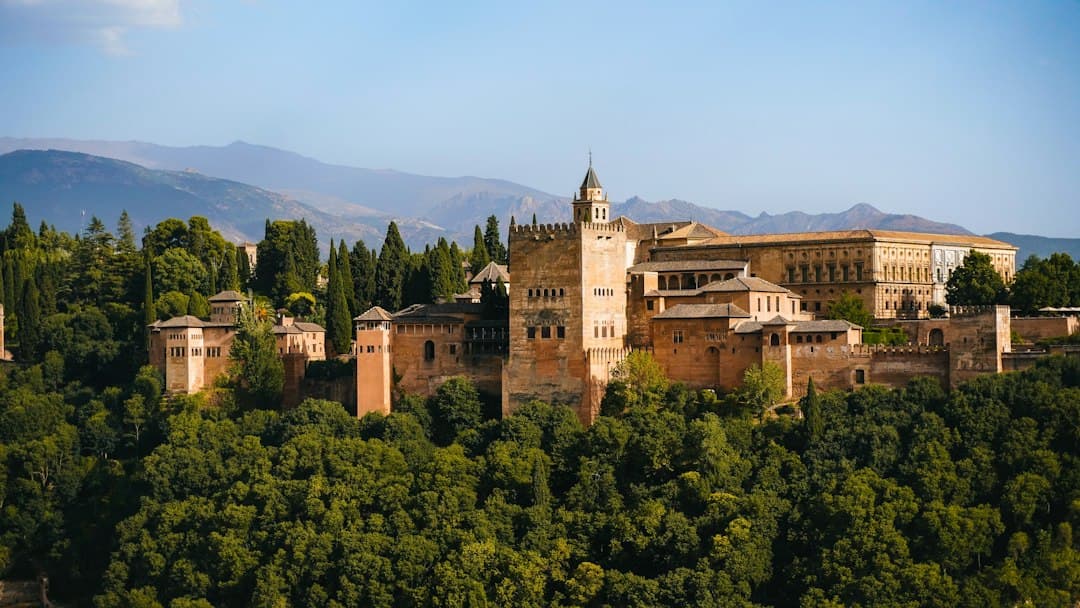
The Alhambra, a Nasrid palatine city
The Alhambra, the Generalife, and the Albaicín form a complex listed as a UNESCO World Heritage Site. They occupy two neighboring hills separated by the Darro River, above the modern city[1]. The Alhambra has been continuously occupied over the centuries and remains the only preserved palatine city from the Islamic period[1]. It was founded in the 13th century under the Nasrid dynasty and brings together palaces, gardens, and military remains[2].
The heart of the visit is the Nasrid palaces: the Mexuar, with its carved wooden ceilings and finely crafted azulejos; then the Comares Palace, whose Hall of the Ambassadors is covered by a wooden dome made of roughly 8,000 pieces arranged in star patterns[2]. Next comes the Palace of the Lions, with its patio of 124 columns and the fountain of twelve lions, a symbol of Nasrid sultanic power[2]. The decoration is more than ornamental: plasterwork, wood, and ceramics, combined with Arabic epigraphy, form what UNESCO describes as "speaking architecture," tied to the political and poetic world of the Nasrid dynasty[3].
The Palace of Charles V, built against the Nasrid palaces as a symbol of the conquest of Granada by the Catholic Monarchs[4], offers a sharp contrast: a Renaissance building with a massive, austere look that stands apart from the rest of the site[5]. It now houses the Museo de Bellas Artes and the Museo de la Alhambra[5].
Alcazaba, Generalife, and gardens: views and water
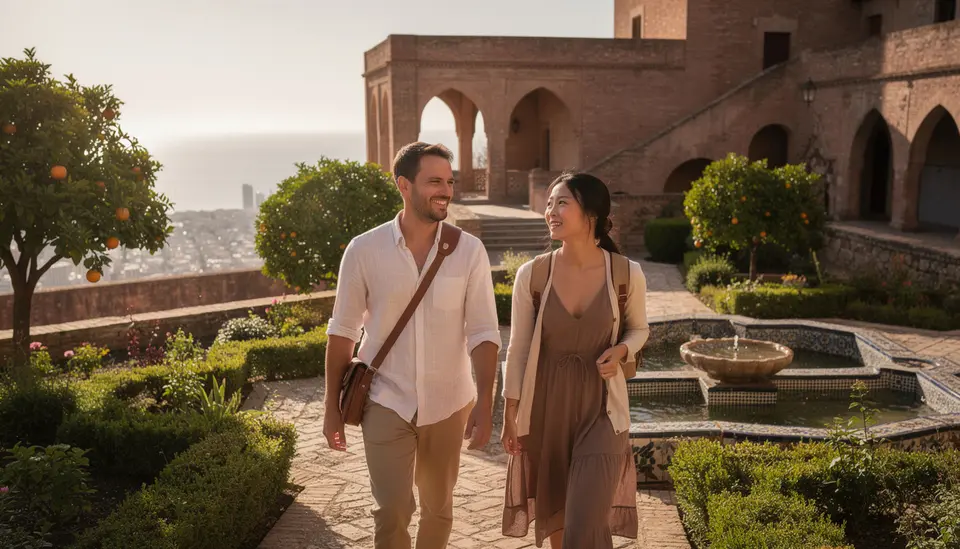
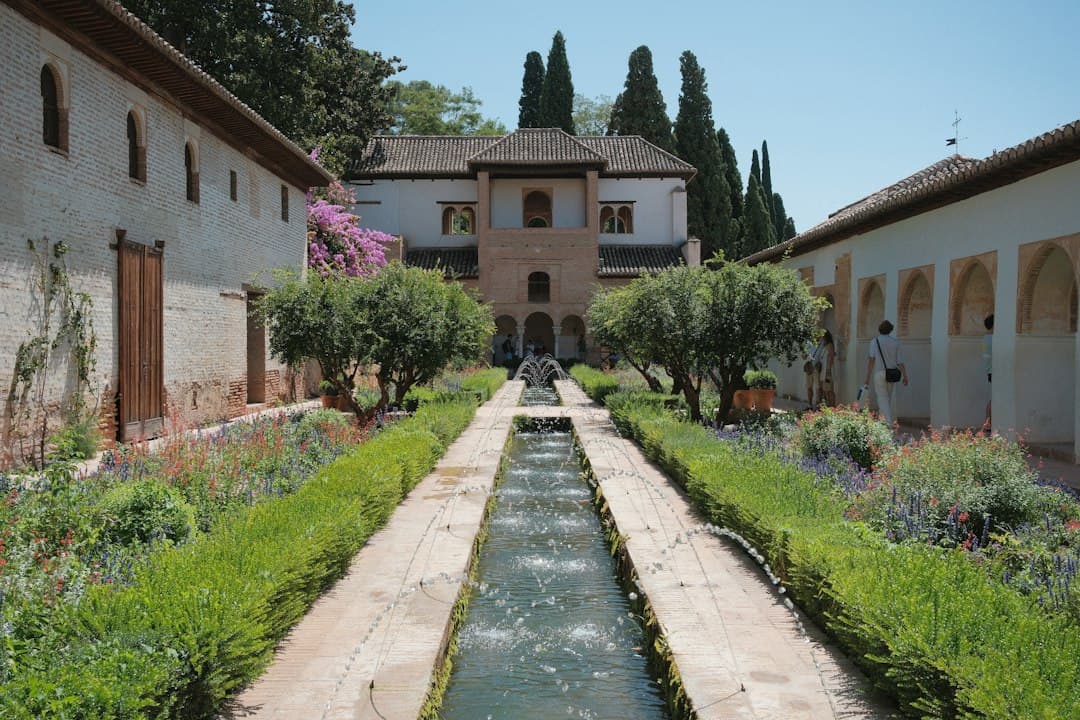
The Alcazaba, a medieval fortress, offers panoramic views over Granada[5]. The Generalife, east of the fortress, was the country residence of the emirs who ruled this part of Spain in the 13th and 14th centuries[1]. You stroll among fountains, clipped hedges, cypresses, and flowers[5], notably in the Patio de la Acequia, where basins lined with jets of water and cypresses make a much-photographed scene[2].
These gardens also tell a story about technique: they carry on the tradition of Moorish gardens, the decorative use of water, and the alternation of pleasure gardens and farmland, with one of the oldest known agricultural terrace zones in Europe[3]. Their creation was made possible by the irrigation engineering already present in Al-Andalus[3].
For the order of your visit, the timing of the Nasrid palaces dictates everything: the last entry ends one hour before closing and lasts at least half an hour, so visit the Generalife and the Alcazaba first[6]. Plan around the time slot on your palace ticket, and organize the rest of the day around it.
The Albaicín and the Sacromonte, legendary neighborhoods
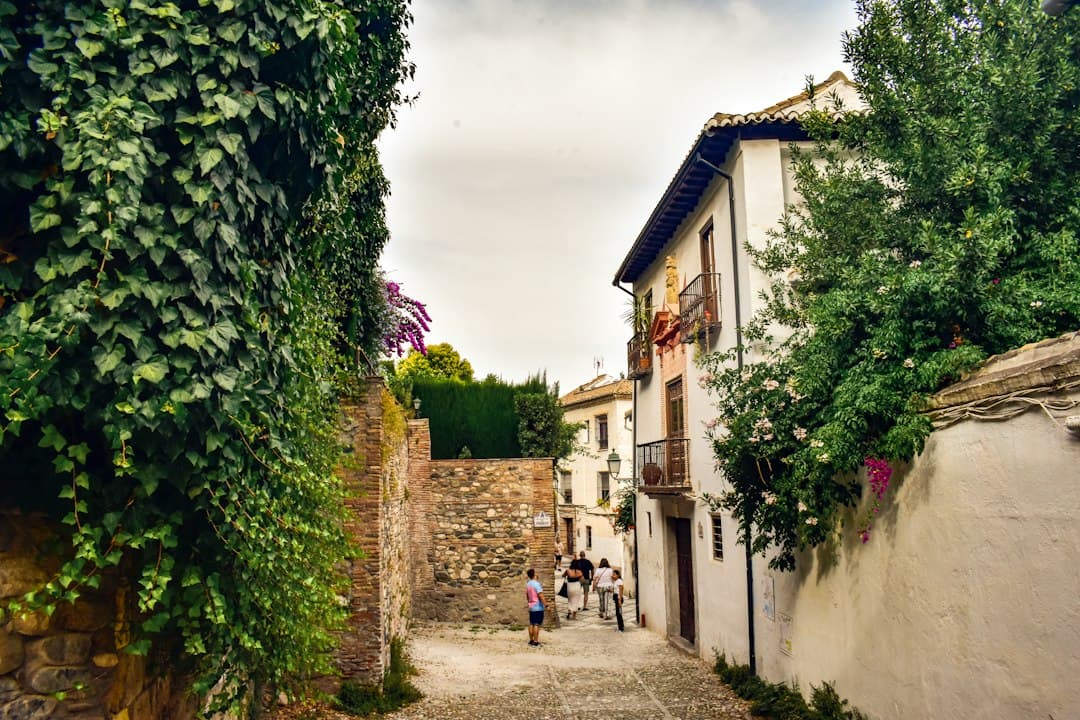
Facing the Alhambra, on the opposite hill, the Albaicín is the former Arab quarter, listed as a UNESCO site[2]. It preserves a rich body of Moorish vernacular architecture, where traditional Andalusian architecture blends harmoniously[1]. Get lost in its lanes: every turn changes your view of the Alhambra. Watch out for the uneven paving and the maze of steep streets[7].
The Mirador de San Nicolás is the lookout most visited by locals and tourists alike, and the one with the finest view of the Alhambra; sunset there is a sought-after moment[4]. In summer, the climb to San Nicolás in the middle of the day can be exhausting because of the heat[8].
Higher up, the Sacromonte is a cave-dwelling quarter built into the hillside, famous for its casas-cuevas, caves to which walls and a facade have been added[2]. There you will find the Cuevas del Sacromonte, which count among the city's museums[9], and this is where to go for a flamenco and zambra show[9].
The historic center: cathedral, royal chapel, Realejo
The center is best discovered through the cathedral, a Renaissance gem begun in 1518 on the remains of the old medina[2]. The area around it is pedestrian-only, and the Cathedral of the Incarnation is one of the city's must-see monuments[9]. Nearby, the royal chapel, the Basílica de San Juan de Dios, and the archaeological museum complete a few-hour walk through shaded lanes and squares[7].
Carrera del Darro, one of Granada's loveliest streets, links Santa Ana Square to the Paseo de los Tristes: stone bridges, baroque and classical facades, the Renaissance Palacio de los Córdova, and old Arab baths preserved since the 11th century[2]. The Realejo, the former Jewish quarter, is easy to reach from Santa Ana Square; on Pavaneras Street, the fortified facade of the los Tiros house-museum, decorated with warrior sculptures, is worth the detour[2].
Tapas, flamenco, Arab baths: living Granada
Around Campo del Príncipe Square, tapas bars make socializing easy: tapas come free with every drink[2]. Order a drink and let the local specialties arrive at your table.
For music, dinner followed by a flamenco and zambra show in the Sacromonte is a reliable choice for any trip to Andalusia[9]. To recover after a day of walking, a hammam experience in an Andalusian Arab bath is a good option[9]; the Hammam Al Ándalus is just below the Alhambra, behind the Santa Ana church[8].
Granada also sits at the foot of the Sierra Nevada, where you can ski[8]: in winter, the Pradollano resort and snow hikes are accessible from the city[9]. If you have more time, the city can serve as a base for hiking or skiing in the Sierra Nevada[7].
How long, when to come, how to get there
Two or three days are enough to visit Granada, at any time of year[9]. For the Alhambra, plan on about 4 hours[8]; for a first visit, allow at least half a day, as the site is very large[7]. The second day can be devoted to the center, with the cathedral and royal chapel[7].
Spring and autumn are the best seasons, with milder temperatures than the height of summer, which is very hot and hard going at the Alhambra in midday[8]. Winter has its charm: in December, the city is quiet and the snow on the Sierra Nevada beautifies the view from the Alhambra, but evenings are cooler[8].
- By plane: Federico García Lorca airport is about 15 km from the city[10]; to reach the center, take an Alsa bus or a taxi[9].
- Other access: by train or bus, with stations in town, or by car via the A-92 motorway[10].
- By car: part of the center has restricted access[9], and private vehicles cannot drive up to the Alhambra from the city center: access is via the southern ring road, toward the Sierra Nevada[11].
On site, Granada is very walkable: the center, the Alhambra hill, the Albaicín and the Realejo are within walking distance of one another[7]. Buses are mainly useful for climbing to the Alhambra, the upper Sacromonte or the Albaicín viewpoints, since walking down is less tiring[7]. Useful routes include the C30 between Plaza Isabel II and the Alhambra, the C31 between Plaza Nueva and the Albaicín, and the C34 between Plaza Nueva and the Sacromonte[7].
Pitfalls and things to watch for
A few ticketing rules can cost you access to the Nasrid palaces; it's best to know them before you buy.
- Tickets are limited: they can sell out long in advance, especially in busy periods[8]. In high season, they sell out several weeks before the date[12].
- Nasrid palace time slots: you can only enter during the time printed on your ticket, and entry is refused if you arrive late, even though you can stay in the rest of the complex[6].
- Named tickets: an original ID card or passport is required at the entrance[6].
- Final purchase: once your order is confirmed, you can no longer change the time or date of your visit, and all ticket purchases are final[11].
- Each area only once: you may enter each space (Alcazaba, Nasrid palaces, Partal, Generalife) only once, but you can leave the complex and come back freely[11].
- Strollers: they cannot enter the buildings; a supervised stroller service (on presentation of the day's ticket) and a cloakroom at the Puerta del Vino are available[11].
Some areas may be closed or adjusted depending on the time of year: check the official website of the Patronato de la Alhambra before you go.
Steps, in order
- Book your Alhambra tickets first, before the rest of the trip, choosing your entry time to the Nasrid Palaces[10].
- Fit the Generalife and Alcazaba around the Palaces time slot, either before or after, depending on your ticket.
- Book your accommodation: ideally 2 months ahead in high season and 3 weeks ahead in low season[9].
- Set aside one day for the city center: the cathedral, the Royal Chapel, Carrera del Darro, and the Realejo.
- Head up to the Albaicín and the Mirador de San Nicolás late in the afternoon.
- End at the Sacromonte for flamenco and zambra, or for tapas at Campo del Príncipe.
This article covers the essentials for a first visit. If you want to stay longer, the guide to accommodation and restaurant addresses, a line-by-line budget, and how to choose your neighborhood requires going further.
Going further
- Spain: The Highlights, Region by Region
- Málaga and the Costa del Sol: What to See and Do, from the Alcazaba to the White Villages
- Barcelona: What to See and Do, from Gaudí to the Beaches
- Segovia: What to See and Do, from the Roman Aqueduct to the Alcázar
Sources
- 1.^ abcdwhc.unesco.org — Alhambra, Generalife and Albayzín, Granada - UNESCO World Heritage Centre: “Dominating the modern city built on the plain, the Alhambra and the Albayzín, located on two adjacent hills, form the medieval part of Granada.” ; “The Alhambra, despite its continuous occupation over the centuries, is currently the only palatine city from the Islamic period that has been preserved.” ; “East of the fortress and residence of the Alhambra extend the marvelous gardens of the Generalife, the former country residence of the emirs who ruled this part of Spain in the 13th and 14th centuries.” https://whc.unesco.org/fr/list/314 (accessed November 14, 2026)
- 2.^ abcdefghijviamichelin.fr — Weekend: visiting Granada in 3 days - ViaMichelin Magazine: “Founded in the 13th century under the Nasrid dynasty, this unique complex brings together palaces, gardens and military remains.” ; “There you can admire the Palacio del Mexuar, whose carved wooden ceilings and azulejos are of rare refinement, and the Palacio de Comares: its Hall of the Ambassadors is impressive for its wooden dome made of some 8,000 pieces arranged in stars!” ; “The highlight, the Palacio de los Leones and its patio with 124 columns lead you to the fountain of the twelve lions, a symbol of the power of the Nasrid sultans.” https://www.viamichelin.fr/magazine/article/week-end-visiter-grenade-en-3-jours (accessed November 14, 2026)
- 3.^ abcwhc.unesco.org — Alhambra, Generalife and Albayzín, Granada - UNESCO World Heritage Centre: “Associated with Arabic epigraphy, the buildings have become an ensemble of ‘speaking architecture,’ whose content is linked to the religious, political and poetic universe of the Nasrid dynasty.” ; “The Alhambra, and in particular the Generalife, incorporates the tradition of Moorish gardens, the aesthetic use of water and productive and ornamental gardens, with one of the oldest known areas of cultivated terraces in Europe.” ; “These palaces were made possible by the irrigation engineering existing in Al-Andalus, well established at the Alhambra and the Generalife.” https://whc.unesco.org/en/list/314/ (accessed November 14, 2026)
Show 9 more sourcesShow less
- 4.^ ablevoyageauthentique.com — Visiting Granada in 2 days | The 8 must-sees: “Backing onto the Nasrid palaces, the Palace of Charles V, built in the Renaissance style, was added as a symbol of the conquest of Granada by the Catholic Monarchs.” ; “It is from here that you will enjoy the finest view of the Alhambra.” ; “The Mirador de San Nicolás is Granada’s most visited viewpoint by locals and tourists alike.” https://levoyageauthentique.com/visiter-grenade-en-2-jours (accessed November 14, 2026)
- 5.^ abcdroutard.com — Visiting the Alhambra: plan your stay and trip to the Alhambra | Routard.com: “The Palace of Charles V: an impressive example of Spanish Renaissance architecture whose massive, austere appearance contrasts with the rest.” ; “The building today houses the Museo de Bellas Artes and the Museo de la Alhambra.” ; “The Alcazaba: the medieval fortress offers a panoramic view over the city of Granada.” https://www.routard.com/fr/guide/europe/espagne/andalousie/grenade-et-sierra-nevada/granada-grenade/alhambra (accessed November 14, 2026)
- 6.^ abcalhambradegranada.org — Alhambra ticket sales - Ticket office - AlhambraDeGranada.org: “Keep in mind that the last visit to the Nasrid Palaces ends one hour before closing time and will take at least half an hour, so you should visit the Generalife and the Alcazaba beforehand.” ; “Your entry will be refused if you do not respect this time, although you may stay inside the monumental complex.” ; “You must present your original identity card or passport to access the monument, as tickets are personal.” https://www.alhambradegranada.org/fr/info/billeterie.asp (accessed November 14, 2026)
- 7.^ abcdefghlonelyplanet.com — Guide to Granada, Spain - Lonely Planet: “(Keep in mind the uneven paving and the maze-like, steep alleys of the Albaicín.)”; “On the second day, spend a few hours wandering the narrow streets and shaded squares of the Centro: the cathedral, the Royal Chapel, the Basílica de San Juan de Dios, the archaeological museum, the 11th-century Moorish baths and other sites.”; “If you have more time, consider using Granada as a base for hiking or skiing in the nearby Sierra Nevada.” https://www.lonelyplanet.com/articles/guide-to-granada-spain (accessed November 14, 2026)
- 8.^ abcdefginbetweentravels.com — Visiting Granada (Spain): What to Do, the Alhambra and Free Tapas (2026): “Summer in Granada is very hot, which can make visiting the Alhambra or climbing up to San Nicolás in the middle of the day hard going.”; “Just below the Alhambra, behind the Santa Ana church, you'll find Hammam Al Ándalus.”; “Granada sits at the foot of the Sierra Nevada, where you can even go skiing if the mood takes you.” https://inbetweentravels.com/fr/visiter-grenade/ (accessed November 14, 2026)
- 9.^ abcdefghijroutard.com — Visiting Granada: plan your stay and trip to Granada | Routard.com: “Architecture and museum lovers (the Alhambra, the Fine Arts Museum, the Cuevas del Sacromonte, Max Moreau…)”; “Finally, a dinner at a restaurant and a flamenco and zambra show make for an unforgettable stay in Andalusia.”; “Another must-see landmark: the Cathedral of the Incarnation, located in the center and surrounded by pedestrian streets.” https://www.routard.com/fr/guide/europe/espagne/andalousie/grenade-et-sierra-nevada/granada-grenade (accessed November 14, 2026)
- 10.^ abcalhambra.org — Granada Guide: What to See, How to Get There and Where to Stay: “By plane, to Federico García Lorca airport, about 15 km away; by train or bus, with stations in the city; or by car via the A-92 motorway.”; “Start with the Alhambra: it is Spain's most-visited monument and tickets are limited, so book it before planning the rest of your trip.” https://www.alhambra.org/fr/guide-granade.html (accessed November 14, 2026)
- 11.^ abcdalhambra-patronato.es — F.A.Q. - Patronato de la Alhambra y Generalife: “Access to the Alhambra by car is via the city's southern ring road, toward the Sierra Nevada; private transport is not allowed to reach the Alhambra from the city center.”; “Once your purchase is confirmed, it is not possible to change the time or date of the visit.”; “All ticket purchases are final and non-refundable.” https://www.alhambra-patronato.es/en/visit/faq (accessed November 14, 2026)
- 12.^alhambra.org — Alhambra Guided Tour with Tickets Included | Alhambra.org: “In high season, tickets sell out several weeks in advance.” https://www.alhambra.org/en/ (accessed November 14, 2026)