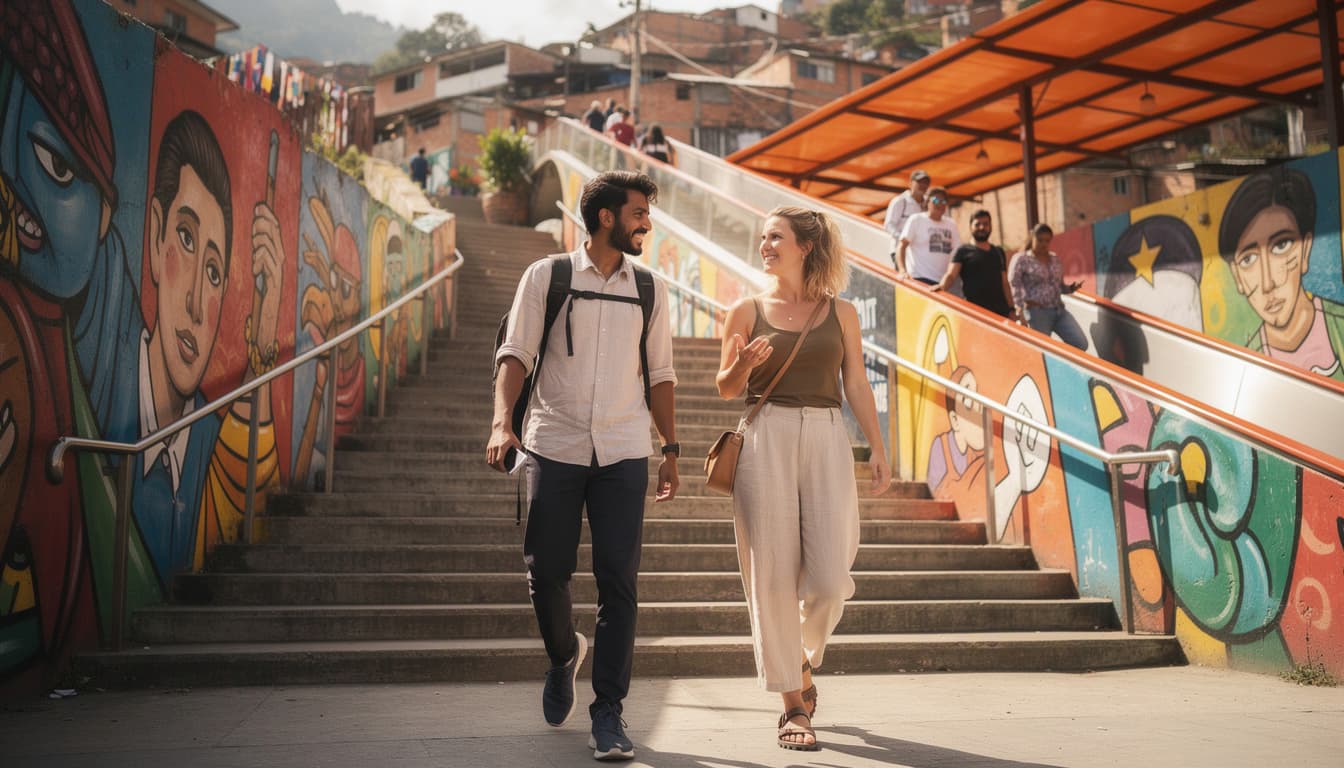
In Colombia, Spanish opens doors that English cannot. This article helps you understand where English still gets you by, adopt the customs that make everyday exchanges with locals easier (invitations, dining, punctuality, tipping), choose a first base that fits your profile, and avoid the most common safety pitfalls. It also covers the entry and stay rules that matter for a long stay.
Spanish in Colombia: What You Need to Know Before You Arrive
About 4.2% of the Colombian population speaks English, and almost exclusively in expat neighborhoods such as El Poblado in Medellín or northern Bogotá[1]. Government offices, shops, healthcare, and transport are all experienced in Spanish[1]. Even in tourist areas, English remains limited outside hotels and international restaurants[1].
The good news: Colombians appreciate the effort to speak Spanish and are generally patient with learners[1]. Speaking a few sentences, even hesitantly, pays off from day one.
Communicating for Real: The Customs That Matter
Greetings and Invitations
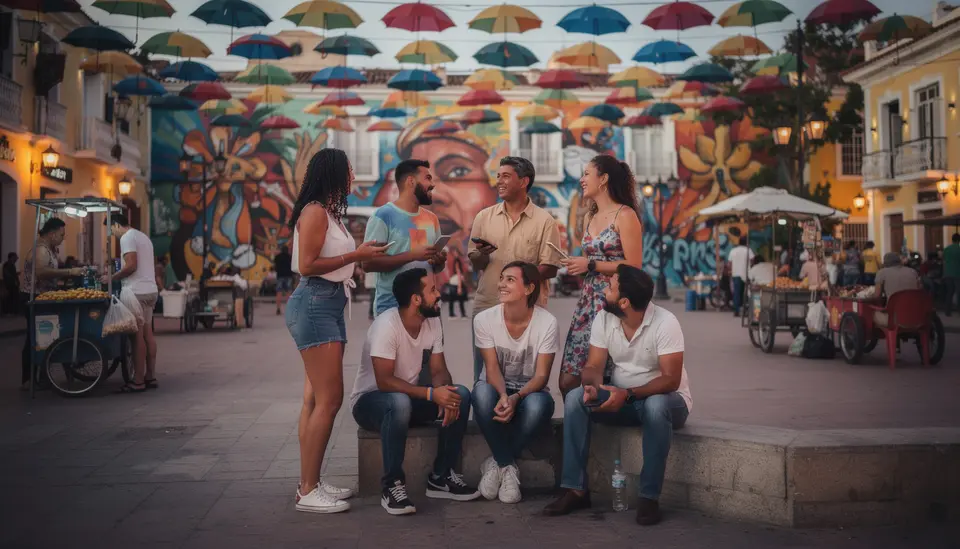
The standard greeting is a firm handshake between men; otherwise, people greet each other with a kiss on the right cheek[2]. If you are invited into someone's home, know that declining is perceived as a lack of interest in building a personal connection[3]. That does not oblige you to accept an invitation from someone you have just met, especially if you are traveling alone: judge the situation carefully. Visitors are systematically offered a coffee, the tinto[3].
At the Table
- When sitting down to eat, say “Buen provecho” to wish everyone a good meal[3].
- It is polite to taste every dish offered[3].
- To indicate you have finished, leave a small portion on your plate[3].
- The most common toast is “Salud”[3].
Punctuality and Gestures
In social settings, punctuality is flexible: arriving up to an hour late is socially accepted, known as “tiempo colombiano,” Colombian time[2]. Do not extend this to all your appointments, however: the tolerance applies to social occasions.
A few gestures are poorly received: talking with your hands in your pockets, chewing gum with your mouth open, slouching; slamming doors is also best avoided[2].
Everyday Life: Tipping, Public Holidays, and Closures
In restaurants with table service, tipping (propina) is generally optional and amounts to about 10% of the bill[4]. The note may include the mention “servicio voluntario” or “propina voluntaria”; you can ask to have it removed[4]. Some tourist establishments or certain groups may have a 10% service charge applied automatically[4]. Tipping is not expected in taxis or street stalls, although it is appreciated[4].
On the calendar, Colombia has 18 national public holidays, 10 of which are movable: if they do not fall on a Monday, they are moved to the following Monday[5]. The main closure dates are January 1, May 1, July 20, August 7, and December 25[5]. Holy Week is widely observed: many shops close as early as Wednesday[5]. Schedule your errands and shopping outside these dates.
Choosing Your Destination Based on Your Profile
Your level of Spanish is the first criterion. For a first stay with little Spanish, El Poblado in Medellín and northern Bogotá concentrate English speakers[1]. Outside these neighborhoods, expect to rely on Spanish for everything[1].
The second criterion is safety, which varies considerably from one neighborhood to another[6]. French authorities report a sharp rise in crime in major urban centers such as Bogotá, Cali, Medellín, and Cartagena[6].
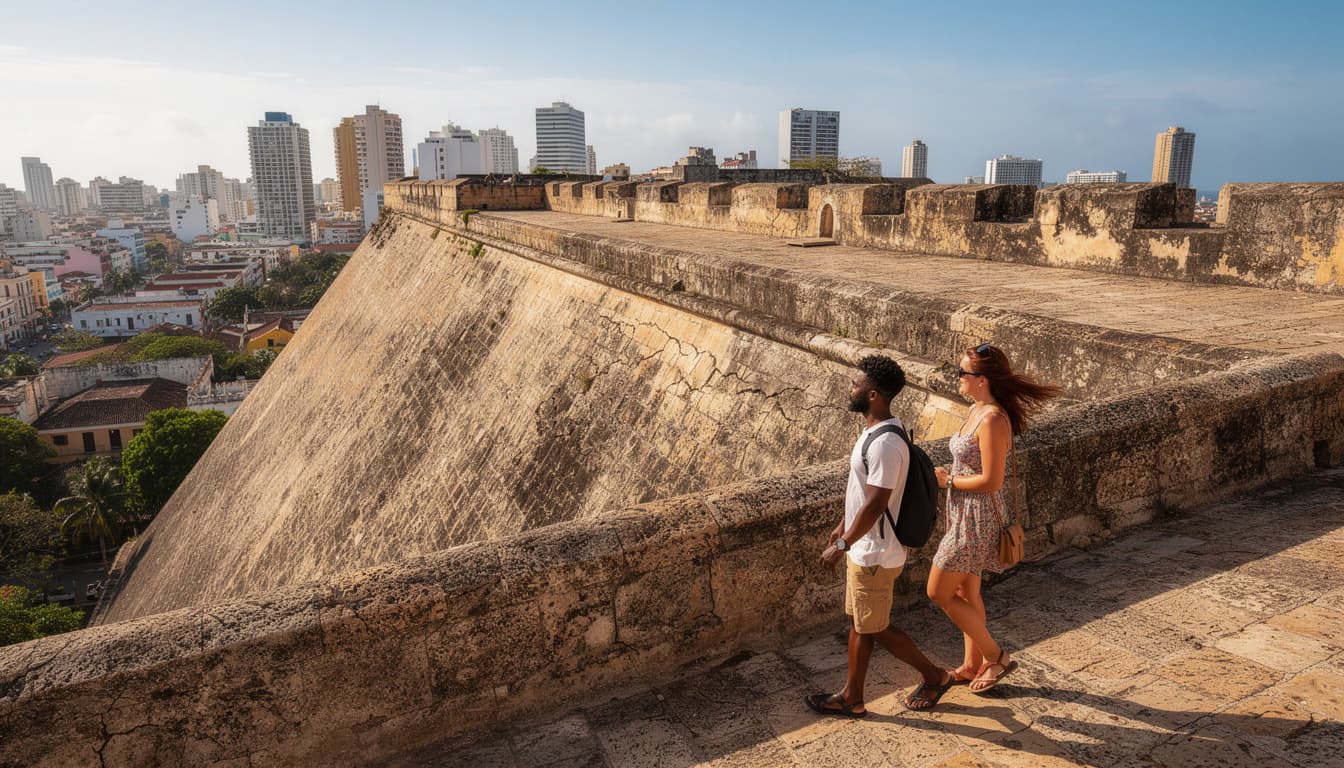
In Cartagena, the situation is considered satisfactory inside the walls of the old town and in the Bocagrande, Castillogrande, and Getsemaní neighborhoods, with caution required in deserted alleyways at night[6]. Certain areas are also formally advised against due to the security situation: this is the case of the Puracé volcano region in Cauca[7].
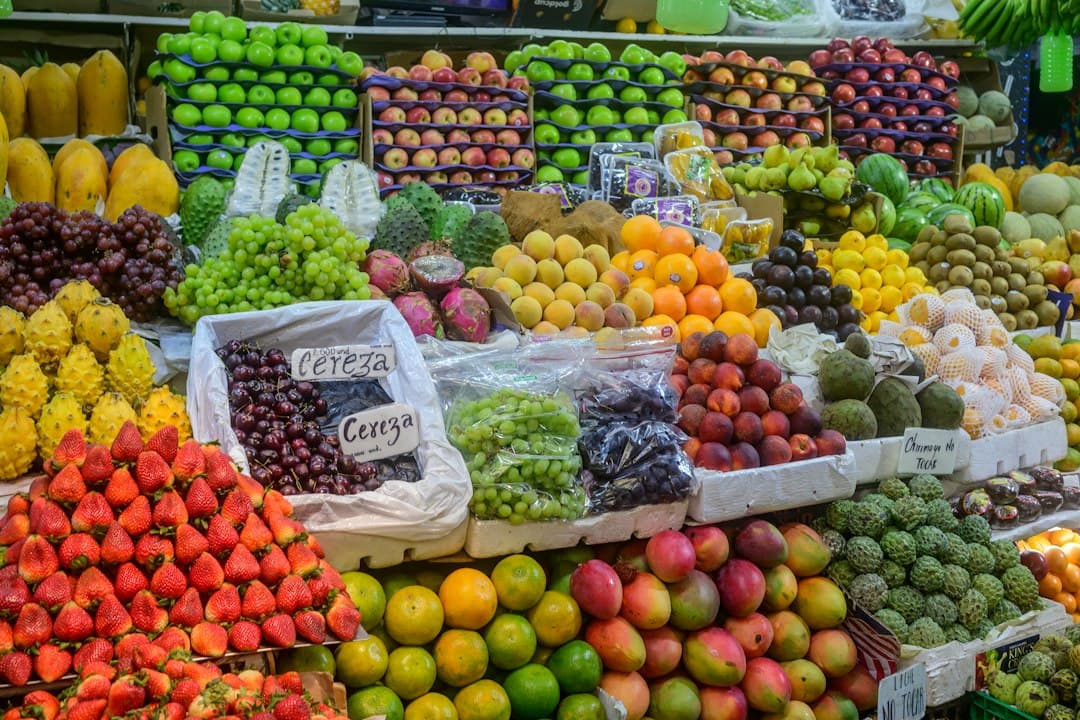
The third is budget. For groceries, you'll find the Éxito, Carulla, and Jumbo supermarkets, along with the D1 and Ara discounters, which are everywhere in the cities[8]. Covered markets (plazas de mercado), such as Paloquemao in Bogotá or the Mercado del Río in Medellín, offer a local and affordable alternative for fresh produce[8]. A monthly grocery basket for one person comes to roughly COP 150,000 to 400,000 when you shop at covered markets[8].
Entering and Staying: The Essentials for a Long Stay
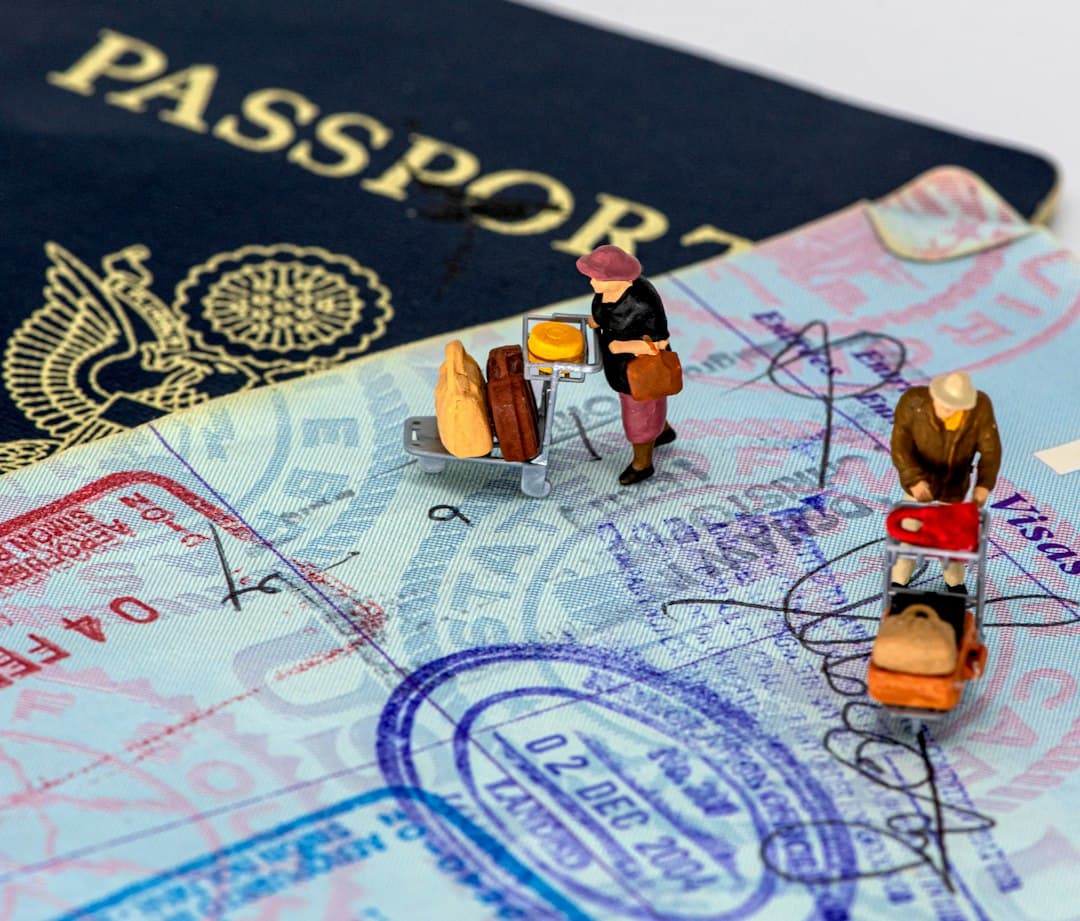
Holders of a French passport can enter Colombia without a visa and stay for up to 90 days, provided they show a round-trip ticket[9]. The passport must be in good condition and valid for the entire stay; proof of departure from the country within the 90 days is mandatory[10]. The immigration officer may grant fewer than 90 days, for example 30 or 60[10]. Travelers arriving by air or sea must complete the Check-Mig immigration form before entering or leaving the country[9].
Once in Colombia, you can extend your stay by an additional 90 days through the Permiso Temporal de Permanencia (PTP) procedure, within the dual limit of 180 continuous days and 180 days in the calendar year[10].
For long-term remote work, Colombia offers a digital nomad visa. It requires a passport from a country exempt from short-stay visas[11]. It prohibits any paid activity for companies or individuals based in Colombia[11]. Its validity does not exceed two years[11]. Conversely, carrying out paid work on a tourist visa exposes you to heavy fines[9].
If your stay exceeds 90 days, take out specific travel insurance: standard policies, such as those included with bank cards, only cover the first 90 days counted from the date you left France[10].
Scams, Traps, and Points of Vigilance
These points are aimed first at travelers on their own and at those looking to meet locals, which is precisely what you are coming to do.
Taxis Hailed on the Street
French authorities recommend not hailing taxis on the street, due to the risk of assault, theft, or kidnapping, especially express kidnapping: attackers, sometimes posing as taxi drivers, force passengers to withdraw money from several ATMs[6]. Prefer app-booked taxis, which are “traceable”: Uber, Cabify, Taxis Libres[6]. If attacked, do not resist[6]. Urban public transport is not safe, as bus passengers are regularly assaulted[6].
Dating Apps and Scopolamine
Dating apps are often used by criminals to spot and lure foreigners who travel alone and want to meet locals[12]. French authorities advise against using these apps in Colombia, given the risk of being drugged without your knowledge with scopolamine[7]. They also advise never leaving your drink unattended in bars and nightclubs, especially when meeting strangers through these apps[7].
Fake Police Officers and Fake Couriers
Fake police officers run scams under the pretext of checking identity documents and currency[6]. If you are stopped on the street, particularly in Bogotá, ask to be escorted to the nearest police station or to a public place, such as your hotel[6]. Fake couriers may also enter restaurants to rob customers[6].
Getting Around and Length of Stay
It is strongly recommended to travel only during daylight hours and only on main roads[6]. Finally, overstaying the period written on your entry stamp will result in a fine[12].
Steps, in Order
- Make sure your passport is in good condition and valid for your entire stay, and plan for an exit ticket[10].
- Fill out the Check-Mig form before entry if you arrive by air or sea[9].
- Get suitable travel insurance if your stay exceeds 90 days[10].
- Choose your first base based on your Spanish level, your budget, and your tolerance for risk, then request an extension through the PTP if needed[10].
- Note public holidays and Holy Week in your calendar so you don't find yourself in front of closed shops.
This article covers the essentials: the step-by-step visa process in detail, a line-by-line budget, and choosing the right neighborhood require going further before you truly settle in.
Sources
- 1.^ abcdefMira Knowledge — Only about 4.2% of the Colombian population speaks English, almost exclusively in expat neighborhoods (El Poblado in Medellín, northern Bogotá). Verified June 13, 2026: 2 consistent sources (livingcost.org, expat.com). https://livingcost.org/cost/colombia (accessed June 13, 2026)
- 2.^ abcMira Knowledge — The standard greeting is a firm handshake between men, and a kiss on the right cheek in other cases. Verified June 13, 2026: 2 consistent sources (expat.com, culturalatlas.sbs.com.au). https://www.expat.com/en/guide/south-america/colombia/ (accessed June 13, 2026)
- 3.^ abcdefMira Knowledge — In Colombia, it is extremely rude to decline an invitation to come inside someone's home, as it is interpreted as a lack of interest in building a personal connection. Verified June 13, 2026: reference source culturalatlas.sbs.com.au. https://culturalatlas.sbs.com.au/colombian-culture/colombian-culture-etiquette (accessed June 13, 2026)
Show 9 more sourcesShow less
- 4.^ abcdMira Knowledge — In Colombia, tipping (propina) is generally optional and amounts to about 10% of the bill in restaurants with table service. Verified June 13, 2026: reference source culturalatlas.sbs.com.au. https://culturalatlas.sbs.com.au/colombian-culture/colombian-culture-etiquette (accessed June 13, 2026)
- 5.^ abcMira Knowledge — Colombia has 18 national public holidays, 10 of which are movable: if they don't fall on a Monday, they are moved to the following Monday. Verified June 13, 2026: 2 consistent sources (expat.com, en.wikipedia.org). https://www.expat.com/en/guide/south-america/colombia/ (accessed June 13, 2026)
- 6.^ abcdefghijkdiplomatie.gouv.fr — Colombia - Security | France Diplomatie: “The security situation varies from neighborhood to neighborhood.”; “Colombia is facing a sharp rise in crime, particularly in major urban centers such as Bogotá, Cali, Medellín, Bucaramanga, Santa Marta, Barranquilla and Cartagena.”; “The security situation varies from neighborhood to neighborhood. It is satisfactory inside the walls of Cartagena's old town and in the Bocagrande, Castillogrande and Getsemaní neighborhoods, although caution is advised in the alleys of the historic center, which are necessarily emptier at night; armed robberies and knife attacks have been reported there.” https://www.diplomatie.gouv.fr/fr/information-par-pays/colombie/conseils-aux-voyageurs-securite (accessed November 11, 2026)
- 7.^ abcdiplomatie.gouv.fr — Colombia - Travel Advice - Latest Updates and Alerts - Page 1 of 1 - France Diplomatie: “French nationals passing through or residing in the country are advised to avoid the area, which is also formally advised against due to the deteriorated security situation (red zone).”; “Given the risk of being unknowingly administered drugs or psychoactive substances (scopolamine), it is advised not to use dating apps in Colombia.”; “It is also advisable not to leave your drink unattended in bars, nightclubs or other social venues, particularly when meeting strangers through these apps.” https://www.diplomatie.gouv.fr/fr/information-par-pays/colombie/dernieres-minutes-et-alertes (accessed November 11, 2026)
- 8.^ abcMira Knowledge — The main supermarket chains include Éxito, Carulla, Jumbo, and the discount chains D1 and Ara, which are everywhere in the cities. Verified June 21, 2026: reference source expat.com. https://www.expat.com/en/guide/south-america/colombia/ (accessed June 21, 2026)
- 9.^ abcddiplomatie.gouv.fr — Colombia - Entry / Stay | France Diplomatie: “Holders of a French passport may enter Colombia without a visa and stay for a maximum of 90 days, upon presentation of a round-trip ticket.”; “International travelers arriving in Colombia by air or sea must complete the Check-Mig immigration form before entering or leaving the country.”; “Colombian authorities impose heavy fines on travelers who are in the country irregularly, including those who engage in paid activities after entering on a tourist visa.” https://www.diplomatie.gouv.fr/fr/information-par-pays/colombie/conseils-aux-voyageurs-entree-sejour (accessed November 11, 2026)
- 10.^ abcdefgco.diplomatie.gouv.fr — Entry and Stay Conditions in Colombia | France in Colombia: “Present a passport in good condition, valid for the entire stay.”; “Present proof of exit from the territory within 90 days (a return ticket to France or a ticket to a third country is mandatory).”; “However, the immigration officer at the border may grant a shorter stay (30 or 60 days, for example).” https://co.diplomatie.gouv.fr/fr/vivre-venir/conditions-dentree-et-de-sejour-en-colombie (accessed November 11, 2026)
- 11.^ abcminjusticia.gov.co — Pages - Visa-nómada-digital.aspx: “Hold a passport from a country exempt from short-stay visas.”; “The holder may not perform any paid activity for companies or individuals domiciled in Colombia.”; “The digital nomad visa is valid for a maximum of two (2) years.” https://www.minjusticia.gov.co/programas-co/LegalApp/Paginas/Forms/DispForm.aspx?ID=834 (accessed November 11, 2026)
- 12.^ abtravel.gc.ca — Colombia travel advice: “Online dating apps are often used by criminals to spot and lure foreigners who travel alone and want to meet locals.” ; “You will be fined if you stay longer than the period stated on your entry stamp.” https://travel.gc.ca/destinations/colombia (accessed November 11, 2026)