Chichén Itzá is best visited when you know what you're looking at: a Maya city reshaped by influences from central Mexico, where every monument tells a story. This article helps you spot the buildings not to miss, understand the history of the site, and plan your day (opening hours, ticket prices, getting there). A final section gathers the points to watch before you buy your ticket.
Chichén Itzá at a glance: why you should go
Chichén Itzá was one of the largest Maya centers on the Yucatán Peninsula[1]. The city has been a UNESCO World Heritage Site since 1988[2]. It is one of the most visited archaeological sites in Mexico[2], making it a memorable cultural day for anyone living in or traveling through the Yucatán, whether from Mérida, Valladolid, or Cancún.
What sets it apart is its mix of styles: traditional Maya building techniques combined with Toltec influences from central Mexico[2]. UNESCO sees it as one of the most important examples of Maya-Toltec civilization in the Yucatán[1].
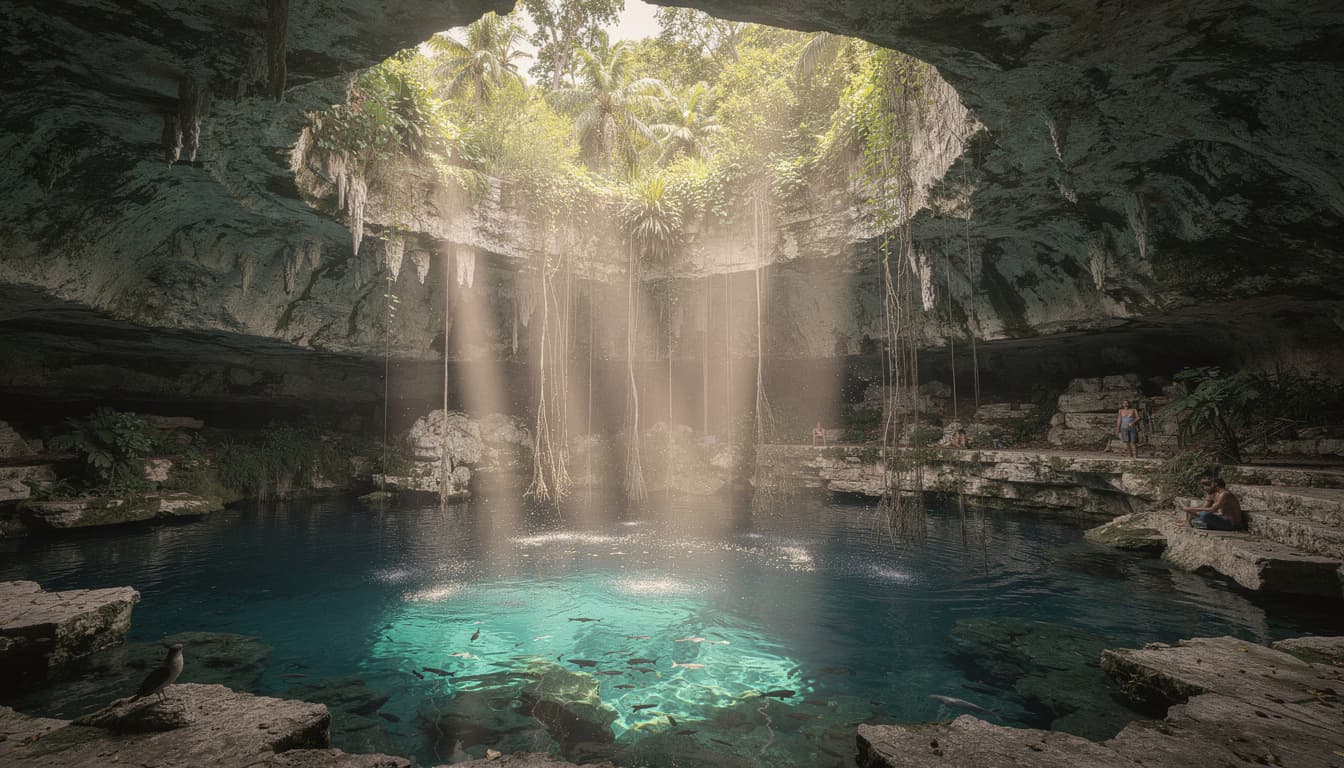
The name itself points to water: the city was established near two natural sinkholes, cenotes, which gave it its name, "at the mouth of the well of the Itzás"[1]. To place this site among the other stops in the country, check out our article "Mexico: The Must-Sees, Region by Region."
A Maya-Toltec city: history and culture
The history of Chichén Itzá spans nearly a thousand years, and different peoples left their mark on it[1]. Indigenous books written at the start of the Conquest say the city was founded by the Itzás, a Maya-Chontal people who came from the west[3].
The oldest part, Chichén Viejo, is believed to have been built between 415 and 455 CE; several buildings were added from the 5th to the 10th century, including El Caracol[4]. The site then reached the scale we admire today at the end of the Classic period[3].
The second settlement, the most important for historians, corresponds to the migration of Toltec warriors from the Mexican plateau southward in the 10th century[1]. This period left several buildings still standing: the Pyramid of Kukulkán (El Castillo), the Great Ball Court, the Tzompantli, and the Temple of the Warriors[4].
After the 13th century, no major monument seems to have been built, and the city declined rapidly from around 1440; the ruins were not excavated until 1841[1]. What remains is a vision of the world and the cosmos carved in stone[5]: a sophisticated calendar, advanced astronomy, and the worship of the feathered serpent Kukulcán, whose name is the Maya translation of Quetzalcoatl[4].
What to see: the essential monuments
El Castillo, a calendar in stone
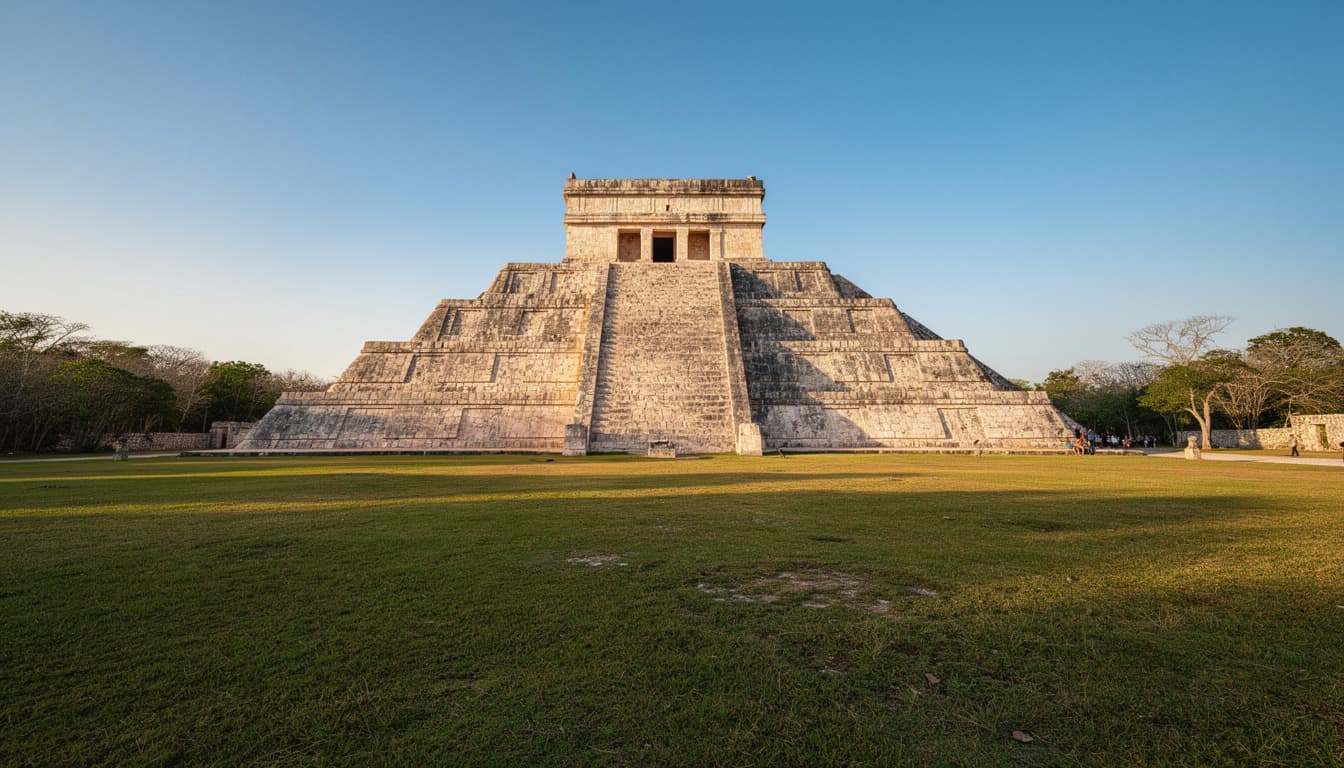
The Pyramid of Kukulcán dominates the esplanade. It is a Maya calendar formed in stone: each of its four staircases has 91 steps, and adding the platform at the top brings the total to 365, the number of days in the year[6]. Each face also carries 52 flat panels, a nod to the 52-year cycle of the Maya calendar[6]. The current temple, 30 m high, was built over an earlier temple predating the Toltecs[6].
The Great Ball Court
Northwest of the pyramid, the Gran Juego de Pelota is the largest and most impressive in Mexico[6]. Its tall parallel walls are lined with relief carvings, including scenes of players being beheaded[6]. Le Routard notes that, whether winners or losers, the debate over the identity of the beheaded continues[7].
The Temple of the Warriors and the colonnades
The Temple of the Warriors and the neighboring rows of columns form another group worth observing: take the time to distinguish the carved figures and the layout of the spaces, rather than walking through them with your eyes already on the next facade[8].
El Caracol, the observatory
The circular observatory of El Caracol is one of the most fascinating buildings on the site[6]. Its round plan contrasts with the square volumes of El Castillo[8]. In other groups, geometric decorations and representations of Chaac, the rain deity, invite you to look closely at the facades[8].
The Tzompantli and the Platform of the Eagles and Jaguars
The Tzompantli, or wall of skulls, bears more than 500 human skulls carved in stone[7]. Next to it, the Platform of the Eagles and Jaguars shows these animals gripping human hearts in their claws; it is believed to have been part of a temple dedicated to the military orders tasked with capturing sacrificial victims[6].
The Sacred Cenote
From the Platform of Venus, a 400 m sacbé (raw stone causeway) runs north to the Sacred Cenote, a natural water-filled sinkhole where victims were sacrificed to the gods[6]. The cenote was considered an entrance to the underworld[2].
The Buildings of Ancient Chichén
Other major structures on the site include the Church, the Akab-Dzib, the Casa Colorada, the Casa del Ciervo and the Nunnery Quadrangle, as well as the Temples of the Jaguars and of the Bearded Man[3].
What to Experience: Look Closely, Equinoxes and the Night Show
Walk all the way around El Castillo rather than stopping at the first photo: depending on the angle, the steps, the volumes and the temple at the top stand out differently[8]. For the ball court, a guide can help you read reliefs that are often less obvious than the pyramid's silhouette[8].
During the equinoxes, a play of light and shadow forms the silhouette of a serpent that seems to descend the pyramid's staircase[4]. INAH notes that visitors come every year in the days before and after the phenomenon; in 2026, it occurred on September 22 at 6:06 pm[9]. This period draws a particularly large crowd, but it is not a requirement for appreciating the monument[8].
In the evening, a sound and light show, “Noches de Kukulcán,” is projected onto the pyramid on certain nights, generally from Wednesday to Sunday[2]. The event is run by the government of the State of Yucatán[3].
The Gran Museo de Chichén Itzá, located in the municipality of Tinum, was inaugurated on February 28, 2024[10].
Around the Site: Cenotes, Valladolid, Uxmal
The subsoil of Yucatán is a relief turned upside down, where caves and cenotes number in the thousands[7]. For a day with several stops, starting from Valladolid or staying in Pisté shortens the morning drive[8].
Another great Maya city to include in the same itinerary, Uxmal is the jewel of the Routard itinerary, with its Pyramid of the Magician and its Nunnery Quadrangle[7]. It lies south of Mérida, about an hour and a half by car via federal highway 261[11].
Practical Info: Duration, Hours, Fees and Access
Plan for at least two to three hours to see the main areas[12]. Arrive at opening: you will enjoy the coolest temperatures and an almost empty esplanade, as most excursion buses arrive from late morning onward[12].
The site is listed as open every day from 8:00 am to 5:00 pm[12]. For foreign visitors, the single INAH-AAFY ticket costs 697 MXN, made up of 105 MXN for INAH and 592 MXN for the Yucatán State Tax Administration Agency[9]. Check hours and fees before you go, as they may change.
From Mérida, the site is 115 km to the east, in the State of Yucatán[3]. By car, take federal highway 180 toward Cancún as far as Pisté, where the turnoff to the site is located[11]; Pisté is 2 km from the center of the site[3]. The trip takes about two hours[11]. From Cancún, the site is about 200 km away[2], or roughly 2 to 2.5 hours via the 180D toll highway[12].
Watch the local time: Yucatán is one hour behind Cancún, in the neighboring state of Quintana Roo[8].
Pitfalls, Scams and Things to Watch Out For
- Buying your ticket: tickets issued by INAH can only be purchased at the ticket counters of the Visitor Reception Center (Catvi) at Chichén Itzá[9].
- Total price: the 105 MXN for INAH is only part of the ticket; foreign visitors pay 697 MXN in total, including the state's share[9].
- Free Sunday entry: it applies to Mexican nationals and to foreigners residing in Mexico upon presentation of an ID, not to passing tourists[12]. Sunday is also one of the busiest days[12].
- Equipment: professional photo or video gear, tripods, or drones require prior authorization from the INAH National Coordination of Legal Affairs[9].
- Climbing: climbing El Castillo is prohibited, and closed areas must remain off the route[8].
Before You Go: The Essentials
- Arrive at opening time, with enough to spend two to three hours on site[12].
- Buy your full ticket at the site's ticket counters[9].
- Choose a nearby base (Valladolid or Pisté) if you're combining several stops[8].
- If the evening show appeals to you, check its dates on the event's website[3].
This article gives you the essentials for a visit.
Keep exploring
- Mexico: The Must-Sees, Region by Region, to Help You Choose Where to Go
- Mérida and the Yucatán: What to See and Do in a Few Days
- Tulum: What to See and Do Between Mayan Ruins, Beaches and Cenotes
- Palenque: What to See and Do in the Maya City of Chiapas
Sources
- 1.^ abcdefwhc.unesco.org — Pre-Hispanic City of Chichen-Itza - UNESCO World Heritage Centre: “This sacred site was one of the largest Maya centers on the Yucatán Peninsula.”; “The fusion of Maya building techniques with new elements from central Mexico makes Chichén Itzá one of the most important examples of Maya-Toltec civilization in the Yucatán.”; “The city of Chichén Itzá was established during the Classic period near two natural cavities (cenotes), which gave it its name: At the mouth of the well of the Itzá.” https://whc.unesco.org/en/list/483/ (accessed November 10, 2026)
- 2.^ abcdefroutard.com — Visiter Chichén Itzá : préparez votre séjour et voyage Chichén Itzá | Routard.com: “Listed as a UNESCO World Heritage Site since 1988, the site was also named one of the New Wonders of the World in 2007.”; “An ancient Maya city on the Yucatán Peninsula, Chichén Itzá is one of Mexico's most important and most visited archaeological sites.”; “The site's architecture is a unique blend of styles, combining traditional Maya building techniques with Toltec influences from central Mexico.” https://www.routard.com/fr/guide/ameriques/mexique/yucatan/chichen-itza (accessed November 10, 2026)
- 3.^ abcdefgsic.cultura.gob.mx — Chichén ltzá: Zonas arqueológicas México: Sistema de Información Cultural-Secretaría de Cultura: “Indigenous books written at the beginning of the Conquest recount that Chichén Itzá was founded by the Itzás, a Maya-Chontal people who came from the west.”; “The area was occupied for a long time, beginning before the Common Era, but it was at the end of the Classic period that the site reached the proportions and urban characteristics we admire today.”; “Among the main structures: the Church, the Akab-Dzib, the Casa Colorada, the Casa del Ciervo and the Nunnery Quadrangle, the Ball Court, El Caracol, and the Temples of the Jaguars and of the Bearded Man.” https://sic.cultura.gob.mx/ficha.php?table=zona_arqueologica&table_id=119 (accessed November 10, 2026)
Show 9 more sourcesShow less
- 4.^ abcdblogs.loc.gov — Chichén Itzá – Pic of the Week | In Custodia Legis: “The oldest part of the city, Chichén Viejo, was built between 415 and 455 CE. From the 5th to the 10th century, several buildings were added; one that survives from this period is El Caracol, believed to be a proto-observatory.”; “Several standing buildings were constructed during the Toltec influx, including the stepped pyramid of Kukulkán, or El Castillo, the Great Ball Court (the largest Mesoamerican ballcourt of its kind), the Tzompantli or wall of skulls, and the Temple of the Warriors.”; “The king of Tula, Ce Acatl Topiltzin Quetzalcoatl, or, as the Maya translated it, Kukulkan (or Kukulcan), is said to have taken the city between 967 and 987 CE.” https://blogs.loc.gov/law/2023/09/chichn-itz-pic-of-the-week/ (accessed November 10, 2026)
- 5.^whc.unesco.org — UNESCO World Heritage Centre - Document - Pre-Hispanic City of Chichen-Itza (UNESCO/NHK): “The Maya and Toltec worldview and understanding of the universe are revealed in their stone monuments and works of art.” https://whc.unesco.org/en/documents/103974 (accessed November 10, 2026)
- 6.^ abcdefghlonelyplanet.com — Chichén Itzá | Mexico | Attractions - Lonely Planet: “Each of El Castillo's nine levels is split in two by a staircase, creating 18 terraces that recall the 18 months of 20 days in the Maya vague year. The four staircases have 91 steps each; with the platform at the top, the total is 365, the number of days in the year.”; “Each face of the pyramid has 52 flat panels, recalling the 52 years of the Maya calendar cycle.”; “The first temple predates the Toltecs, built around 800 CE; the current structure, 30 m high and built over the earlier one, bears the feathered serpent carved along the staircases and the Toltec warriors depicted on the sculptures of the doorway at the top of the temple.” https://www.lonelyplanet.com/points-of-interest/chichen-itza/501660 (accessed November 10, 2026)
- 7.^ abcdroutard.com — Le Yucatán au Mexique : nos 10 coups de cœur: “Opposite, there's also the largest ball court in the Maya world, with scenes showing decapitated players — winners or losers, the debate continues.”; “Nearby, or almost, the sinister Tzompantli adds another layer, with more than 500 human skulls carved in stone, as if stacked.”; “In this reversed relief, the caves number in the thousands, just like the cenotes.” https://www.routard.com/fr/mag/reportage/a/yucatan-au-mexique-nos-10-coups-de-coeur (accessed November 10, 2026)
- 8.^ abcdefghijpartir.ouest-france.fr — Chichén Itzá à Chichen-Itza : Visites et informations pratiques (horaires, prix, réservations) : “The Temple of the Warriors and the neighboring rows of columns form another ensemble worth observing. Take the time to make out the carved figures and the layout of the spaces, rather than walking through them on your way to the next façade.” ; “Further on, El Caracol has a circular plan and a very different silhouette. This building is associated with astronomical observation. The contrast with the square volumes of El Castillo makes this part of the route interesting even without going into the details of the alignments.” ; “In some complexes, the geometric decorations and the depictions of Chaac, the rain god, invite you to look closely at the façades.” https://partir.ouest-france.fr/mexique/villes/chichen-itza/activites/chichen-itza (accessed November 10, 2026)
- 9.^ abcdefinah.gob.mx — La Zona Arqueológica de Chichén Itzá implementará el operativo equinoccio de otoño 2026 : “Each year, visitors come to the pre-Hispanic city to witness the phenomenon of light and shadow that casts the silhouette of a serpent onto the balustrade of El Castillo’s north face, also known as the Temple of Kukulcán, in the days leading up to and following the event, which will take place on September 22 at 6:06 pm.” ; “The cost for foreign visitors under the INAH-AAFY single ticket is 697 Mexican pesos (105 pesos for INAH, plus 592 pesos for the Yucatán Tax Administration Agency).” ; “The public is reminded that INAH entrance tickets can only be purchased at the ticket windows of the Chichén Itzá Visitor Reception Center (Catvi).” https://www.inah.gob.mx//boletines/la-zona-arqueologica-de-chichen-itza-implementara-el-operativo-equinoccio-de-otono-2026 (accessed November 10, 2026)
- 10.^en.wikipedia.org — Chichen Itza - Wikipedia : “The Great Museum of Chichén Itzá is an archaeological space inaugurated on February 28, 2024, located in the municipality of Tinum, Yucatán.” https://en.wikipedia.org/wiki/Chichen_Itza (accessed November 10, 2026)
- 11.^ abcyucatan.com.mx — Antiguas urbes mayas, destinos para pasar el día en Yucatán: horarios, precios y cómo llegar - Diario de Yucatán : “Another option: Uxmal, south of Mérida, about an hour and a half by car. To get there, take federal highway 261 toward Santa Elena.” ; “To drive there, take federal highway 180 toward Cancún until Pisté, where the turnoff to the archaeological zone is. The trip takes about two hours.” https://www.yucatan.com.mx/merida/2026/11/07/antiguas-urbes-mayas-destinos-para-pasar-el-dia-en-yucatan-horarios-precios-y-como-llegar.html (accessed November 10, 2026)
- 12.^ abcdefgcancuniairport.com — Chichén Itzá depuis Cancún : billets 2026, horaires et conseils : “Plan on at least two to three hours to see the main areas.” ; “Arrive at opening to enjoy the coolest temperatures and an almost empty site—most tour buses arrive from late morning onward.” ; “Chichén Itzá is open every day from 8:00 am to 5:00 pm.” https://www.cancuniairport.com/fr/chichen-itza-guide-de-visite/ (accessed November 10, 2026)