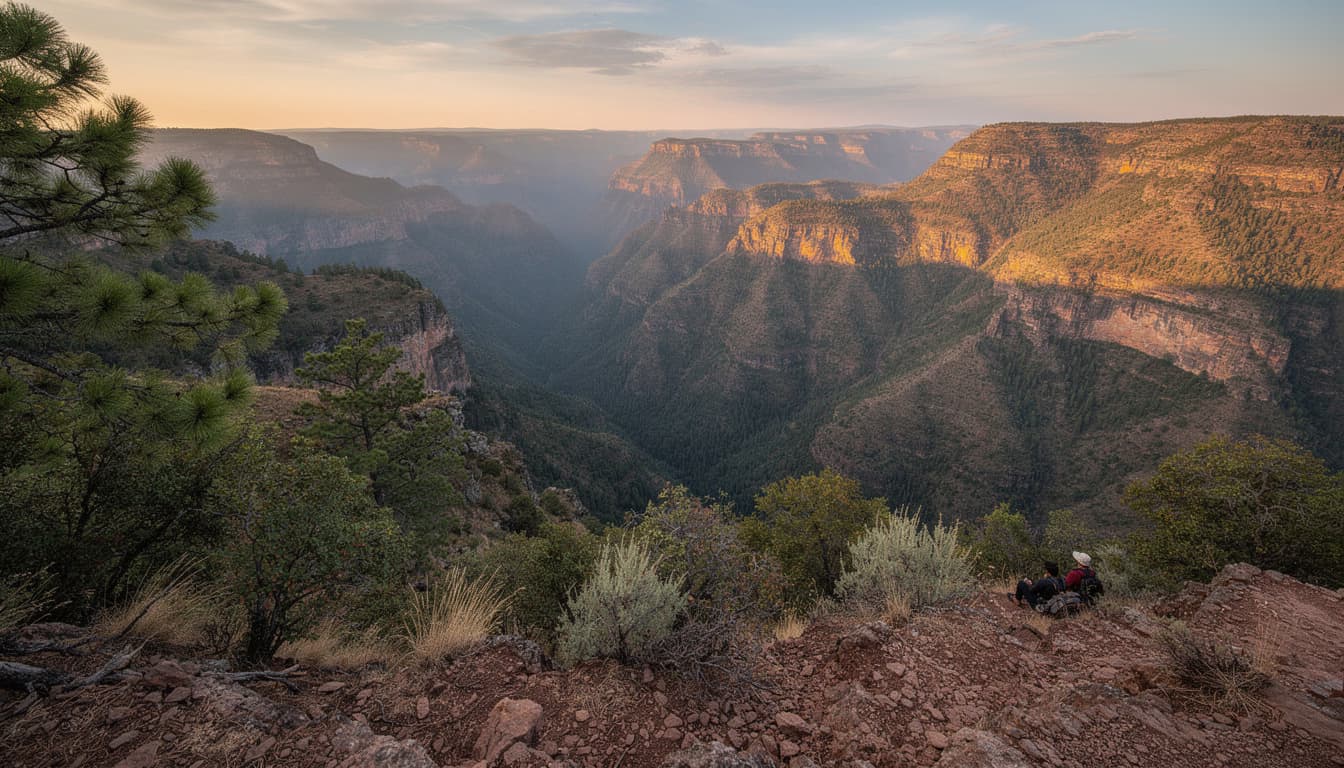
Palenque is a Maya city set in the jungle of Chiapas, surrounded by waterfalls and forest. This article helps you choose what to see at the site, combine ruins and excursions, decide how many nights to plan for, understand how to get there, and know what precautions to take on the road.
Palenque, a Maya City in the Jungle
Palenque is an outstanding example of a Maya sanctuary from the Classic period: the city reached its peak between the 6th and 8th centuries and extended its influence across the whole Usumacinta basin[1]. The site has been a UNESCO World Heritage Site since 1987[1].
What strikes you first is the elegance of the buildings and the lightness of the sculpted reliefs, which illustrate Maya mythology[1]. The setting is part of the charm: Palenque lies within a jungle national park, with waterfalls, streams, howler monkeys whose calls carry through the trees, and vegetation that swallows whatever is not restored[2].
What you walk through is only a small part of the city: less than 10% has been uncovered[3]. The mounds you pass along the path are not hills; they are buildings[3].
What to See at the Archaeological Site
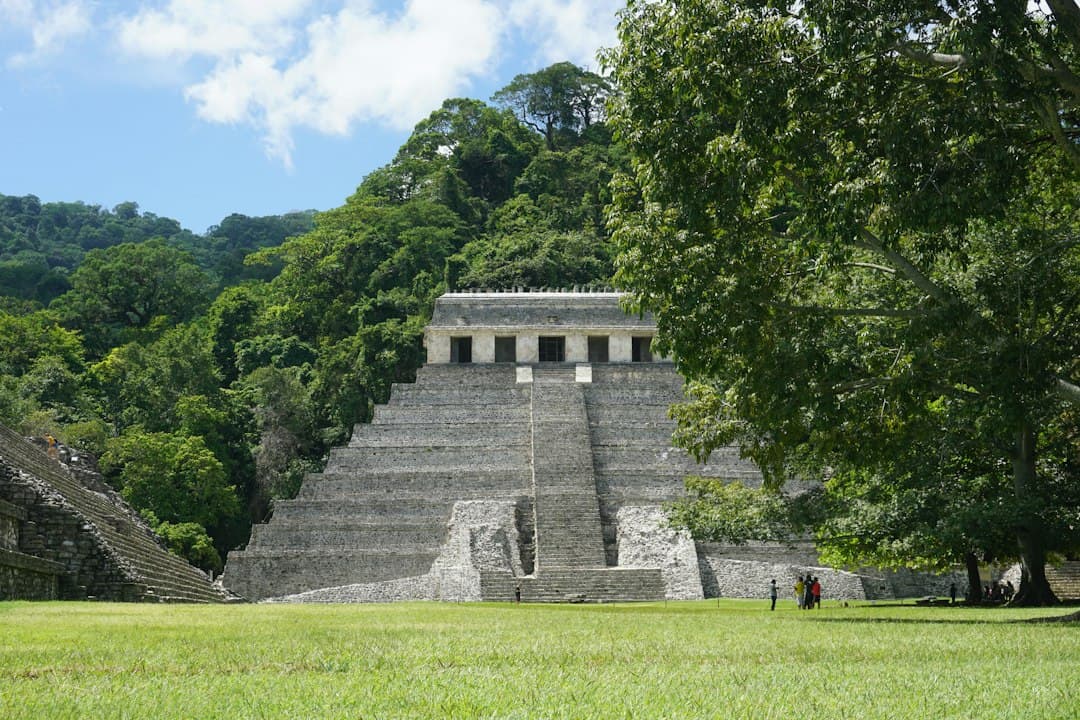
The most famous monument is the Temple of the Inscriptions, the funerary pyramid of the great king Pakal, inside which one of the most important royal tombs in the Americas was found[2]. Facing it stands the Palace, a maze of courtyards and galleries dominated by a multi-story tower, possibly an observatory[2].
The Group of the Cross brings together the Temple of the Cross, the Temple of the Foliated Cross, and the Temple of the Sun. It was commissioned by K'inich Kan B'alam II, Pakal's son, to reinforce the legitimacy of his reign through art and writing[2]. The Temple of the Sun has the best-preserved roof comb on the site[3].
Pakal and the History of Palenque
In June 1952, archaeologist Alberto Ruz Lhuillier opened the burial chamber of the Temple of the Inscriptions and found the intact tomb of K'inich Janaab' Pakal, who died in 683 after a 68-year reign[4]. The king wore a funerary mask made of jade mosaic[4]. The sarcophagus lid shows him at the moment of his death, falling along the World Tree[4].
Today, the sarcophagus and the remains are still inside the pyramid, and the burial chamber is closed to visitors[4]. The jade mask is held at the National Museum of Anthropology in Mexico City[4]. A life-size replica of the sarcophagus can be seen at the site museum[3].
Pakal's work was continued by his sons[2]. The city was frequently at war with rival cities such as Calakmul and Toniná, whose warriors sacked it at the beginning of the 8th century[5].
The Site Museum and the Waterfall Trail
The Alberto Ruz Lhuillier Museum is located below the site, at the end of the waterfall trail, and is included in your ticket[3]. Half an hour is enough, but it changes the visit: you can see pieces too fragile to stay outdoors, carved tablets, effigy incense burners, objects from the Red Queen, and the replica of Pakal's sarcophagus[3]. If your day is tight, go after the ruins: you understand what you're looking at better once you've walked through it[3].
Jungle, Waterfalls and Nearby Sites
The classic pairing is the Agua Azul and Misol-Ha waterfalls, visited on a day trip along the road to San Cristóbal or on the way back[2]. Misol-Ha is a rather vertical fall behind which you can walk[6]. Agua Azul is more horizontal, with many stepped pools and good spots for swimming, especially toward the upper section[6]; check locally before swimming, as currents can be dangerous depending on the season and water level.
Palenque is also a base for the Maya sites of the jungle: Yaxchilán, reached by boat on the Usumacinta, and Bonampak, famous for its murals, in the heart of the Lacandon forest[2]. The Bonampak murals are described as the most elaborate and best-preserved wall paintings in the Maya world[6]. The Bonampak and Lacandon forest excursion leaves very early, around 5 am, and includes a forest hike led by a Lacandon guide[6]. There is no public transport in this direction: the organized excursion is the best option[6].
How Long to Plan For and When to Come
Allow three hours at the archaeological zone if you push on to the South Acropolis and come back down by the waterfall trail, plus half an hour at the museum[3]. Between the site, Agua Azul, Misol-Ha and possibly Yaxchilán, Palenque justifies two nights on site[3]. Coming for the day from San Cristóbal means spending around ten hours on a bus for two hours of ruins[3].
The dry season, from November to April, is the best period: the weather is more predictable[7]. The climate is humid tropical, with temperatures of 18 to 35 °C and heavy rain, especially in September[8].
How to get there
The archaeological site is about 8 km from the town of Palenque, 15 to 20 minutes by colectivo, taxi or excursion[2].
- From Villahermosa: 2 to 2.5 hours by road[2]. It is the fastest gateway, with its international airport[3].
- From San Cristóbal de las Casas: 5 to 6 hours through the mountains[2]. The road is 191 km, winds through the mountains and passes through Ocosingo; maps that promise three hours are wrong[3]. Many travelers take it as a combined excursion with Agua Azul[2].
- By Tren Maya: the Palenque station is the western terminus of the Tren Maya, in service since late 2023, linking Campeche and Mérida[3]. Frequencies remain limited, so check them before planning around them[3].
Where to stay, where to eat, and what to prepare
El Panchán, just outside the site, is a lively area known for its restaurants, bars and accommodations, popular with travelers unwinding after the ruins[7]. You'll find cabins, small bungalows and dormitories with hammocks, relatively close to the ruins[5]. The town of Palenque, however, lacks the charm of San Cristóbal: it mainly serves as a base for excursions[6].
The site is in humid tropical forest: bring insect repellent and sturdy shoes, as the trails can be muddy and shaded by dense vegetation[8]. Wear comfortable clothing suited to jungle terrain and climbing the ancient structures[7]. You can also hire a local guide at the entrance to the site to better understand the history and meaning of the ruins[7].
Pitfalls, scams and things to watch out for
The Palenque site is open to visitors, but the road between San Cristóbal and Palenque requires particular caution: French authorities report blockades on Federal Highway 199 in Chiapas[9]. In Chiapas, local communities organize blockades to demand a right of passage on Federal Highway 199 linking San Cristóbal to Palenque[9]. They are frequent and can halt the route for several hours[3]; that is why it is best to find out before you leave and check before you go[9].
- French authorities recommend, for getting to the Palenque site, transport accompanied by tourism professionals rather than traveling independently[9].
- Drive by day and stay on the tourist circuit[3].
- Tourist minibuses run directly between Palenque and San Cristóbal, but this depends on the security situation: check locally before you leave[6].
- ADO buses detour through Villahermosa to avoid these blockades: the trip takes nearly 9 hours instead of 5[6].
Key takeaways for your stop
- Plan two nights to combine ruins, waterfalls and a more distant excursion.
- Visit the ruins first, then the museum, and if possible between November and April.
- Choose an organized excursion for Agua Azul, Misol-Ha and Bonampak.
- Check Tren Maya schedules before planning around them.
- Bring walking shoes, light clothing and repellent.
Keep exploring
- Mexico: The Must-Sees, Region by Region, to Help You Choose Where to Go
- San Cristóbal de las Casas: What to See and Do in the City and Beyond
- Mérida and the Yucatán: What to See and Do in a Few Days
- Puerto Escondido: What to See and Do on the Oaxaca Coast
Sources
- 1.^ abcwhc.unesco.org — Pre-Hispanic City and National Park of Palenque - UNESCO World Heritage Centre : “A prominent example of a Classic Maya sanctuary, Palenque reached its peak between the 6th and 8th centuries and extended its influence across the entire Usumacinta basin.” ; “In 1987, UNESCO recognized the archaeological site as a World Heritage Site.” ; “The elegance and technique of the constructions, like the lightness of the sculpted reliefs with Maya mythological themes, bear witness to the creative genius of this civilization.” https://whc.unesco.org/en/list/411/ (accessed November 12, 2026)
- 2.^ abcdefghijkviajacongus.com — Things to Do in Palenque (Archaeological Site) : “The setting is part of the charm: Palenque sits inside a jungle national park, with waterfalls, streams, howler monkeys whose calls carry through the trees, and vegetation that swallows everything that hasn't been restored.” ; “Its most famous monument is the Temple of the Inscriptions, the funerary pyramid of the great king Pakal, inside which one of the most important royal tombs in the Americas was found, along with the famous slab depicting the ruler at the moment of his death.” ; “Facing it stands the Palace, a maze of courtyards and galleries with an unusual multi-story tower, possibly an observatory.” https://viajacongus.com/en/mexico/palenque/ (accessed November 12, 2026)
- 3.^ abcdefghijklmnopcapmexique.fr — Palenque : la cité maya du Chiapas et la tombe de Pakal : “The number that puts the visit in perspective: less than 10% of the city has been excavated.” ; “The mounds you walk past on the trail are not hills: they are buildings.” ; “The Temple of the Sun has kept the best-preserved roof comb on the site.” https://capmexique.fr/voyage/palenque (accessed November 12, 2026)
Show 6 more sourcesShow less
- 4.^ abcdeculturalheritageonline.com — UNESCO Heritage Sites Near Palenque, Mexico : “When Alberto Ruz Lhuillier opened the burial chamber of the Temple of the Inscriptions in June 1952, he found the tomb of K'inich Janaab' Pakal (Pakal the Great) intact; he had died in 683 after a 68-year reign.” ; “The king's remains wore a funerary mask made of jade mosaic and were surrounded by jade jewelry, red cinnabar, and the remains of six servants sacrificed to accompany him.” ; “The sarcophagus lid, a carved limestone panel 3.8 meters long, shows Pakal at the moment of his death: his body falls backward along the World Tree, the central axis of Maya cosmology.” https://culturalheritageonline.com/magazine/unesco-world-heritage-sites-near-palenque/ (accessed November 12, 2026)
- 5.^ aben.wikivoyage.org — Palenque – Travel guide at Wikivoyage : “As was common at the time, Palenque was often at war with rival cities, such as Calakmul and Toniná (whose warriors sacked the city in the early 8th century).” ; “It is relatively close to the ruins and offers huts, small bungalows, and shared sleeping spaces with hammocks.” https://en.wikivoyage.org/wiki/Palenque (accessed November 12, 2026)
- 6.^ abcdefghindietraveller.co — The Not-Your-Usual Guide To Palenque, Mexico : “Misol-Ha is much more vertical and you can walk behind it, it's incredible!” ; “Agua Azul is a much more horizontal waterfall, with many stepped cascades and good spots for swimming (especially toward the top… keep climbing if you don't find a good spot).” ; “Known as the most elaborate and best-preserved murals in the Maya world, these frescoes offer a view of the past that you won't find at any other site.” https://www.indietraveller.co/palenque-travel-guide/ (accessed November 12, 2026)
- 7.^ abcdwtp.travel — Guide de voyage Palenque - Mexique | World Travel Package : “Best time to visit: the dry season (November to April) is the best time to visit Palenque, when the weather is more predictable and the ruins are less likely to be hidden by vegetation.” ; “El Panchán: a lively area just outside the archaeological site, known for its restaurants, bars, and accommodation, making it a favorite with travelers to relax and socialize after exploring the ruins.” ; “Comfortable clothing: wear comfortable clothes and sturdy walking shoes, suited to exploring jungle terrain and climbing ancient structures.” https://wtp.travel/fr/guides-voyage/mexique/palenque/ (accessed November 12, 2026)
- 8.^ abtraveldojo.com — Palenque, Mexico: Visitor Guide | TravelDojo : “Temperatures range from 18 °C to 35 °C. Heavy rainfall (2,896 mm per year), wettest month: September.” ; “Practical info: the site is in a humid tropical forest; bring insect repellent and sturdy shoes, as the trails can be muddy and shaded by dense vegetation.” https://www.traveldojo.com/palenque/ (accessed November 12, 2026)
- 9.^ abcddiplomatie.gouv.fr — Mexique - Sécurité | France Diplomatie : “In the state of Chiapas, road blockades by local communities demanding payment of a toll have been observed on Federal Highway 199 connecting San Cristóbal de Las Casas to Palenque.” ; “To get to the Palenque tourist site, transport accompanied by tourism professionals should be preferred over traveling on your own.” https://www.diplomatie.gouv.fr/fr/information-par-pays/mexique/conseils-aux-voyageurs-securite (accessed November 12, 2026)