Casablanca is nothing like a postcard Morocco. It is a 20th-century Atlantic metropolis, shaped by Art Deco, port life and ocean air. This article helps you plan two days on the ground: the Hassan II Mosque, the medina, the Art Deco center, the Habous and the corniche. You will also learn when to visit, how to get downtown from the airport and which traps to avoid.
Casablanca, a 20th-century city: what you come here for
Casablanca is presented as Morocco's economic engine, a buzzing metropolis that mixes modern infrastructure and charming neighborhoods, between Arab-Muslim heritage and the legacy of the colonial period[1]. People come for a 20th-century Morocco of Art Deco, port life, rap, football and migration from the countryside[2].
If you are looking for a medieval labyrinth, you will be disappointed: Casablanca's medina is one of the most recent in Morocco[1]. It dates from the late 18th century, it is small, and its streets are straight[2].
The center, for its part, was laid out after the protectorate was established in 1912: General Lyautey commissioned the urban planner Henri Prost to design a new European city outside the medina walls, as well as a new Moroccan quarter, the Habous. Hence the grid of boulevards and white buildings that looks more like Marseille than Marrakech[3].
Plan two days for the essentials[1]. A third day lets you add the Habous quarter and the museums[2].
Hassan II Mosque, a monument on the ocean
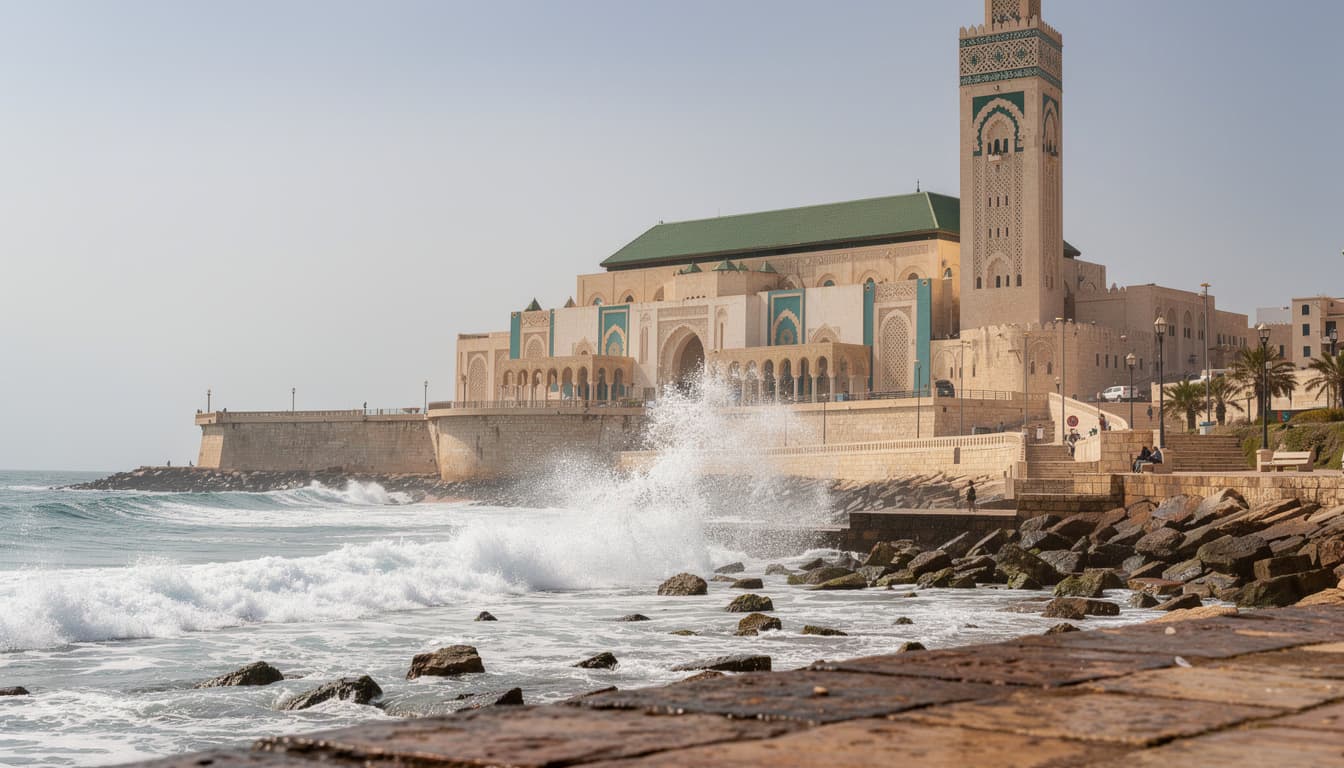
Begun in 1980 and opened in 1993, the Hassan II Mosque stands at the edge of the Atlantic. Its 210-meter minaret is presented as the tallest in the world, and its vast prayer hall has a retractable roof that can open to the sky[4].
It is the only mosque in Morocco whose interior is open to non-Muslim visitors[5]. A typical itinerary schedules the guided tour for 9 am[2]. The site remains an active place of worship, so modest dress is strongly recommended[6].
Unofficial guides approach visitors at the mosque entrance offering a “shortcut” or a “ticket.” Tickets are only sold at the foundation's ticket office[2].
The old medina and the Habous quarter
You wander Casablanca's medina for its atmosphere more than its monuments: it is small and has no labyrinth[2]. The terraces of the old medina are one of the places where conversations spill out onto the street[7].
The Habous, often called the “new medina,” is a quarter Prost designed as a new Moroccan town. It keeps the atmosphere of the 1930s, with arcaded lanes near the Royal Palace where brass, books and carpets are sold[3]. According to Lonely Planet, it is in many ways the quarter that feels most Moroccan in the city[4]. Many visitors here feel they are discovering rather than ticking off a list[5].
For a break, buy gazelle horns or a pastilla at the Bennis pastry shop on Rue Fkih El Gabbas, then have tea at the tables of Café Imperial on the street[3]. The Mahkama du Pacha, a former court with more than 60 rooms of carved wood and stucco, is best visited with a guide[3], who can guarantee entry[5].
The Art Deco and neo-Moorish center
Between Place Mohammed V, Boulevard Mohammed V and the Central Market, the French built in the 1920s and 1930s a city of Art Deco and neo-Moorish buildings, often with carved balconies and Moroccan tilework. The central post office of 1918 overlooks the square[3]. Henri Prost deliberately blended French styles with Moroccan touches in the new city[6].
Walk Boulevard Mohammed V and look up at the facades, then finish at Place Mohammed V, when the five neo-Moorish buildings light up and the fountain plays to music[2].
Casamémoire, the association that champions 20th-century heritage, organizes the Journées du Patrimoine: free guided tours of buildings that are normally closed, as well as evening Nocturnes du Patrimoine. Check its website for upcoming dates before planning your stay[3].
Central Market, museums and culture
At the Central Market, the day's catch arrives early in the morning and is served grilled in small restaurants at lunchtime[4]. A typical itinerary schedules a fish lunch there on the first day[2].
Among the museums, the Museum of Moroccan Judaism traces the history of Jews in Morocco; it is the only Jewish museum in the Arab world[5]. Casablanca also keeps Christian places of worship inherited from the protectorate, such as the Church of Notre-Dame de Lourdes, still active and known for its stained glass, on Avenue Zerktouni[4].
The city also has a festive side, with its clubs and festivals: the Casablanca Festival, Jazzablanca and the Tremplin L'Boulevard[1].
The Ain Diab corniche and the seafront
The corniche is a long coastal promenade lined with beaches, cafés and fish restaurants, ideal at sunset[8]. Ain Diab is the busiest sandy beach in the city[5]. The shoreline has developed beaches, with diving, jet-ski and boating available on site[1].
Ain Diab beach begins 5 km west of the center, at the terminus of tram line T2[2].
Two days, season and day trips
One possible split: on day one, a guided visit of the Hassan II Mosque at 9:00 am, then the Sqala and the medina, lunch at the Central Market, and Boulevard Mohammed V and Place Mohammed V at the end of the day. On day two, the sea and the Ain Diab corniche; the Habous is reserved for the option below or for a third day[2]. Another option: the mosque in the morning, the Habous in the afternoon, as another guide suggests[3]. If you stay a third day, you can also devote a full day to the Habous and the museums[2].
The best period runs from April to June and from September to October, with mild weather. Winter can be rainy[1].
During Ramadan, whose dates change each year, many restaurants and cafés close during the day and the city comes alive after sunset[8].
From Casablanca, three day trips are possible: Rabat (about 1 hour), El Jadida (about 1 hour 15 minutes) and Mohammedia (about 30 minutes)[1].
Arriving and getting around
Mohammed V Airport is in Nouasseur, about 25 km from the center[9]. The most efficient way to reach the center is the ONCF train, roughly one departure per hour, which serves Casa-Voyageurs and Casa-Port stations directly[10].
In the city, the small red taxis carry up to three passengers and pick up other customers along the way[3]. Uber returned in November 2025 with UberX and UberXL in Casablanca, Rabat and Marrakech, operating through licensed transport operators, as ride-hailing is still not formally legal in Morocco[3]. Tram T2 runs to the corniche[2].
Pitfalls, scams and things to watch for
- Fake guides at the mosque and in the medina: answer “la, shukran” without stopping, and buy the mosque ticket only at the foundation's ticket office[2].
- Taxis: common scams include a meter supposedly broken, an inflated quoted fare, or an unnecessarily long route. Prefer taxis with a meter in large cities like Casablanca, and insist that it be switched on[11].
- Bag snatching: in Casablanca, thieves on motorbikes ride along the sidewalks to steal bags and phones[12]. Carry your bag in front of you, keep your phone in a front pocket, and don't walk with your phone in hand near the curb[2].
- At night: avoid deserted places, especially beaches and public parks, and don't carry valuables in city centers[12]. Some streets empty out at night: according to one guide, it's best to avoid walking alone in the evening[3].
Steps, in order
- Choose your season: April to June or September to October for mild weather[1].
- On arrival, take the airport train to Casa-Voyageurs or Casa-Port[10].
- Day 1: Hassan II Mosque at 9:00 am, medina, lunch at the Central Market, Boulevard and Place Mohammed V[2].
- Day 2: Habous and a pastry break, then the Ain Diab corniche by tram T2[3][2].
- If you have time: Rabat, El Jadida or Mohammedia[1].
- To explore the country further, see our article “Morocco: the highlights, region by region.”
This article covers the essentials for two days. Entry procedures for Morocco, a line-by-line budget, and choosing the neighborhood to stay in require going further if you want to settle in for real.
To go further
- Morocco: the highlights, region by region
- Rabat: what to see and do in Morocco's imperial capital
- Agadir and Taghazout: what to see and do on Morocco's Atlantic coast
- Tangier: what to see and do between medina, kasbah and Atlantic coast
Sources
- 1.^ abcdefghivisitmorocco.com — Casablanca: What to See and When to Go? | Visit Morocco: “Modern infrastructure blends with charming neighborhoods, between Arab-Muslim heritage and the legacy of the colonial period.”; “Casablanca is Morocco's economic powerhouse, a buzzing metropolis always on the move.”; “Stroll through the medina, one of the latest in Morocco, cross the center with its Art Deco buildings, and head to the Hassan II Mosque, an architectural marvel built over the water.” https://www.visitmorocco.com/fr/voyage/casablanca (accessed November 9, 2026)
- 2.^ abcdefghijklmnopnilopelomundo.com — Casablanca: Map, What to Do and When to Go: “Come for the 20th-century Morocco, made of Art Deco, port life, rap, football, and migration from the countryside.”; “If you're looking for a medieval labyrinth, you'll be disappointed: the medina here dates from the late 18th century, it's small, and its streets are straight. And the sea is underwhelming at first glance, because it's hidden behind the port.”; “Plan two days in Casablanca: one for the mosque, the medina, and Art Deco, the other for the corniche and Anfa, and add a third for the Habous quarter and the museums.” https://nilopelomundo.com/en/place/casablanca/ (accessed November 9, 2026)
- 3.^ abcdefghijkbootsnall.com — Casablanca Travel Guide | BootsnAll: “After the 1912 protectorate, General Lyautey had urban planner Henri Prost lay out a new European city outside the medina walls, and a new Moroccan quarter, the Habous. The grid of boulevards and white buildings you walk through today is the result, and that's why central Casablanca looks more like Marseille than Marrakech.”; “Between Mohammed V Square, Mohammed V Boulevard, and the Central Market, the French built, in the 1920s and 1930s, a city of Art Deco and neo-Moorish buildings, often adorned with carved balconies and Moroccan tiles. The central post office, dating from 1918, overlooks the square.” https://www.bootsnall.com/morocco/casablanca (accessed November 9, 2026)
Show 9 more sourcesShow less
- 4.^ abcdworldtravelguide.net: “The richly ornate minaret is the tallest in the world, at 210 m (656 ft), while two laser beams reach 30 km toward Mecca.”; “The vast prayer hall even has a sliding roof that can open to the sky.”; “Begun in 1980 and opened in 1993, it is the work inspired by French architect Michel Pinseau and some 35,000 Moroccan craftsmen.” https://www.worldtravelguide.net/guides/africa/morocco/casablanca/things-to-see/ (accessed November 9, 2026)
- 5.^ abcdelonelyplanet.com — A First-Time Guide to Casablanca - Lonely Planet: “The magnificent Hassan II Mosque is the only mosque in Morocco whose interior non-Muslims can visit, and exploring the Habous quarter feels more like discovery than ticking off must-sees in a very touristy city.”; “The Pasha's Mahakama is best visited with a guide, who can secure entry and bring its Islamic architectural details to life.”; “The fascinating Museum of Moroccan Judaism traces the history of Jews in Morocco; it is the only Jewish museum in the Arab world.” https://www.lonelyplanet.com/articles/guide-to-casablanca (accessed November 9, 2026)
- 6.^ ablatimes.com — Casablanca, Morocco Travel Guide & Local Tips - Los Angeles Times: “Because it is an active place of worship, visitors are strongly encouraged to dress modestly at religious sites like this, out of respect and to avoid disapproving looks.”; “The renowned urban planner Henri Prost fully designed the New City's layout, deliberately blending French styles with traditional Moroccan touches.” https://www.latimes.com/eta/story/2024-10-29/casablanca-tradition-meets-modernity (accessed November 9, 2026)
- 7.^guide.en-vols.com — Visiting Casablanca: Guide, Practical Info, Useful Addresses: “On this canvas, life lays down its colors: those of the little red taxis, the flower stalls of the central market, and the conversations spilling out from the terraces of the old medina.” https://guide.en-vols.com/destination/casablanca/ (accessed November 9, 2026)
- 8.^ abrwandair.com — Casablanca Travel Guide: Things to Do & Best Time to Visit | RwandAir: “During Ramadan, whose dates shift every year, many restaurants and cafés close during the day, and the city comes alive after sunset.”; “The corniche and Aïn Diab: the long oceanfront promenade lined with beaches, cafés, and seafood restaurants, ideal at sunset.” https://www.rwandair.com/destinations/casablanca (accessed November 9, 2026)
- 9.^airporttransportation.com — Casablanca Airport (CMN): Terminals, Train and Taxis: “Mohammed V International Airport is located about 25 km from central Casablanca, in Nouasseur.” https://airporttransportation.com/es/aeropuertos/cmn (accessed November 9, 2026)
- 10.^ aball.accor.com — Visiting Casablanca: Travel Guide | Limitless: “The most efficient way to reach central Casablanca from Mohammed V International Airport is the airport ONCF train, which runs about once an hour and connects the airport directly to the Casa-Voyageurs and Casa-Port stations.” https://all.accor.com/a/en/limitless/travel-guide/casablanca.html (accessed November 9, 2026)
- 11.^assurance-voyage.axa-assistance.fr — 12 Tourist Scams and Traps to Avoid in Morocco: “Common scams include the taxi meter supposedly being broken, being quoted an inflated fare, or being taken on an unnecessarily long route.”; “Prefer taxis with a meter (especially in big cities like Marrakech or Casablanca) and insist that it be switched on.” https://www.assurance-voyage.axa-assistance.fr/blog/arnaques-pieges-maroc (accessed November 9, 2026)
- 12.^ abdiplomatie.gouv.fr — Morocco - Safety | France Diplomatie: “Increased vigilance is required in large urban areas such as Casablanca or Marrakech, where thieves on motorcycles ride along sidewalks to snatch handbags and mobile phones.”; “It is inadvisable to walk around, especially at night, in places deserted by the public (notably beaches and public parks), or to carry valuable items in the evening in city centers or outlying neighborhoods of urban areas, in order to limit the risk of theft.” https://www.diplomatie.gouv.fr/fr/information-par-pays/maroc/conseils-aux-voyageurs-securite (accessed November 9, 2026)