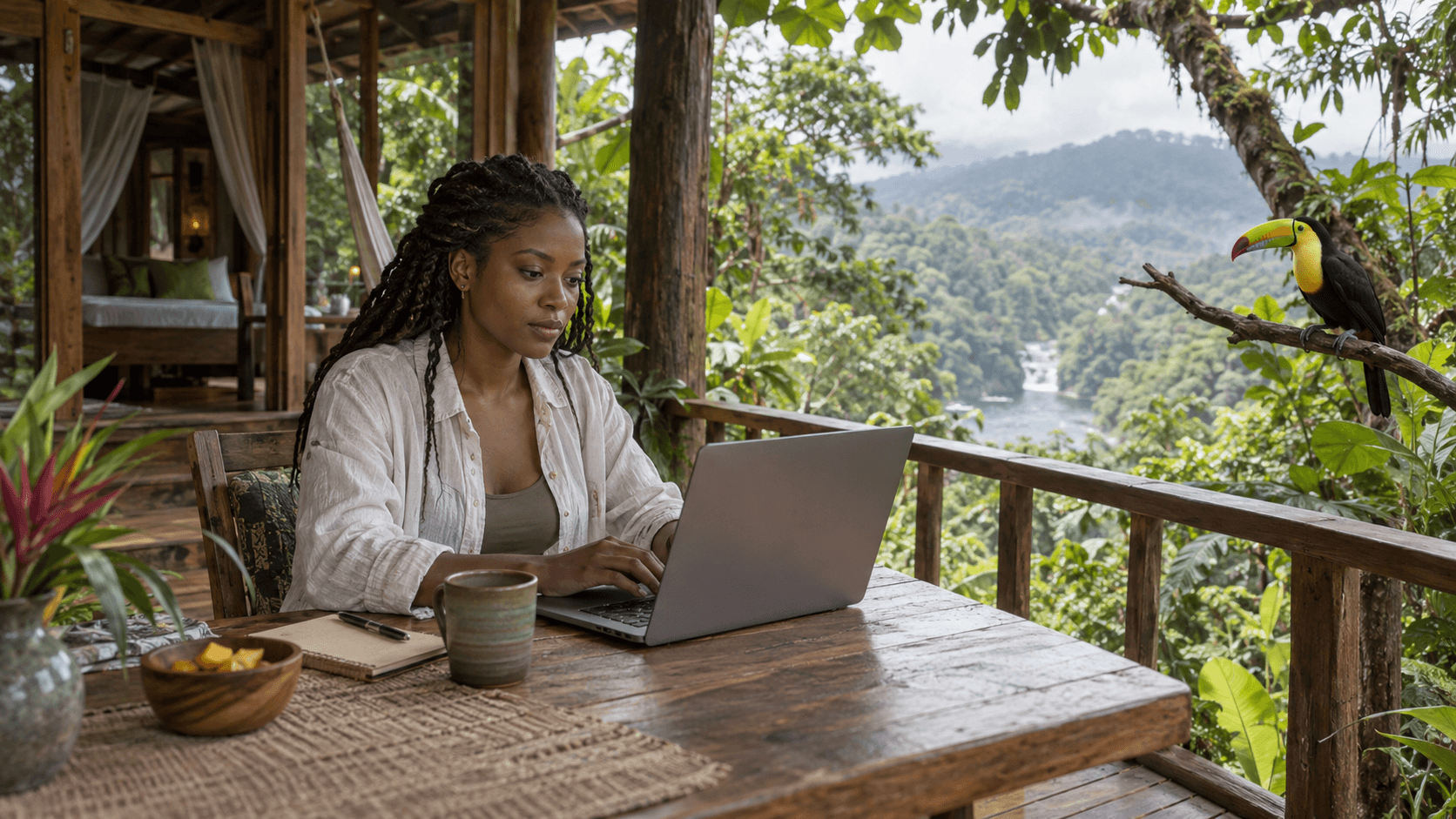
Want to work remotely from Costa Rica for a year or more? This article helps you choose between a tourist stay and an Estancia for remote workers, put together your application in the right order, anticipate the fees and delays that catch people out, and organize your arrival: banking, healthcare, housing, internet, and choosing your city.
The Essentials at a Glance
- French citizens get 90 days of tourist stay without a visa[1].
- The digital nomad program lets you extend that 90-day stay to a full year, renewable for one additional year[2].
- Required income: at least $3,000 USD per month from outside Costa Rica, or $4,000 USD per month to include dependents[3].
- Your health insurance must cover the entire length of your stay, with at least $50,000 USD in coverage[2].
- A $100 USD deposit must arrive net in the Ministry of Finance's accounts: bank fees are your responsibility[2].
- Once the resolution is notified, you have three months to get your immigration document issued, or the status granted will be canceled[4].
- Costa Rica only taxes income sourced in Costa Rica, but there is no tax treaty between France and Costa Rica[5].
- Status holders may open a savings account at a bank within the national banking system, subject to conditions[6].
Which Status to Work Remotely in Costa Rica: Tourist or Estancia?
On arrival, French citizens get 90 days of tourist stay without a visa, extendable on request through the DGME, Costa Rica's immigration directorate[7]. This status has very concrete limits: it does not let you open a bank account or access the CCSS, the public healthcare system[1].
For a long stay, the designated route is the Estancia for remote workers and service providers, often called the digital nomad visa[8]. There is no rule that makes a long tourist stay a safe basis for remote work: it's better not to build a lasting setup on that foundation[8].
Other residency routes exist (pensionado, rentista, inversionista), but they suit different profiles: retirees, holders of passive income, and investors. This article focuses on the Estancia, the natural entry point for a remote worker.
Estancia: Requirements, Application, and Cost
Who Can Apply
You must provide remote services paid by a natural or legal person located outside Costa Rica, with a minimum of $3,000 USD per month from outside the country, or $4,000 USD per month if you also want to host your dependents[3]. These amounts are set according to the official sale price fixed by the Central Bank of Costa Rica[3].
Documents to Gather
- The application form, filed online through the Tramite Ya platform or in person at DGME offices[9].
- Proof of the $100 USD payment to the government (or the equivalent in colones at the Central Bank's reference rate)[9].
- Bank statements accompanied by a sworn statement certifying that they were requested and obtained from the financial institution concerned[3].
- Health insurance covering the entire length of your stay, with at least $50,000 USD in coverage[2].
You can take out this policy with an international provider or a regulated Costa Rican insurance company, and any dependent who accompanies you must also be covered[2].
Translations and Legalizations
All documents issued in a foreign language must be accompanied by an official Spanish translation[3]. Only one document requires an additional consular legalization or apostille: the income certification issued by a chartered accountant or notary, when you submit it in place of bank statements[3].
After Approval
Once the resolution is notified, you and your dependents have three months to get your immigration document issued, by appointment and against a $90 USD receipt[4].
Employed by a foreign company or self-employed: what the status allows
The status is aimed at people who provide services remotely, whether or not those services are subcontracted, to an individual or company located outside Costa Rica[3]. The criterion is therefore not the form of your activity but the source of your income: it must come from outside the country[3].
Whether you are employed or self-employed, you prove this income with bank statements. You can also present a certificate issued by a chartered accountant or a notary (or their equivalents abroad, depending on the legislation of the country concerned)[3].
Duration, renewal and leaving the country
The program extends the 90-day tourist stay to a full year, with the option to renew for one additional year[2].
To renew, you must prove a minimum period of presence on Costa Rican territory: the program's official renewal page states 80 days[10].
The application file includes new income statements, the receipt for the payment indicated in the approval resolution, the receipt for $90 USD, a passport that is still valid, and a health insurance policy covering you and your dependents for the entire authorized stay[10].
Taxation and tax residence
Costa Rica applies a territorial tax system: only income from Costa Rican sources is subject to income tax[5]. Digital nomads are not considered ordinary residents for tax purposes and are therefore exempt from formal and substantive obligations toward the Directorate General of Taxation of the Ministry of Finance[11].
The pitfall lies on the French side. If you are or remain a French tax resident, be aware that there is no bilateral tax treaty between France and Costa Rica[5]. Without a treaty, France may continue to tax your worldwide income if your tax residence has not been clearly severed[5].
Another point to anticipate if you are concerned: the French exit tax (article 167 bis of the CGI) applies if you transfer your tax domicile outside France and hold more than €800,000 in shareholdings or more than 50% of a company[5]. Taxation depends on your personal situation: consult a tax specialist before you leave.

Health and insurance
The CCSS, the public system, is presented as the best in Central America, but it suffers from long waiting times for specialists[1]. Its main limitations: waiting for non-urgent care and the lack of choice of practitioner[12].
Whatever your possible affiliation, medical insurance remains a mandatory part of the Estancia application file: it must cover the entire length of the stay and your dependents, with at least $50,000 USD in coverage[2].
Arrival steps: DIMEX, bank, phone
The identity document issued to regularized foreigners is the DIMEX[12].
Status holders can open a savings account at a bank within the national banking system, provided they comply with anti-money-laundering legislation[6].
For your phone, consider a local SIM card or eSIM: several Costa Rican banks send verification codes by SMS or app, which requires a working data connection[13].
Housing
Online listings and Facebook groups make searching easier, but visit the places and check the contract before committing[14]. Rents range widely, from a simple apartment in San José to a beachfront home costing up to three times as much[14].
Also budget for water, electricity and internet[14]. On the coast, air conditioning is not always included in the rent and can significantly increase the electricity bill[15].

Cost of living
Costa Rica is the most expensive country in Central America, even though it remains 22 to 33% cheaper than the United States excluding rent[12]. The most sought-after beaches on the Pacific coast cost noticeably more, especially in high season, from December to April[15].
Internet and Connectivity
In the big cities and the main expat hubs, internet infrastructure is reliable, with very high-speed fiber[15].
In remote rural areas, especially on the Osa Peninsula or in some mountainous regions, the connection can be unstable or even nonexistent[15]. Before signing a lease in an isolated place, check the quality of the connection and plan for a portable router as a backup[15].
Even in tourist areas, coverage varies: some coastal villages handle messaging but occasionally drop video calls, which is why it's worth testing the connection before you commit[13].

Cities and Regions to Settle In
- San José and the Central Valley: you live here for the airport, the hospitals, and reliable fiber, with the option to reach both coasts in three hours[16].
- Tamarindo: a real digital nomad community, though less dense than Santa Teresa, with many year-round residents, so the community is more stable[17].
- Santa Teresa: along with Tamarindo, one of the most popular destinations on the Pacific coast, with higher rents[15].
- Atenas: a small town of 27,000 residents, including about 1,500 expats[12].
Transportation
The bus network is very developed, but trips are long and few tourist sites are served[18]. The country has two international airports, one near San José and one in the north, as well as domestic flights and ferries to the Nicoya Peninsula[18].
To rent a car, you must be between 21 and 75 years old and hold a national driver's license that is more than two years old[18]. An international credit card in the name of the main driver listed on the reservation is also required[18].
Language, Integration, and Community
Although some Costa Ricans speak English, especially in tourist areas, making the effort to learn Spanish shows real respect and opens the door to deeper integration[19]. Outside of Escazú and the tourist areas, Spanish is essential[12].
Costa Ricans place great importance on courtesy (greeting your neighbors, respecting the calm of the neighborhood) and on the environment[19]. In Tamarindo, people connect through surfing, yoga classes, and the Facebook groups of Guanacaste[17].
Pitfalls, Scams, and Things to Watch For
Application and Procedures
- The full USD 100 must arrive: the fees of the sending bank and the receiving bank are your responsibility[2].
- All documents in a foreign language require an official Spanish translation; only the income certification, if you submit it in place of bank statements, must also bear an apostille or consular legalization[3].
- After the approval notification, the deadline is three months: beyond that, proceedings are initiated to cancel the granted status[4].
- The status is intended for services provided to clients located outside Costa Rica, with income coming from abroad: it does not allow you to work for the local market[3].
- Rules and thresholds change: check the current conditions with the Directorate of Migration before taking any steps[8].
Taxation
The absence of a tax treaty with France creates a risk of double taxation if your French tax residence is not clearly severed[5]. The recommended approach: notify the tax authorities of your departure, move your family, transfer your economic interests, and consult a specialized tax advisor before leaving[5].
Safety
- Cases of burglary and serious violence have been reported, especially in Guanacaste around Tamarindo: be vigilant when choosing your accommodation[20].
- Passport theft is common, so store your documents in a safe and carry only a copy of your passport, including the page with the entry stamp[20].
- Costa Rica has a very high rate of road accidents: drive with caution[20].
- Drownings are common: be careful at sea and check beach conditions before swimming[20].
Steps, in Order
- Check the current conditions and thresholds with the Directorate of Migration[8].
- Purchase medical insurance (at least $50,000 in coverage) and gather your proof of income, with official Spanish translations[2][3].
- Pay the $100 fee, accounting for bank charges so that the full amount arrives net, then submit your application online or at the DGME[2][9].
- Once approved, have your immigration document issued within three months[4].
- Open a local savings account, get a SIM card or eSIM, and arrange your accommodation[6][13].
- Plan your renewal: minimum physical presence in the country, new proof of income, and valid insurance[10].
These benchmarks will help you choose your status and assemble your file in the right order. They do not replace the details of each procedure, from the online submission to collecting your immigration document, nor a line-by-line budget, nor choosing a city and neighborhood. To truly settle in, those are the points you need to explore further.
Frequently Asked Questions
Can I work remotely on a simple tourist stamp?
The dedicated channel is the Estancia, and there is no framework that makes a long tourist stay a safe basis for remote work[8].
Does the Estancia give me access to a bank account?
Yes, under the conditions of the anti-money laundering law, whereas tourist status does not allow it[6][1].
Is my driver's license valid?
Digital nomads may use their home-country driver's license for the entire duration of their stay[11].
Can I import my computer equipment duty-free?
Digital nomads may be eligible for an exemption from customs duties on telecommunications and electronic devices needed for remote work, under certain conditions[2].
Sources
- 1.^ abcdxn--lexpatri-i1a.fr — Moving Abroad to Costa Rica in 2026: Visas, Taxes, Budget: “All French nationals receive 90 days of visa-free tourist stay, but this status does not allow you to open a bank account or access the CCSS.” ; “The CCSS (public system) is the best in Central America but suffers from long waiting times for specialists.” https://xn--lexpatri-i1a.fr/destinations/costa-rica (accessed October 19, 2026)
- 2.^ abcdefghijkfr.visitcostarica.com — Digital Nomads: Live and Work - Visit Costa Rica: “This program allows you to extend a 90-day tourist visa to a full year, with the option to renew for an additional year.” ; “Medical insurance must cover the digital nomad's entire stay in Costa Rica for the full authorized period and must provide coverage of at least $50,000.” ; “The $100 fee associated with this application must be received in full (net) by the Ministry of Finance accounts.” https://fr.visitcostarica.com/digital-nomads (accessed October 19, 2026)
- 3.^ abcdefghijklfr.visitcostarica.com — Digital Nomad Requirements - Visit Costa Rica: “You must earn at least $3,000 per month from outside Costa Rica for providing these services, or at least $4,000 per month if you also want your dependents to be able to stay legally in the country.” ; “Bank statements accompanied by a sworn statement attesting that the statements were requested and obtained from the corresponding financial institution.” ; “Under the law, all documents issued in a foreign language must be accompanied by an official Spanish translation.” https://fr.visitcostarica.com/digital-nomads/requirements (accessed October 19, 2026)
Show 17 more sourcesShow less
- 4.^ abcdfr.visitcostarica.com — Digital Nomads: Issuance of the Immigration Document - Visit Costa Rica: “If the person does not complete the process within this period, proceedings will be initiated to cancel the immigration status granted.” ; “Once the resolution is notified, the foreign national and their dependents have three months to have the immigration accreditation document processed.” ; “To obtain documents, the foreign national must request an appointment by calling the immigration call center at 1311 or the Bank of Costa Rica at 800-227-2482.” https://fr.visitcostarica.com/digital-nomads/issuance-of-the-immigration-document (accessed October 19, 2026)
- 5.^ abcdefgxn--lexpatri-i1a.fr — Taxation in Costa Rica: taxes and tax treaty: “Costa Rica applies a strictly territorial tax system: only income sourced in Costa Rica is subject to income tax.” ; “But there is a major point of caution, often overlooked: there is no bilateral tax treaty between France and Costa Rica.” ; “The French exit tax (article 167 bis of the CGI) applies if you transfer your tax residence outside France and hold more than €800,000 in shareholdings or more than 50% of a company.” https://xn--lexpatri-i1a.fr/destinations/costa-rica/fiscalite (accessed October 19, 2026)
- 6.^ abcdvisitcostarica.com — Digital Nomads: Live and Work - Visit Costa Rica: “Digital nomads may open savings accounts at financial institutions within the national banking system, provided they comply with Law 8.204 on narcotics, money laundering, and the financing of terrorism.” https://www.visitcostarica.com/digital-nomads (accessed October 19, 2026)
- 7.^Mira Knowledge — The 90-day tourist stay granted on entry can be extended upon request with the DGME; check the procedure and fees on migracion.go.cr. Verified on 06/09/2026: 2 concordant sources (migracion.go.cr, visitcostarica.com). https://migracion.go.cr (accessed June 9, 2026)
- 8.^ abcdeMira Knowledge — The rules evolve through the DGME; the Estancia for remote workers is the dedicated channel, with no protective framework for a long tourist stay. Verified on 06/09/2026: official source migracion.go.cr. (accessed June 9, 2026)
- 9.^ abcvisitcostarica.com — Digital Nomads Requirements - Visit Costa Rica: “The application form must be signed by the applicant or their representative, and submitted online via the Tramite Ya platform or in person at the DGME’s central or regional offices.” ; “Proof of payment to the government of 100 US dollars, or its equivalent in colones at the reference exchange rate of the Central Bank of Costa Rica, in accordance with article 256 of the General Law on Migration and Foreigners.” https://www.visitcostarica.com/digital-nomads/requirements (accessed October 19, 2026)
- 10.^ abcfr.visitcostarica.com — Digital Nomad Renewals - Visit Costa Rica: “For renewals in this immigration category, the foreign national must prove that they have been present in the territory of Costa Rica for a minimum period of 80 days.” ; “Health insurance policy covering the applicant and their dependents for the entire authorized legal stay.” https://fr.visitcostarica.com/digital-nomads/renewal (accessed October 19, 2026)
- 11.^ abvisitcostarica.com — Digital Nomad Benefits - Visit Costa Rica: “Digital nomads are not considered ordinary residents for tax purposes: they are exempt from formal and material obligations toward the General Directorate of Taxation of the Ministry of Finance.” ; “Digital nomads may use their driver’s license from their country of origin for the entire duration of their stay.” https://www.visitcostarica.com/digital-nomads/benefits (accessed October 19, 2026)
- 12.^ abcdeexpat.com — Expat Guide to Costa Rica: everything you need to know about expatriating - Expat.com: “The main limitations: waiting times for non-urgent care and no choice of practitioner.” ; “The identity document issued is the DIMEX.” ; “Costa Rica is the most expensive country in Central America according to Numbeo (2025), but it remains overall 22 to 33% cheaper than the United States excluding rent.” https://www.expat.com/fr/guide/amerique-centrale/costa-rica/ (accessed October 19, 2026)
- 13.^ abccostarica-spirit.com — Best eSIM Costa Rica 2026: “Coverage map figures don’t always translate into usable connectivity.” ; “Variable areas such as Dominical or Sámara generally handle messaging and basic browsing well, but sometimes drop video calls: plan your important work calls accordingly.” https://www.costarica-spirit.com/fr/guides/esim-internet-costa-rica/ (accessed October 19, 2026)
- 14.^ abccyriljarnias.com — Housing in Costa Rica: Useful Tips and Advice: “Online platforms such as Encuentra24 and Facebook groups make it easier to find housing, but it is essential to visit the premises and check contracts before committing.” ; “In San José, expect to pay around 500 USD for a city apartment, while a house in the countryside may be cheaper but far from amenities.” ; “A beachfront apartment can cost between 800 and 1,500 USD per month.” https://www.cyriljarnias.com/expatriation/guide-sinstaller-costa-rica-expatrie/trouver-logement-costa-rica-conseils-astuces/ (accessed October 19, 2026)
- 15.^ abcdefexpat.com — Being a Digital Nomad in Costa Rica - Costa Rica Guide - Expat.com: “Think about air conditioning when looking for coastal housing: it is not always included in the base rent and can significantly increase your electricity bill.” ; “Rents are higher: expect between 800 and 950 USD per month for a one-bedroom apartment, and easily 1,500 USD or more during peak tourist season (December to April).” ; “Metrocom is the country’s best-performing fixed broadband provider, with a median download speed of 310 Mbps and upload of 277 Mbps, according to Ookla.” https://www.expat.com/fr/guide/amerique-centrale/costa-rica/37169-travailler-en-tant-que-nomade-numerique-au-costa-rica.html (accessed October 19, 2026)
- 16.^ledigitalnomad.com — Digital nomad in San José: budget, neighborhoods and coworking spaces (2026): “Budget €660 to €890 per month for a furnished rental leased monthly.” ; “Several coworking spaces in Escalante and Escazú (€120 to €220).” ; “San José is a pragmatic choice, not a love at first sight: you live there for the airport, the hospitals, reliable fiber, and the ability to reach both coasts in three hours.” https://ledigitalnomad.com/s-expatrier/san-jose/ (accessed October 19, 2026)
- 17.^ abledigitalnomad.com — Tamarindo for Digital Nomads: Where to Live, How Much to Budget (2026): “Between €1,230 a month on a tight budget and €3,010 without restrictions, with a comfortable profile around €1,910: monthly furnished rental (€740 to €1,010), food, transport, coworking, health insurance, and going out.” ; “Two decent coworking spaces (€150 to €220) and several digital-nomad-friendly cafés.” ; “Strong North American and European presence, a real nomad community but less dense than in Santa Teresa.” https://ledigitalnomad.com/s-expatrier/tamarindo/ (accessed October 19, 2026)
- 18.^ abcdcomptoirdesvoyages.fr — Getting Around: How to Travel in Costa Rica? | Costa Rica Travel Tips: “Although the bus network is very developed, getting around by bus takes time and few tourist sites are served.” ; “Two international airports: Juan Santamaría, 17 km from San José, and Daniel Oduber Quirós, in the north of the country. Sansa and Nature Air share the domestic routes.” ; “The Naviera Tambor ferry makes it easy to reach the south of the Nicoya Peninsula. It connects Puntarenas to Paquera in about 1 hour 15 minutes.” https://www.comptoirdesvoyages.fr/guide/costa-rica/informations-pratiques-costa-rica/transports-comment-se-deplacer-au-costa-rica/1548 (accessed October 19, 2026)
- 19.^ abcyriljarnias.com — Settling in Costa Rica: A Guide for Expats: “Even though some Costa Ricans speak English, especially in tourist areas, making the effort to learn their language shows real respect and opens the door to deeper integration.” ; “Costa Ricans place great importance on courtesy (greeting your neighbors, respecting the calm of the neighborhood), on the environment (recycling, nature conservation), and on mutual respect.” https://www.cyriljarnias.com/expatriation/guide-sinstaller-costa-rica-expatrie/ (accessed October 19, 2026)
- 20.^ abcddiplomatie.gouv.fr — Costa Rica - Safety | France Diplomatie: “Burglaries and serious violence have been reported, particularly in Guanacaste, around the town of Tamarindo.” ; “Passport theft is common: leave your documents in the hotel safe and carry only a copy of your passport (or a photo of it), including the page with the Costa Rica entry stamp.” ; “Costa Rica has a very high road accident rate.” https://www.diplomatie.gouv.fr/fr/information-par-pays/costa-rica/conseils-aux-voyageurs-securite (accessed October 19, 2026)