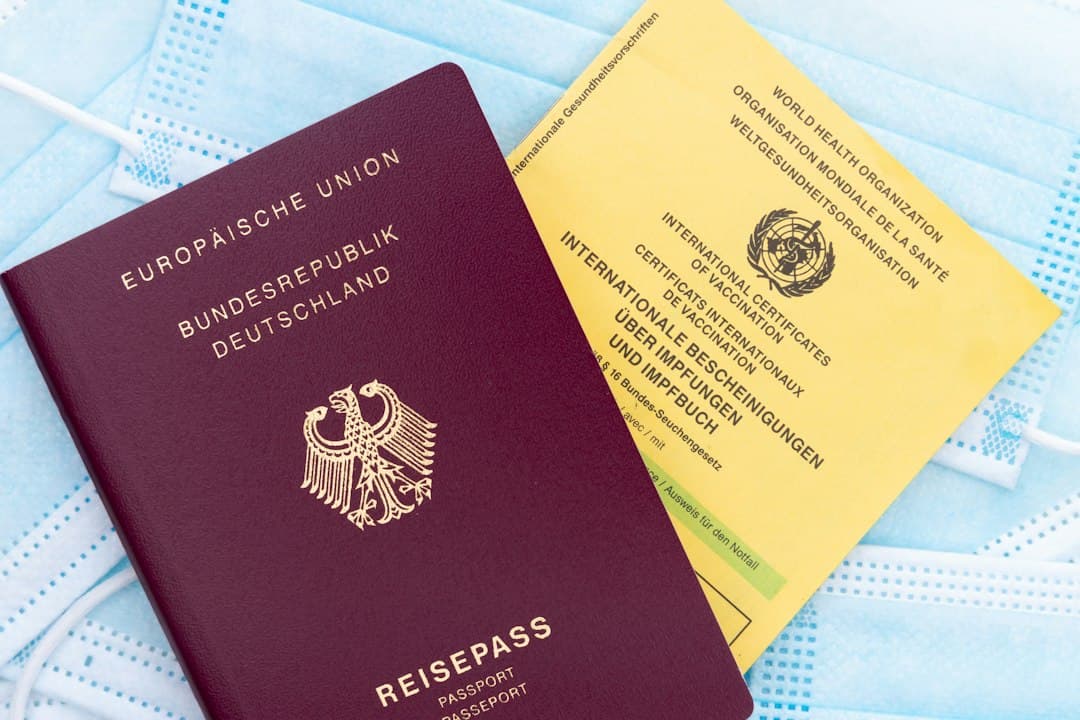
Germany does not offer a digital nomad visa. To work remotely from its territory, you need to fit into an existing residence category. This article helps you choose the right path for your situation (employee, Blue Card, freelancer, EU citizen), explains the 2026 Blue Card salary thresholds, and walks you through the steps on arrival. It also covers the pitfalls to avoid: fake online jobs, short Schengen stays, and losing your job.
No digital nomad visa: what the German framework says
Germany has no visa dedicated to digital nomads in 2026[1][2]. Paid remote work from abroad therefore has to fit into the existing categories[2].
Remote work paid exclusively by an employer or clients abroad does not fit directly into these categories: the Blue Card and the skilled worker status require a link to an employer or the German economy[1]. Two options remain open: freelance status (§ 21) if you practice a viable liberal profession, or the Blue Card / skilled worker status with a German link[2].
The rules keep changing: Blue Card thresholds are indexed every year, and the Skilled Immigration Act reform and the Opportunity Card are among the recent changes[2].
Residence paths for working: employee, Blue Card, freelancer
Non-EU employee
To work as an employee in Germany, you must first obtain an entry visa[3]. Once on site, you must obtain a residence permit that authorizes work[3].
The Blue Card
The Blue Card requires a German university degree or a foreign degree comparable to a German university degree[4]. You also need a concrete job offer from an employer in Germany, for a period of at least six months[4].
The minimum gross annual salary depends on your profile. For the "regular" Blue Card, it is €50,700 in 2026[4]. People working in a shortage occupation and those starting their careers can apply with a lower minimum of €45,934.20 in 2026[4].
In the second case, approval from the Federal Employment Agency is required: it checks that the employment conditions (salary, working hours, leave) are comparable to those of employees in the country, which may mean paying a salary above the minimum[4].
A special scheme exists for IT specialists: the Blue Card is possible without formal qualifications, provided you hold an academic-level position in IT and have at least three years of relevant work experience within the last seven years, with a gross salary of at least €45,934.20 in 2026 and approval from the Federal Employment Agency[4].
The Blue Card's validity follows that of the employment contract: if the contract is fixed-term, the permit is issued for the length of the contract plus three months[4]. An extension is in principle possible, but it must be requested from the foreigners' authority[4].
Freelance status
Freelance status is only viable if you practice a liberal profession and present a business plan proving sustainable livelihood in Germany[1].
EU and Swiss citizens: a simpler route
Citizens of the European Union generally do not need a work permit to work in another EU country, including Germany; self-employed people never need one within the EU[5]. Swiss nationals can also live and work freely in the EU thanks to the EU-Switzerland agreement on the free movement of persons[5].
After three months, you may have to register your residence with the competent authority. You then receive a registration certificate confirming your right of residence. Only a valid identity card or passport and a supporting document depending on your situation (employment, self-employment, studies, or sufficient resources) may be requested from you[6].

Arrival procedures and administrative steps
If you're coming from a non-EU country, the process happens in two stages. You first apply for the visa at the German embassy or consulate in your country of origin; it is only granted if the foreigners' authority at your planned place of residence consents[3]. The Blue Card visa application can be submitted online via the Consular Services Portal[7], a portal operated by the German Federal Foreign Office[8].
Once you are in Germany, you apply for a residence permit for employment from the local foreigners' authority[3]. The Federal Employment Agency must consent to this permit: it can do so if your recruitment has no negative effect on the labor market and if no qualified German, EU/EEA or equivalent candidate is available for the position. It also checks that the proposed salary and working conditions are appropriate[3].
Prepare the following documents: a valid passport, health insurance, sufficient financial resources and proof of housing[3]. Residence permits for employment are generally granted for one year and can be renewed[3]. Decisions on residence permits can be challenged before the local administrative courts[3].
Remote Work and German Labor Law
If your contract sets a specific place of work (typically the employer's premises in a city) and says nothing about working from home, your employer cannot unilaterally require you to work remotely. One exception exists in truly exceptional circumstances: a national pandemic, closures or evacuations ordered by the authorities, force majeure[9].
On taxes, regardless of labor law, an employee can claim a home office flat-rate deduction in their tax return[9]. On accidents, German case law holds that statutory accident insurance applies to work from home when the accident occurs while performing a task done with the intention of serving the company[9].
If you work remotely from abroad for a German employer, you generally remain subject to the labor law of the country where you habitually work; an employee who is habitually employed in Germany and works abroad for a limited period therefore generally remains governed by German labor law[9].
A multilateral framework agreement on cross-border telework, in effect since July 1, 2023, allows, depending on the case, up to 49.99% of total working time to be spent teleworking from your country of residence without changing the applicable social security legislation, that of the employer's country. Its application depends on your situation, which should be checked. For telework stays outside the EU, the EEA, the United Kingdom and Switzerland, this framework agreement has no effect[9]. Check your social security situation before you leave.

Scams, Traps and Points to Watch
Fake Online Jobs
Text messages supposedly sent by the Federal Employment Agency (Bundesagentur für Arbeit) promise "Online Jobs"[10]. These are phishing attacks[10]. Do not reply to these messages and do not share any personal data.
Short Stay in the Schengen Area
A short Schengen stay sometimes tolerates occasional remote work, but it is risky for long-term or systematic remote work: entry refusal, regularization, tax and social security problems[1]. The Entry/Exit System (EES) automatically calculates the 90-days-in-180 rule based on recorded entries and exits, which makes overstays detectable in all Schengen countries[11].
For a short-stay Schengen visa for Germany, you must prove sufficient means of subsistence for the length of your stay and your return, as well as health insurance covering medical expenses, repatriation and hospitalization within the Schengen area (a minimum of €30,000 is often recommended)[12].
Job Loss and Changing Employers
If you lose your job, your residence permit may be revoked if you no longer have sufficient means of subsistence. As long as you are entitled to unemployment insurance, you can generally remain in Germany for the remaining validity of your permit, unless stated otherwise[3].
If your residence permit is tied to a specific employer or position, you must obtain authorization from the foreigners' authority to change jobs, which may need to request the consent of the Federal Employment Agency[3]. To become self-employed, the required permits must also have been issued, or it must be certain that they will be, and the foreigners' authority must have given its approval[3].
Official Sources and Steps Before You Leave
Since the rules change regularly, rely on official tools before taking any step: the Quick Check on the Make it in Germany website and the Visa Navigator of the Federal Foreign Office (Auswärtiges Amt). Also check the information on the Auswärtiges Amt website and with your local foreigners' authority[2].
- Identify your status: citizen of the EU or Switzerland, or national of another country.
- If you come from another country: choose between an EU Blue Card, salaried employment, or freelance status (liberal profession with a business plan), since no digital nomad visa exists.
- For the Blue Card: make sure you have a job offer of at least six months and that the salary exceeds the threshold that applies to you.
- Submit your visa application to the embassy or consulate, or through the Consular Services Portal.
- After arrival: apply for your residence permit at the local foreigners' authority (non-EU), or register your residence if you are an EU citizen staying more than three months.
- Before changing jobs or workplace: check with the foreigners' authority and about your social protection.
This article gives you the main outline. Step-by-step procedures, taxes, social security, housing, and cost of living require going further to truly settle in.
Sources
- 1.^ abcdMira Knowledge — Germany has no visa specifically for digital nomads; paid remote work exclusively from a foreign employer or foreign clients does not directly fit the standard categories (the Blue Card and the skilled worker status require a link to a German employer or the German economy). Verified on 06/08/2026: official source make-it-in-germany.com. (accessed June 8, 2026)
- 2.^ abcdeMira Knowledge — Germany has no visa specifically for digital nomads in 2026; remote stays paid from abroad must fit into existing categories (freelance under § 21 if a viable liberal profession, or Blue Card / skilled worker with a German link). Verified on 06/08/2026: official source make-it-in-germany.com. (accessed June 8, 2026)
- 3.^ abcdefghijkhome-affairs.ec.europa.eu — Employed worker in Germany - Migration and Home Affairs: “To work as an employee in Germany, you must first obtain a visa to enter Germany.”; “Once in Germany, you must obtain a residence permit that authorises you to work.”; “You must first apply for a visa at the embassy or consulate of your country of origin. The visa can only be granted if the local foreigners' authority of the intended place of residence consents.” https://home-affairs.ec.europa.eu/policies/migration-and-asylum/eu-immigration-portal/employed-worker-germany_en (accessed October 26, 2026)
Show 9 more sourcesShow less
- 4.^ abcdefgharbeitsagentur.de — EU Blue Card | Bundesagentur für Arbeit: “To be eligible for the European Blue Card, you must hold a German university degree or a foreign university degree comparable to a German university degree.”; “Another condition for the European Blue Card: a concrete job offer from an employer in Germany for a period of at least six months.”; “To obtain the regular European Blue Card, applicants must earn a minimum gross annual salary, which is €50,700 in 2026.” https://www.arbeitsagentur.de/vor-ort/zav/working-and-living-in-germany/iss-en/issue-03-2026/blue-card (accessed October 26, 2026)
- 5.^ abMira Knowledge — EU citizens generally do not need a work permit to work in another EU country, including Germany; self-employed persons never need one. Swiss nationals can also live and work freely in the EU thanks to the EU-Switzerland agreement on the free movement of persons. Verified on 11/10/2026: official source europa.eu. https://europa.eu/youreurope/citizens/work/work-abroad/work-permits/index_en.htm (accessed October 11, 2026)
- 6.^Mira Knowledge — After three months, an EU citizen may need to register their residence with the competent authority and then receives a registration certificate; only a valid ID card or passport and proof depending on their situation (employment, self-employment, studies, or sufficient resources) may be requested. Verified on 11/10/2026: official source europa.eu. https://europa.eu/youreurope/citizens/residence/documents-formalities/registering-residence/index_en.htm (accessed October 11, 2026)
- 7.^Mira Knowledge — The Consular Services Portal allows you to apply online for an EU Blue Card visa. Verified: official source digital.diplo.de. https://digital.diplo.de/
- 8.^Mira Knowledge — The Consular Services Portal is operated by the German Federal Foreign Office, in accordance with the Online Access Act (OZG). Verified: official source digital.diplo.de. https://digital.diplo.de/
- 9.^ abcdecms.law — Remote Working Legislation, Laws & Regulations in Germany: “If the employment contract specifies a particular place of work (typically the employer's premises in a given city) and says nothing about home working, the employer cannot unilaterally impose remote work on the employee under its general right to issue instructions (§ 106, sentence 1, GewO). An exception may apply in truly exceptional circumstances, such as a nationwide pandemic, closures or evacuations ordered by authorities, or a case of force majeure (fire, water damage, storm) that makes use of the workplace impossible.”; “Regardless of labor law, however, employees may still claim a flat-rate home office deduction on their income tax return.” https://cms.law/en/int/expert-guides/cms-expert-guide-to-remote-working/germany (accessed October 26, 2026)
- 10.^ abarbeitsagentur.de — Warning About Phishing SMS Sent in the Name of the BA | Bundesagentur für Arbeit: “SMS messages purportedly sent by the Federal Employment Agency (BA) are currently circulating.”; “Unknown third parties promise to place you in online jobs with variable pay levels.”; “This is a so-called phishing attack.” https://www.arbeitsagentur.de/warnung-phishing-sms-im-umlauf (accessed October 26, 2026)
- 11.^Mira Knowledge — The Entry/Exit System automatically calculates the 90/180-day rule based on recorded entries and exits, which makes overstays systematically detectable in all Schengen countries. Verified on 08/20/2026: official source travel-europe.europa.eu. https://travel-europe.europa.eu/ees_en (accessed August 20, 2026)
- 12.^Mira Knowledge — For a short-stay Schengen visa for Germany, you must prove sufficient means of subsistence for the duration of your stay and your return, as well as health insurance covering medical costs, repatriation, and hospitalization within the Schengen area (a minimum of €30,000 is often recommended). Verified on 06/08/2026: official source auswaertiges-amt.de. https://www.auswaertiges-amt.de/en/visa-service (accessed June 8, 2026)