Segovia is best explored on foot, from the Roman viaduct to the royal fortress. This article helps you choose what to see first, decide whether one day is enough or whether you should stay overnight, and plan the trip from Madrid.
Why visit Segovia
Segovia, in Castile and León, is a city made for wandering: just strolling its streets shows why its old town and aqueduct are listed as World Heritage[1]. UNESCO added “the historic city of Segovia and its Roman aqueduct” to its list in December 1985[2].
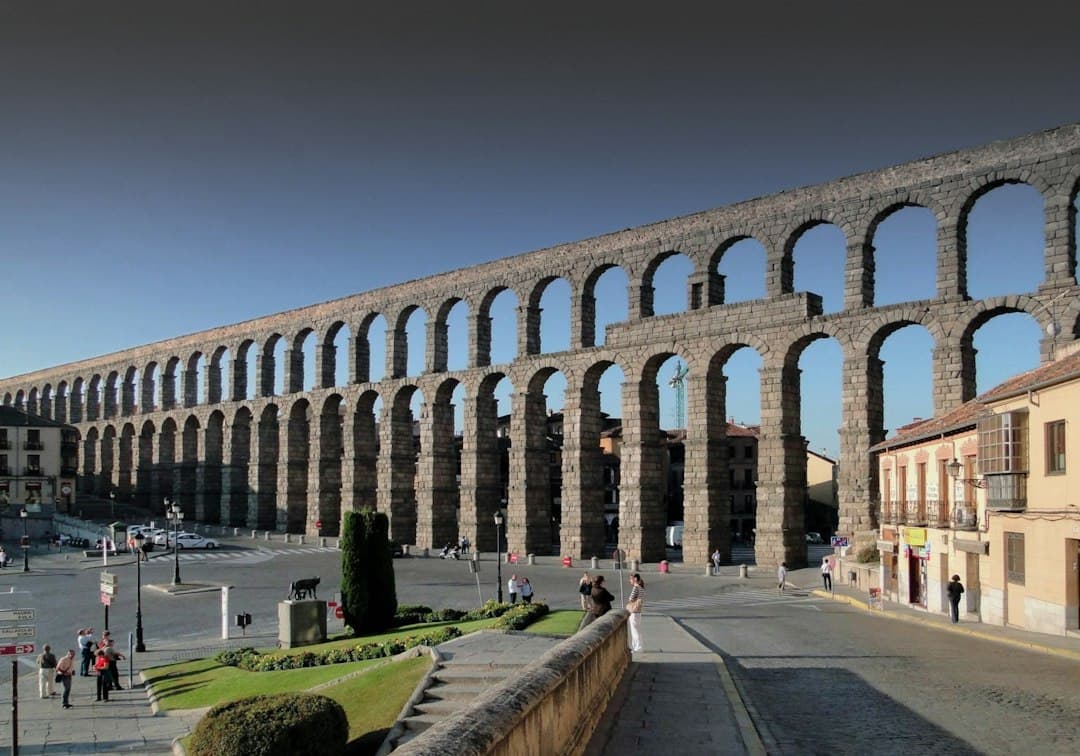
The aqueduct marks the entrance to the city, with the Sierra de Guadarrama in the background[3]. Here, you don't need a bus to see everything[3]. History, culture and nature come together, which makes Segovia a possible getaway at any time of year[4].
The Roman aqueduct, symbol of the city
It's the first monument you come across. According to sources, it has 167 arches on two levels, about 28 m in height and more than 800 m in length in the section visible in the city[5]. Its highest point is at the Azoguejo, where the view gives you a sense of the scale of the structure[6].
The granite is assembled without mortar: only the balance of forces keeps the whole standing[3]. The construction date is still debated: the late 1st century, under the Flavians or under Trajan[7].
A legend says the aqueduct was born from a pact between a young girl and the devil, who was to bring water to her house before dawn in exchange for her soul[8]. It is also known as the “puente del Diablo”[9].
You can view it freely[10]. To see it from above, a staircase runs alongside the aqueduct from the square, with the old town in the background[10]. The interpretation centre opens with a combined ticket that includes the Royal Mint Museum[7].
The Alcázar and the Tower of John II
This royal fortress stands on a rocky spur. First mentioned in 1122, it grew out of a Roman castrum and a Moorish stronghold before becoming the residence of the Castilian monarchs[11]. It later served as a state prison, and in 1762 it housed the Royal Artillery College[11].
The visit moves through the palace rooms, including the Hall of Kings with its frieze of monarchs, and then the Royal Artillery College Museum[10]. The Tower of John II is climbed by a spiral staircase of 152 steps[3]. The authors of the official Spanish tourism guide strongly recommend the climb: the view is unique[3]. Allow 40 to 45 minutes for the palace and museum, and no more than 25 minutes for the tower[10].
Hours and prices checked in October 2026: the Alcázar is open daily from 10:00 am to 7:30 pm from April to October, and from 10:00 am to 6:00 pm from November to March; the palace and museum ticket costs €7, or €10 with the Tower of John II[10]. Check them on the official website before you go.
Cathedral, Plaza Mayor and the old town
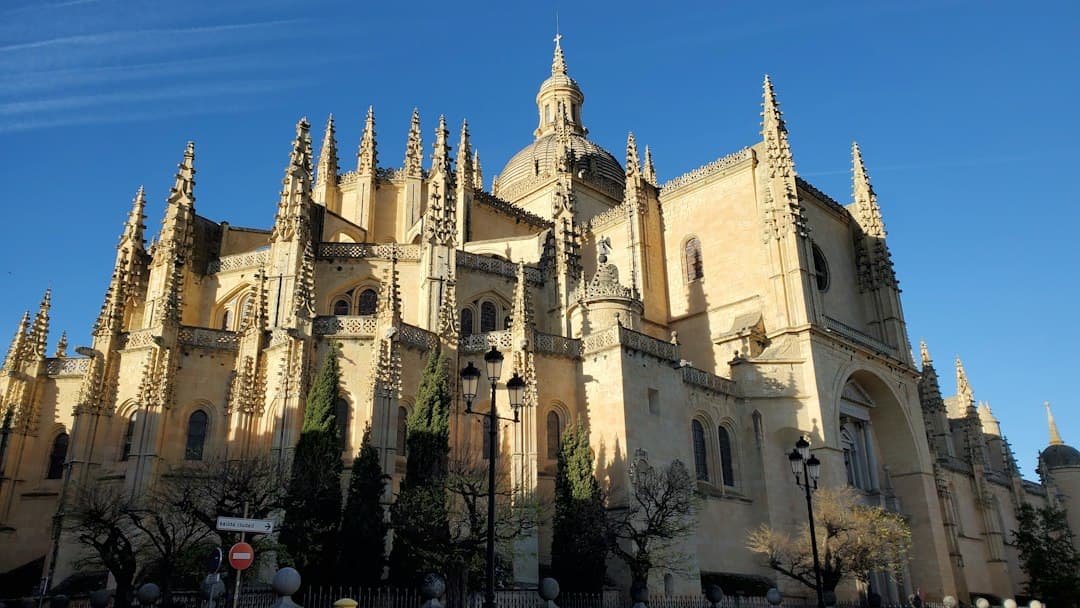
Begun in 1525, the Santa María Cathedral dominates the Plaza Mayor; it is one of the last great Gothic cathedrals in Spain[10]. It is nicknamed “the lady of cathedrals”[3]. Its tower rises to 108 m and is reached after 190 steps[5].
The Plaza Mayor, laid out in 1461 and remodelled in the 16th century, is the city's second centre, with the Juan Bravo theatre and the town hall[5]. It was in this square that Isabella I was proclaimed Queen of Castile in 1474[11].
As you wander through the walled quarter, you'll pass the Casa de los Picos, the Alhóndiga, the Torreón de Lozoya and the church of San Martín[1]. The cathedral is free on Sunday mornings, without access to the cloister[10].
Hours and prices checked in October 2026: the cathedral is open Monday to Saturday from 9:30 am to 6:30 pm, and Sunday from 1:30 pm to 6:30 pm; entry costs €4 (€3 reduced rate), and the guided tour of the tower costs €7[10].
The Judería, the walls and the viewpoints
The palaces of the noble families in the Caballeros quarter and the lanes of the former Jewish quarter extend this journey through time[3]. Around the church of San Miguel, the Judería quarter recalls that Segovia once had a large Jewish community before it was expelled following the Edict of Expulsion of 1492[5]. The Corpus Christi church was originally the city's main synagogue[11].
A walk along the city walls takes you past the Casa de los Picos, the Alhóndiga, the Torreón de Lozoya and the church of San Martín[3]. If you have the chance to climb to one of the viewpoints that offer a distant view of the city, you will see it in a whole new light[1].
The poet Antonio Machado lived for twelve years at number 5 calle Desamparados, in the former Casa de Huéspedes[8]. His house-museum can be visited[1].
A Bit of History
After the Moorish conquest of 714, Segovia declined and was largely emptied of its population; Alfonso VI of León and Castile launched its repopulation in 1088[11]. In the Middle Ages, the city became a center of the wool and textile trade, a wealth reflected in its architecture[11].
Its political weight grew in the 15th century, culminating in the proclamation of Isabella I as Queen of Castile in the Plaza Mayor in 1474[11]. The Real Casa de Moneda, the royal mint from 1586 to 1730, is one of the oldest industrial buildings in the world[11].
At the Table: Cochinillo and Segovian Cuisine
The local specialty is roast suckling pig (cochinillo), served in restaurants around the aqueduct[10]. For a taste, the official Spanish tourism guide recommends the famous Mesón Cándido, or one of the restaurants that have embraced a more contemporary style[1].
Another regional dish is lechazo (young lamb) roasted in a wood-fired oven, served for example at the restaurant Rincón Castellano on the Plaza Mayor[12].
Getting to Segovia, How Much Time to Plan
Segovia is easy to visit in a day from Madrid: the AVANT train connects Chamartín station with Segovia-Guiomar station in about thirty minutes[10]. The station is outside the center: urban bus line 11 reaches the aqueduct in roughly 15 minutes[10]. Buy your round-trip ticket in advance, as weekend trains fill up quickly[10].
Another option is the regional train, which takes about 2 hours but whose station is a few minutes' walk from the center[13]. You can also reach the city by car via the A-6[12].
One day is enough for the aqueduct, the cathedral and the Alcázar; to explore the Judería, the museums and the local food without rushing, a night on site is preferable[11]. Spring and autumn offer pleasant temperatures for strolling through the old town on foot[14].
If you stay longer, the province has two royal palaces, at La Granja and Riofrío[15]. La Granja de San Ildefonso, about ten kilometers from the city, has a royal palace and spectacular gardens[1].
Things to Watch Out For
- Book your Alcázar tickets online, especially on weekends: those that include the Tower of Juan II often sell out[10].
- The high-speed train arrives at Segovia-Guiomar, outside the historic center: plan for a taxi or local bus to reach the old town[14].
- For the Riofrío royal palace, guided tours booked online are all in Spanish[16].
Checklist Before You Leave
- Choose the AVANT train from Madrid-Chamartín and buy your round-trip ticket in advance.
- Book the Alcázar online, with or without the Tower of Juan II.
- Check schedules and prices on the official websites.
- Pack comfortable walking shoes: the city is best explored on foot.
- Decide between a day trip and an overnight stay, depending on whether you want to add the Judería, the museums and an excursion.
This article covers the essentials for a first visit: the details of excursions around Segovia, or choosing where to stay and eat, call for going further.
To Go Further
- Spain: The Essentials, Region by Region
- Toledo: What to See and Do in One or Two Days from Madrid
- Madrid: What to See and Do, from the Prado Museum to Tapas
Sources
- 1.^ abcdefspain.info — Sightseeing in Segovia. What to see | spain.info: “Just stroll through its streets to understand why the old town of Segovia and its aqueduct are listed as World Heritage Sites.”; “Visit the walled part of town to discover the Casa de los Picos, the Alhóndiga, the Torreón de Lozoya, the church of San Martín, and more.”; “Wandering the streets of Segovia is a true pleasure, but if you get the chance to visit some of the viewpoints that let you admire the city from afar, you will be captivated by its magic.” https://www.spain.info/fr/destination/segovie/ (accessed November 9, 2026)
- 2.^turismodesegovia.com — Segovia, a World Heritage Site | Turismo de Segovia: “In December 1985, UNESCO added the historic city of Segovia and its Roman aqueduct to its list of World Heritage Cities.” https://www.turismodesegovia.com/en/segovia-world-heritage-site (accessed November 9, 2026)
- 3.^ abcdefghspain.info — Sightseeing in Segovia. What to see | spain.info: “An impressive aqueduct from the Roman Empire marks the entrance to this fairy-tale Castilian city, with the Sierra de Guadarrama as its backdrop.”; “In Segovia, you don't need a bus to see everything.”; “After the initial awe at this magnificent feat of engineering, with its 167 arches held together by nothing but the balance of forces.” https://www.spain.info/en/destination/segovia/ (accessed November 9, 2026)
Show 13 more sourcesShow less
- 4.^turismodesegovia.com — What to see | Turismo de Segovia: “All of this brings you to Segovia, the perfect destination for a cultural, natural, and gastronomic getaway at any time of year.” https://turismodesegovia.com/fr/que-voir (accessed November 9, 2026)
- 5.^ abcdroutard.com — Spain: Segovia, a Beauty of Castile: “The numbers are dizzying: 167 arches across two levels, 28.10 m high at its tallest, over 800 m long.”; “The cathedral tower in Segovia, which you can visit, rises to 108 m and is reached after 190 steps.”; “The Plaza Mayor, opened in 1461 but remodeled in the 16th century, is the city's second center, with the Juan Bravo theater and the town hall.” https://www.routard.com/fr/mag/reportage/a/espagne-segovie-une-belle-de-castille (accessed November 9, 2026)
- 6.^turismodesegovia.com — Guided tour of the Segovia Aqueduct | Turismo de Segovia: “The adventure begins at the Azoguejo, where the aqueduct reaches its highest point, offering a striking view that perfectly conveys its scale.” https://www.turismodesegovia.com/en/guided-visits-and-activities-for-groups/guided-tour-segovia-aqueduct (accessed November 9, 2026)
- 7.^ abroutard.com — Visit the Segovia Aqueduct: plan your stay and trip to the Segovia Aqueduct | Routard.com: “Built probably toward the end of the 1st century AD, under the reign of the Flavian emperors or Trajan.”; “For the interpretation center, access is through a combined ticket with the Royal Mint Museum.” https://www.routard.com/fr/guide/europe/espagne/castille-et-leon/segovia-segovie/aqueduc-de-segovie (accessed November 9, 2026)
- 8.^ abesmadrid.com — Segovia | Tourism Madrid: “According to legend, the Segovia aqueduct is the result of a pact between a young girl and the devil, in exchange for which she offered her soul in return for water reaching her house before dawn.”; “At number 5 calle Desamparados, you can visit the former Casa de Huéspedes, where Antonio Machado lived for 12 years.” https://www.esmadrid.com/en/trips-segovia (accessed November 9, 2026)
- 9.^routard.com — Visit Segovia: plan your stay and trip to Segovia | Routard.com: “While historians are certain that this is a Roman aqueduct, it is also called the puente del Diablo, even though the last stone has been replaced by an image of the Virgin.” https://www.routard.com/fr/guide/europe/espagne/castille-et-leon/segovia-segovie (accessed November 9, 2026)
- 10.^ abcdefghijklmmadridauthority.com — Segovia from Madrid: aqueduct, Alcázar and day trip by train: “The aqueduct can be seen freely.”; “Climb the staircase along the aqueduct from the square to see it from above, with the old town in the background.”; “The visit passes through the palace rooms, including the Hall of Kings with its frieze of monarchs, then the museum of the Royal Artillery College.” https://madridauthority.com/fr/attractions/segovie (accessed November 9, 2026)
- 11.^ abcdefghioddballtrip.com — Segovia Scavenger Hunt — 4 outdoor treasure trails: “The Alcázar, first documented in 1122, evolved from a Roman castrum and Moorish stronghold into a royal residence of the Castilian monarchs.”; “The Alcázar, for example, was converted into a state prison and then housed the Royal Artillery College in 1762.”; “The city's political importance grew in the 15th century, culminating in the proclamation of Isabella I as Queen of Castile in Segovia's Plaza Mayor in 1474.” https://www.oddballtrip.com/espagne/segovie (accessed November 9, 2026)
- 12.^ abviajar.elperiodico.com — Segovia Guide: “Rincón Castellano (Plaza Mayor): wood-oven roast suckling lamb; it also offers rooms.”; “The most convenient and straightforward options for reaching Segovia are by car (A-6) and by train.” https://viajar.elperiodico.com/guias/guia-segovia-81079666 (accessed November 9, 2026)
- 13.^turismodesegovia.com — How to get there | Turismo de Segovia: “This option takes about 2 hours, but the station is only a few minutes' walk from the city center.” https://www.turismodesegovia.com/en/como-llegar (accessed November 9, 2026)
- 14.^ abartistatours.com — Free guided walking tours of Segovia, in English and Spanish: “Spring and autumn offer pleasant temperatures for exploring the old town, the viewpoints, and the historic streets on foot.”; “High-speed trains arrive at Segovia-Guiomar station, located outside the historic center, so visitors usually need to take a taxi or local bus to reach the old town.” https://www.artistatours.com/fr/segovia (accessed November 9, 2026)
- 15.^spain.info — Segovia (Province). Discover the best travel plans and what to visit | spain.info: “The province has two notable royal sites: the royal palace of La Granja and the royal palace of Riofrío.” https://www.spain.info/en/region/segovia-province/ (accessed November 9, 2026)
- 16.^tickets.patrimonionacional.es — Entry to the Royal Palace of Riofrío (Segovia). Visiting hours and opening times - Patrimonio Nacional: “Guided tours purchased online are all in Spanish.” https://tickets.patrimonionacional.es/fr/tickets/palacio-riofrio (accessed November 9, 2026)