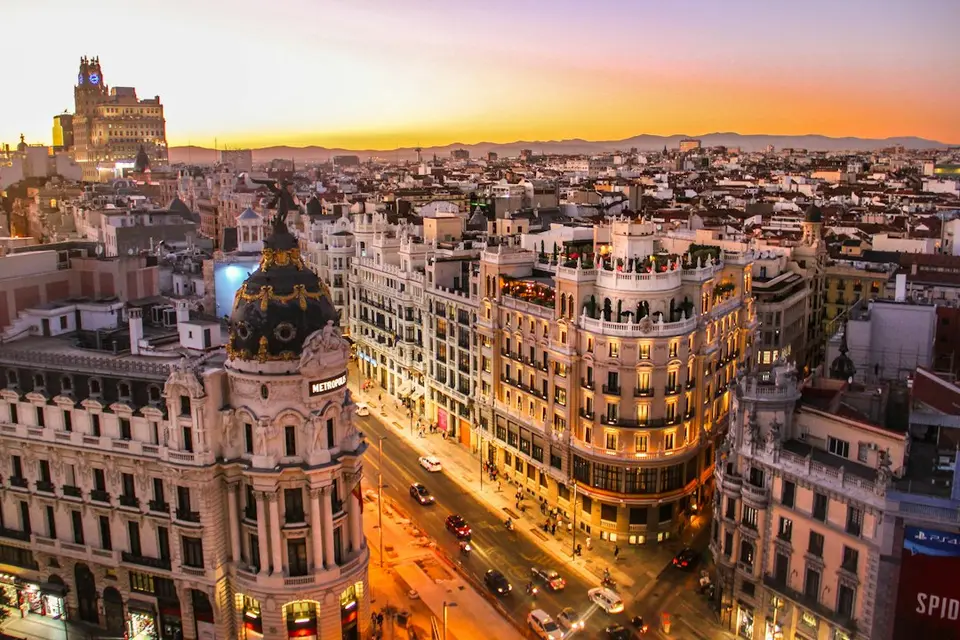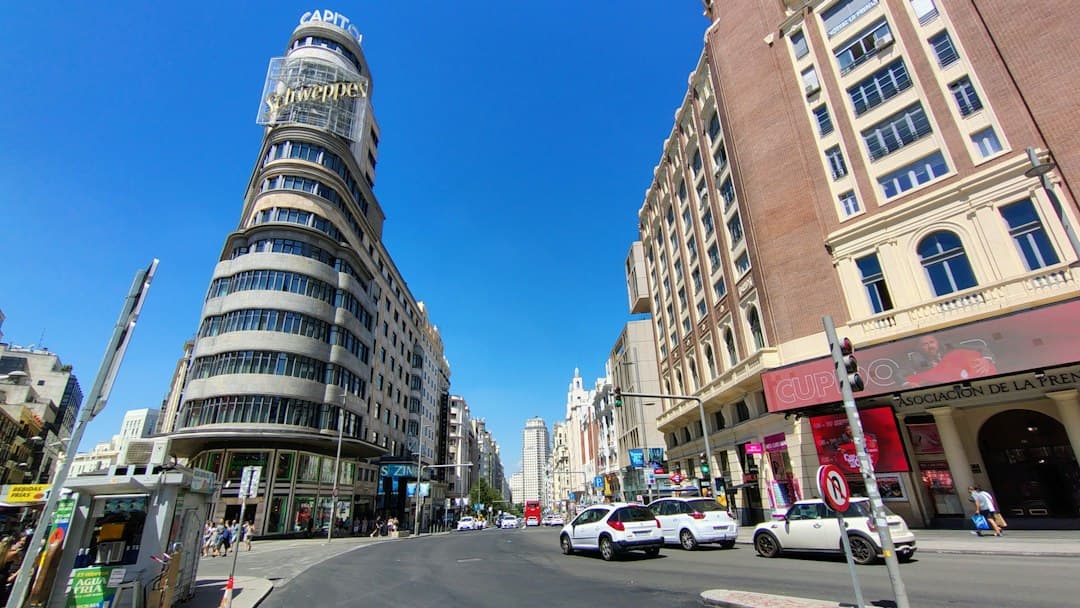
Madrid is best explored on foot, from the museum in the morning to the tapas bar in the evening. This article helps you decide what to see first: the great museums, royal Madrid, the Retiro, the neighborhoods for going out and the dishes to try. You'll also find some tips for organizing your days and the day trips you can take from the city.
Madrid at a glance: why you should go
Madrid sits almost exactly at the center of Spain, and several of Europe's finest art museums are gathered a few hundred meters from one another along the Paseo del Prado[1]. From there, you can walk to the Royal Palace, the squares of the old town and the tapas bars of La Latina[1].
In the heart of the city, the Paisaje de la Luz has been a UNESCO World Heritage Site since July 25, 2021[2]. It is also a city where people dine late and go to bed even later[1]. The city's tourism office sums up the spirit of the place: grapes at Puerta del Sol, cocido (chickpea stew) and flamenco tablaos, "when in Madrid, do as the Madrileños do"[3].
The art triangle: Prado, Reina Sofía, Thyssen
The Prado is the world reference for European painting, from Velázquez to Goya, including El Greco and Bosch[4]. Don't miss Velázquez's Las Meninas or Goya's Black Paintings[4]. The museum opened its doors in 1819, and its collection is built on the art gathered by the kings of Spain[1].
The Reina Sofía is Spain's national museum of 20th-century art[5]. Its centerpiece is Picasso's Guernica, which depicts the bombing of the Basque town in 1937[1]. Guernica draws the largest crowds: go see it first, right when the museum opens[1].
The Thyssen-Bornemisza Museum offers a complete overview of the evolution of painting from the 13th century onward[6]. All three museums are within walking distance of one another[5].
Free time slots and passes
- Prado: free admission Monday to Saturday from 6 pm to 8 pm, and Sundays and public holidays from 5 pm to 7 pm[4]. The line fills up quickly as the free hour approaches: arrive 30 minutes early[4].
- Reina Sofía: free on Mondays and Wednesday to Saturday from 7 pm to 9 pm, and on Sundays from 12:30 pm to 2:30 pm[4].
- Outside free time slots, book your ticket online to enter directly[4].
- The Paseo del Arte pass covers all three museums for €32.80, valid for one year, compared with €41 for three separate tickets[1].
Opening hours and prices change: confirm them on each museum's website before your visit.
Royal and historic Madrid: Royal Palace, Plaza Mayor, Puerta del Sol
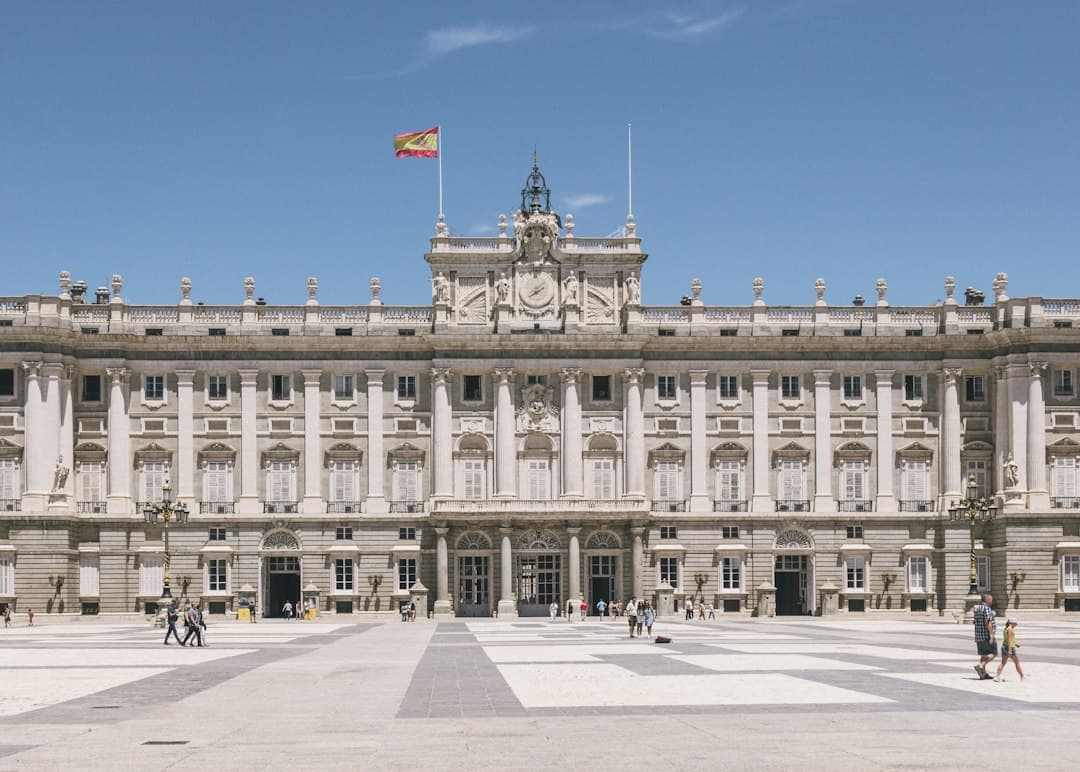
The Royal Palace is one of the most visited monuments in the capital and one of the largest royal residences in Europe[7]. Individual visitors and groups enter via the esplanade of the Almudena Cathedral and the Plaza de la Armería[8]. On the day of your visit, enter through the priority door 15 minutes before the time shown on your tickets, then check in 5 minutes before at the meeting point in the lobby[8].
From Monday to Thursday, from 5 pm to 7 pm (from 4 pm to 6 pm in winter), entry is free for citizens of the European Union, their residents and holders of a work permit, as well as for nationals of Latin America, upon proof of nationality or residence or work permit[8]. This free access is limited to self-guided visits[8].
A combined ticket also gives access to the Royal Collections Gallery, valid for 7 days before or after your palace visit[8]. Note: for the Royal Collections Gallery, free hours are different, from Monday to Thursday from 6 pm to 8 pm, and this ticket cannot be used during that slot[8].
Habsburg Madrid stretches between Cuesta de la Vega and Plaza Mayor, the heart of the city, where traces of the former capital remain: narrow, winding lanes, austere unadorned houses and convents hidden behind high walls[9]. The Mirador de la Cornisa, at the Royal Palace, offers a view over the Campo del Moro gardens and the Casa de Campo[9]. Puerta del Sol is the geographic heart of the city, home to the kilometer zero of the national highways[4]. Plaza Mayor, the Royal Palace and the museums are all within walking distance of one another[4]. It is central and convenient for a first visit, but noisy and touristy if you want to stay the night[4].
Retiro, Landscape of Light and Green Breathing Spaces
The Landscape of Light covers 200 hectares and includes 109 elements spread along the Paseo del Prado, in the Retiro gardens, the Hieronymites district and the Royal Botanical Garden[2]. It brings together 41 monuments, 48 buildings and 20 remarkable trees[2]. The Paseo del Prado is the first urban tree-lined avenue in Europe to appear on the UNESCO list[10].
Retiro Park was once the royal garden and has become the great green lung of the city center[4]. It is free and open every day, with longer hours in summer: check the current opening hours before your visit. Rent a rowboat on the lake facing the monument to Alfonso XII, then head on to the Crystal Palace, a glass and iron greenhouse from 1887 that hosts free exhibitions from the Reina Sofía[4]. This palace and the Palacio de Velázquez may stay closed for long periods for restoration: check the Reina Sofía website before planning to go in[1].
Another curiosity: the Temple of Debod, an authentic Egyptian temple in the heart of Madrid, near Plaza de España, free and open to the public[10]. It dates from the 2nd century BCE, and the view west toward the Sierra makes it the city's best sunset spot[4]. It is closed on Mondays[4].
Neighborhoods to explore: La Latina, Lavapiés, Malasaña, Chueca
- La Latina: traditional Madrid of taverns and tapas, around Cava Baja street[4]. On Sundays, the whole neighborhood converges on El Rastro, the large flea market[4].
- Lavapiés: Madrid's most multicultural neighborhood, popular and lively, with its Indian canteens, vermouth bars and small theaters[4].
- Malasaña: its walls covered in graffiti bear witness to the renewal, and the neighborhood is one of the beating hearts of Madrid's nightlife[6].
- Chueca: together with La Latina and Lavapiés, one of the trendy neighborhoods where you can walk in the footsteps of the Movida[6].
History and Culture: From the Habsburgs to the Movida
Under the Habsburgs, Madrid was not a grand capital: the simplicity of its buildings, the absence of an overall plan and the number of churches surprised foreign envoys and chroniclers[9]. The Alcázar, from which the world was governed, was left in ruins by a terrible fire in 1734[9].
Bourbon Madrid developed along today's Paseo del Prado[9]. In the 17th century, the aristocracy chose to build their residences outside the city limits, and the Buen Retiro palace, built under Philip IV, was the first step toward making eastern Madrid the most elegant side of the capital[9]. It was not until the 18th century that the Prado became the green boulevard lined with residences seen today[9]. Under Charles III, it also established itself as a pillar of Spanish science, with the Cabinet of Natural History (now part of the Prado), the Royal Astronomical Observatory and the Royal Botanical Garden[2].
As for living culture, flamenco tablaos are among the city's classics[3], and the tourist office invites you to explore the city's history, from medieval times to the Movida[3]. You can also trace it in the neighborhoods of Chueca, La Latina or Lavapiés[6].
Food and Markets: Tapas, Cocido, Markets
Set aside at least one full evening for tapas, hopping from bar to bar[6]. A tapa is a small plate, usually served with a glass of wine, a caña (a small glass of beer) or a vermouth, Madrid's favorite aperitif[5]. Some bars offer a tapa with your drink, but in Madrid it is more common to pay for them[5]. Sunday afternoon is the best time to visit Cava Baja street[5].
The most iconic dish of local cuisine is cocido madrileño, which is enjoyed with Madrid wines[11]. As for timing, dinner is generally eaten between 9:00 pm and midnight in Spain[5].
For fresh produce at good prices, municipal markets, such as San Miguel in Madrid, and neighborhood markets remain essential in Spain[12]. Mercadona, Carrefour, El Corte Inglés, Lidl, Aldi and DIA are the country's main supermarket chains[12]. For hot chocolate with churros, a chocolate shop near Puerta del Sol has been serving since 1894, 24 hours a day and 365 days a year[10].
How Much Time to Plan, and Day Trips from Madrid
Two days are enough for the essentials: the Golden Triangle of Art, Retiro, Puerta del Sol, the Royal Palace and the Temple of Debod at sunset[4]. The tourist office also offers ideas for a single 24-hour day or for a weekend[3]. Madrid lends itself to comfortable visits all year round, whether it is hot or cold[3].
To get out of the city, the region has several UNESCO sites: the monastery of El Escorial (San Lorenzo de El Escorial), Alcalá de Henares, and Aranjuez[2]. Alcalá de Henares has been listed since 1998 and is Cervantes' birthplace[2]. The cultural landscape of Aranjuez has been listed since 2001[2]. For Toledo, book your AVE ticket online[4].
Football fans can book a guided tour of the Santiago Bernabéu Stadium (Real Madrid) or the Atlético de Madrid stadium, including the museum, trophies, jerseys, and souvenirs[5].
Key Things to Know Before You Go
- For museums, aim for the free time slots or book online, and go see Guernica as soon as it opens[4][1].
- This Egyptian temple is closed on Mondays, so plan to visit on another day[4].
- At places of worship, covered clothing is generally expected. In the city, casual dress is common, but check the rules for each site.
- Shops usually open from 9:00 am to 9:00 pm, sometimes later in tourist areas[13].
- For the Royal Palace, arrive early at the preferred entrance[8].
This article covers the essentials for a first visit. If you plan to settle in Madrid for longer, you'll need to dig deeper into transportation, budget, and choosing where to stay.
Sources
- 1.^ abcdefghiviajeskris.com — Qué ver en Madrid: las 18 mejores cosas que hacer: “Madrid is almost exactly in the center of Spain, and some of the best art museums in Europe are concentrated within a few hundred meters of each other along the Paseo del Prado.” ; “From the museums, you can quickly walk to the Royal Palace, the old squares of the historic center, and the tapas bars of La Latina.” ; “It's also a city where people dine late and go to bed even later.” https://viajeskris.com/que-ver-madrid/ (accessed November 9, 2026)
- 2.^ abcdefgvisitmadrid.es — World Heritage Sites in Madrid | Must-See UNESCO Sites: “The Landscape of Light is a set of natural and cultural assets located in the heart of Madrid and inscribed on the UNESCO World Heritage List on July 25, 2021.” ; “Covering 200 hectares, the site includes 109 elements spread along the Paseo del Prado, in the Retiro gardens, the Hieronymite quarter, the Royal Botanical Garden, and the surrounding areas. These elements fall into three categories: 41 monuments, 48 buildings, and 20 remarkable trees.” ; “World Heritage sites such as Aranjuez, Alcalá de Henares, and El Escorial.” https://www.visitmadrid.es/fr/faire-madrid-plans-et-experiences-incontournables/faire/culture-madrid-art-histoire-et-traditions-4 (accessed November 9, 2026)
- 3.^ abcdeesmadrid.com — Madrid at a Glance | Tourism Madrid: “Grapes on Puerta del Sol, cocido (chickpea stew), traditional tablaos (flamenco clubs)… When in Madrid, do as the Madrileños do.” ; “From medieval times to the Movida movement, explore the city's rich history.” ; “One day isn't enough for Madrid, but if you only have 24 hours, we'll help you make the most of it.” https://www.esmadrid.com/en/madrid-at-a-glance (accessed November 9, 2026)
Show 11 more sourcesShow less
- 4.^ abcdefghijklmnopqrstnews.travel.orange.com — What to Do in Madrid? Highlights and Itinerary | Orange Travel: “The world's leading reference for European painting, from Velázquez to Goya, passing through El Greco and Bosch.” ; “Don't miss Velázquez's Las Meninas or Goya's Black Paintings.” ; “Admission is free Monday through Saturday from 6:00 pm to 8:00 pm, and on Sundays and public holidays from 5:00 pm to 7:00 pm. The queue fills up fast as the free hour approaches, so arrive 30 minutes early.” https://news.travel.orange.com/fr/que-faire-madrid (accessed November 9, 2026)
- 5.^ abcdefglonelyplanet.com — 12 Best Things to Do in Madrid - Lonely Planet: “The Reina Sofía is Spain's national museum of 20th-century art, with a rich collection of works by surrealist and cubist masters such as Salvador Dalí and Pablo Picasso, including Picasso's immense and groundbreaking antiwar painting, Guernica.” ; “All are within walking distance of each other, near the Real Jardín Botánico.” ; “A tapa is a small plate of food usually served with a glass of wine, a caña (small glass of beer), or a vermouth, Madrid's favorite aperitif.” https://www.lonelyplanet.com/articles/top-things-to-do-in-madrid (accessed November 9, 2026)
- 6.^ abcderoutard.com — Madrid: the highlights | What to do, what to see, what to visit?: “the Thyssen-Bornemisza Museum for a complete overview of the evolution of painting since the 13th century” ; “Malasaña and its graffiti-covered walls, a sign of the revival and one of the beating hearts of Madrid's nightlife.” ; “Walk in the footsteps of the Movida through the trendy neighborhoods of Chueca, La Latina, or Lavapiés.” https://www.routard.com/fr/guide/top/europe/espagne/madrid (accessed November 9, 2026)
- 7.^visitmadrid.es — What to Do in Madrid | Activities, Tours, and Experiences: “The Royal Palace of Madrid is one of the most visited monuments in the Spanish capital and one of the largest royal residences in Europe.” https://www.visitmadrid.es/fr/faire-madrid-plans-et-experiences-incontournables (accessed November 9, 2026)
- 8.^ abcdefgtickets.patrimonionacional.es — Entry to the Royal Palace of Madrid. Visiting hours and opening times - Patrimonio Nacional: “From August 20, access for individual visitors and groups will be through the Almudena Cathedral esplanade/Plaza de la Armería.”; “You must enter the Royal Palace through the priority entrance 15 minutes before the time shown on your tickets, and check in 5 minutes before at the meeting point in the Palace's entrance hall.”; “From Monday to Thursday, from 5 pm to 7 pm (from 4 pm to 6 pm in winter), entry is free for all citizens of the European Union, residents and holders of a work permit from those countries, as well as nationals of Latin America, upon proof of nationality (identity card, passport or driver's license) or of residence or work permit.” https://tickets.patrimonionacional.es/fr/tickets/palacio-real-de-madrid (accessed November 9, 2026)
- 9.^ abcdefgesmadrid.com — History of Madrid | Tourism Madrid: “Between the Cuesta de la Vega and the Plaza Mayor, the heart of the city, you will find traces of the former capital.”; “In Habsburg Madrid, you can still see narrow, winding streets, austere unadorned houses, and convents hidden behind high walls.”; “You can also visit the Mirador de la Cornisa at the Royal Palace, which offers superb views of the Campo del Moro gardens and the Casa de Campo.” https://www.esmadrid.com/en/history-madrid (accessed November 9, 2026)
- 10.^ abcesmadrid.com — Things you can only do in Madrid | Tourism Madrid: “The Paseo del Prado is the first tree-lined urban promenade in Europe to be listed.”; “Our city offers you the unique opportunity to visit an authentic Egyptian temple without leaving Spain, at the Temple of Debod. Located near Plaza de España, this monument is open to the public and free of charge.”; “Since 1894, the famous chocolate con churros has been served here, along with cold drinks, coffees and other pastries. Open 24 hours a day, 365 days a year.” https://www.esmadrid.com/en/things-you-can-only-do-madrid (accessed November 9, 2026)
- 11.^visitmadrid.es — VisitMadrid | VisitMadrid: “Finally, end your evenings by experiencing the intense passion of Madrid flamenco in an authentic tablao.”; “Although its most worthy representative is the cocido madrileño, served with Madrid wines, traditional cuisine offers much more.” https://www.visitmadrid.es/en (accessed November 9, 2026)
- 12.^ abMira Knowledge — Municipal markets, such as San Miguel in Madrid, and neighborhood markets remain essential in Spain for fresh produce at good prices. Checked on June 11, 2026: reference source expat.com. https://www.expat.com/en/guide/europe/spain/ (accessed June 11, 2026)
- 13.^Mira Knowledge — Shops generally open from 9 am to 9 pm, sometimes later in tourist areas. Checked on June 11, 2026: reference source wikitravel.org. https://wikitravel.org/en/Indonesia (accessed June 11, 2026)
- 14.Mira Knowledge — Covered clothing is expected when visiting religious sites, while shorts and tank tops are acceptable for tourists in urban areas. Checked on June 11, 2026: official source travel.state.gov. https://travel.state.gov/en/international-travel/travel-advisories/mauritius.html (accessed June 11, 2026)