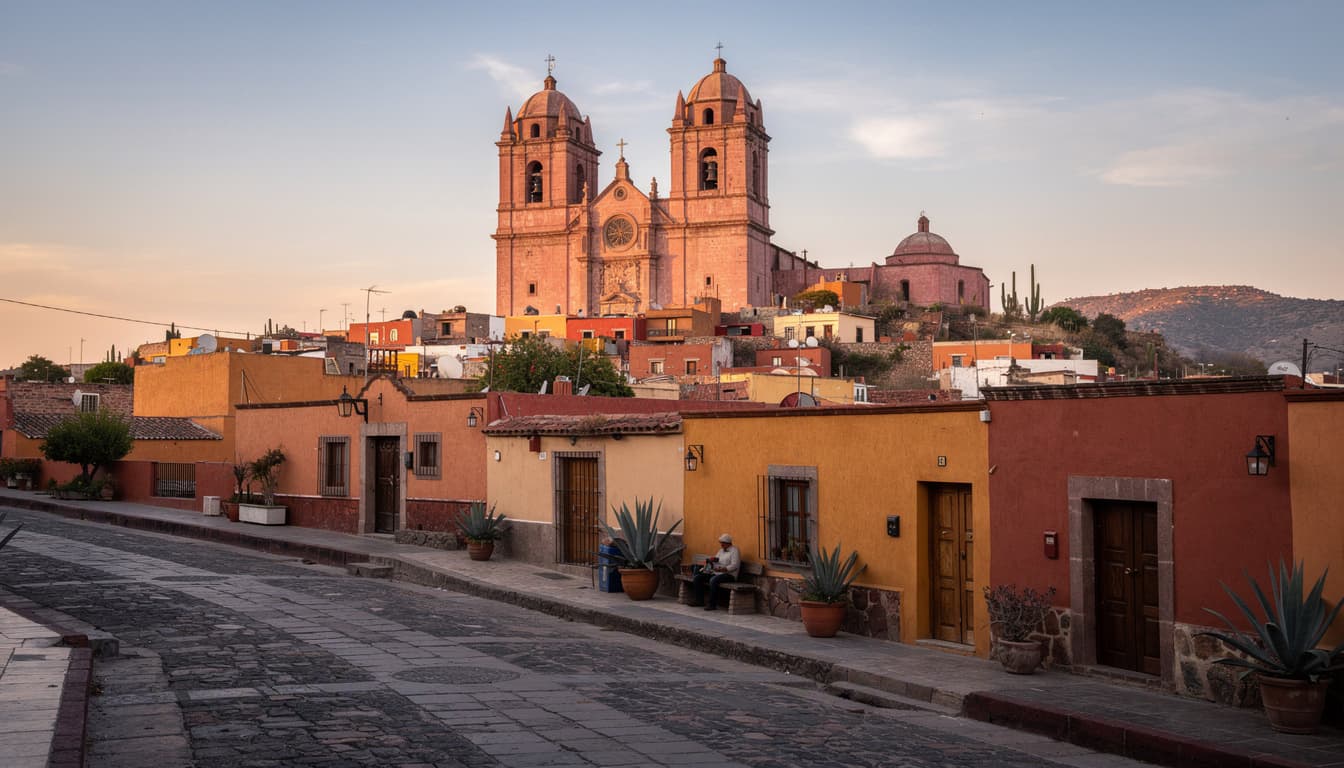
San Miguel de Allende, in the highlands of Guanajuato, is best explored on foot, from the pink facade of the Parroquia to the galleries of a former textile mill. This article helps you choose what to see first, understand the history that explains the city, and plan a stay of a few days: season, access, duration. To place the city within the country, also see "Mexico: The Highlights, Region by Region."
A Colonial City on the UNESCO List: The History in Brief
San Miguel de Allende is a fortified town founded in the 16th century to protect the royal road into the interior. It reached its height in the 18th century, when its main religious and civic buildings were erected in the Mexican baroque style[1]. It was born on the silver road, which linked Mexico City to major mining centers such as Zacatecas[2].
Its location made it a melting pot: Spaniards, Creoles and Indigenous peoples exchanged cultural influences there[1]. The center and the Atotonilco sanctuary have been inscribed on the UNESCO World Heritage List since July 8, 2008, for their cultural and architectural significance as well as the town's role in Mexico's struggle for independence[2].
This is where the country's history meets the town's. The second part of the city's name honors Ignacio Allende, a central figure in the early war of independence, who was born here[2]. Once independence was declared, the first town hall of independent Mexico was established here, and the town received the status of city in 1826[2].
What to See in the Historic Center
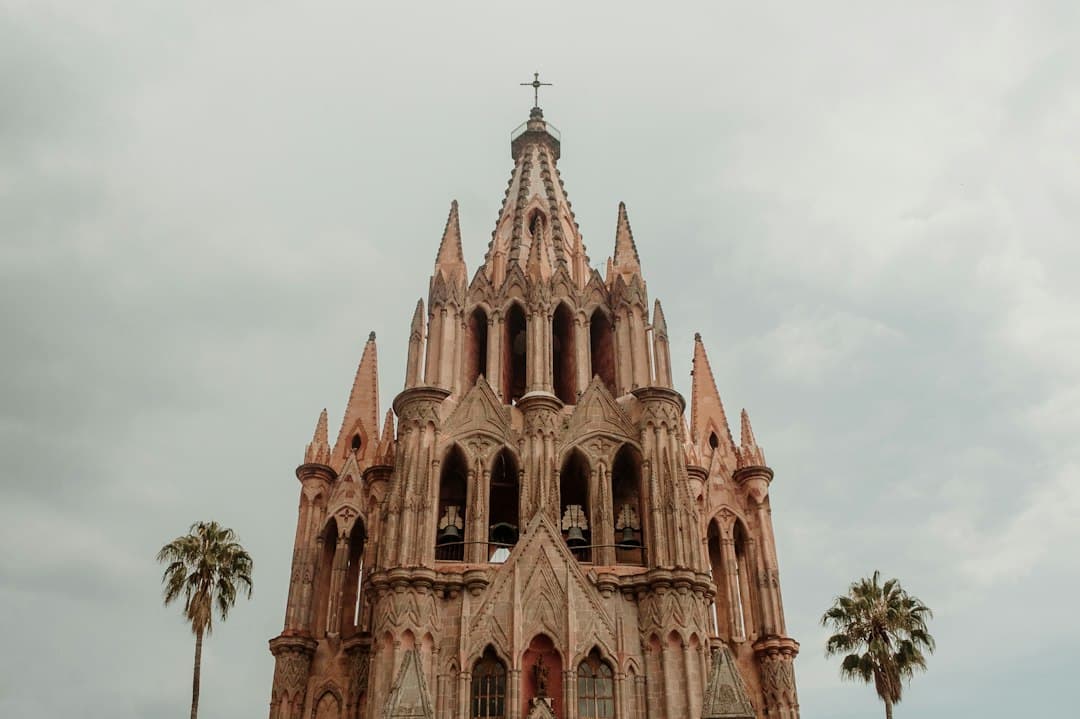
Start with the Parroquia de San Miguel Arcángel, on the main square. Its neo-Gothic facade in pink stone, tall spires and pointed arches make it the symbol of the city[2]. The easiest way to admire it is to sit on a bench in the Jardín or have a meal at one of the restaurants and cafés around it[3].
Baroque style dominates the houses and churches. The church of San Francisco and the chapel of Nuestra Señora de la Salud are examples; the Casa de la Canal shows a transition between baroque and neoclassical[2]. Among the other 17th- and 18th-century buildings, the Templo de la Concepción[4] and the Oratorio de San Felipe Neri, with its richly worked 18th-century facade[5], deserve a visit.
The Casa de Allende is now a museum: it was the home of Ignacio Allende, one of the main figures in the early war of independence[6].
The town is small enough to explore on foot[7]. The best approach is to wander through the network of cobbled lanes and let the discoveries come to you[7].
Arts, Galleries and Crafts
Fábrica La Aurora is a former textile mill that has become a creative complex, housing art galleries, design studios and cafés[5]. On Saturday mornings, artists' studios open their doors, and many creators are happy to talk about their work[5]. The city has more than a hundred galleries, enough to browse even if you have no intention of buying[7].
This artistic identity has a history. The Escuela de Bellas Artes was founded in 1938 by the Peruvian Felipe Cossío del Pomar and the American Stirling Dickinson[6]; it still exists today in a former convent, under the name Centro Cultural El Nigromante[6]. After the Second World War, American veterans who could study abroad thanks to the G.I. Bill came in large numbers, which built the town's cultural reputation[6]. Today the site houses a museum, two galleries and a café in its courtyard[4].
On weekends, art stalls await you at Parque Benito Juárez[3].
Atotonilco and the Surrounding Area
Fourteen kilometers from the town, the Jesuit sanctuary of Atotonilco, also dating from the 18th century, is one of the finest examples of baroque art and architecture in New Spain[1]. It is nicknamed the "Sistine Chapel of Mexico"[8]. It consists of a large church and several smaller chapels, decorated with oil paintings and murals[1]. These baroque frescoes are the main reason to visit[4].
The site also has historical significance: according to tradition, Miguel Hidalgo took an image of the Virgin of Guadalupe there, on the road to San Miguel, and adopted it as his banner[2].
Another outing is the El Charco del Ingenio botanical garden, where you'll see more cactus varieties than you might imagine, with guided tours[7]. To get there, as well as to La Aurora, take an Uber-type ride-hailing car or a taxi[7].
For a day out of the city, you have several options:
- the nearby hot springs, such as La Gruta or Escondido Place, with mineral-rich thermal waters[9];
- the Querétaro wine region, about an hour away[7];
- excursions to Guanajuato, a UNESCO World Heritage city, and to the village of Dolores Hidalgo[9].
Festivals and Cultural Calendar
The city is a hub of festivals: Baroque music in March, chamber music at the Angela Peralta Theater in August, the International Jazz Festival in November, and a film festival[2]. The latter brings together filmmakers and cinephiles in March for a week of independent screenings and discussions[5].
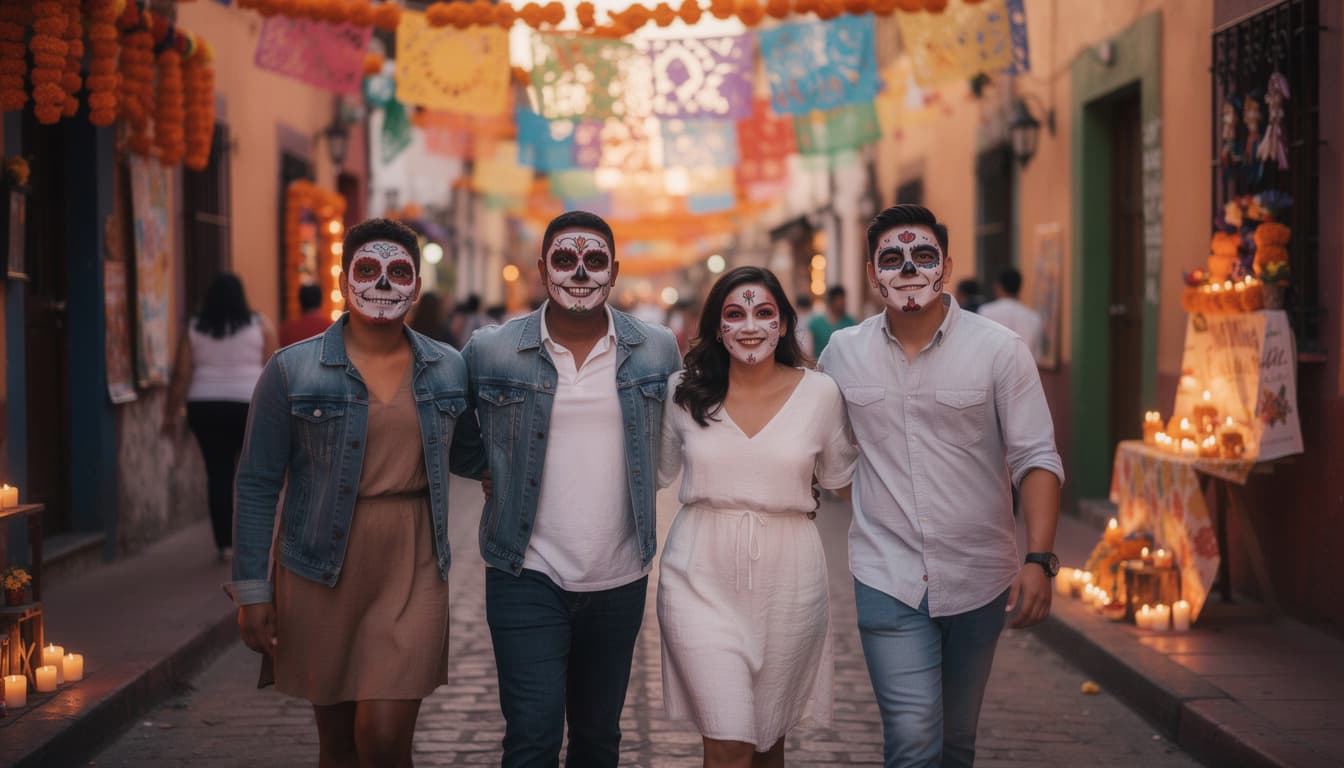
For more traditional celebrations: Holy Week, the Desfile de los Locos in June, the Mojigangas parade, the historic ride to Dolores Hidalgo, and the patron saint festival of San Miguel Arcángel in September[2]. The Desfile de los Locos, a colorful carnival, is one of the year's highlights[10]. In February, Parque Juárez fills with flowers during the Feria de la Candelaria, a flower and garden fair that heralds spring[5]. Day of the Dead celebrations also animate the city[9]; the autumn festival season and Day of the Dead are especially lively there[11].
Food and Markets
At the stalls of the Mercado Ignacio Ramírez, you'll find many specialties from the state of Guanajuato[4]. Try the enchiladas mineras (fried tortillas with cheese or chicken, spicy sauce, and toppings), the pacholas (fried beef patties), and the fiambre (lettuce topped with fruit, vegetables, and meats)[4].
For the views, head up to the rooftop terraces: you can enjoy the panorama and the food scene[11]. And if you want to extend the experience, a cooking class teaches you to prepare traditional Mexican dishes with fresh, local ingredients[9].
Practical Info: Season, Access, Duration
The city sits at about 6,200 ft (1,900 m) of altitude, and the highland climate is mild year-round. From October to April it is dry and pleasant; from June to September, afternoon rains fall[11].
There is no airport in San Miguel. Most American travelers land at Bajío/León (BJX) or Querétaro (QRO), each about 1 hr 30 min away, or in Mexico City (MEX), 3 hrs 30 min to 4 hrs by road[11]. According to Lonely Planet, Querétaro is 1 hr 15 min away and León 1 hr 30 min; you can book a transfer through your hotel, or take a taxi from the airport[7].
Plan for three days: enough time to explore the cobblestone streets, visit Fábrica La Aurora, and take a day trip to a nearby wine estate[7]. On site, you'll walk to almost everything; for taxis, you'll need Mexican pesos in cash in most parts of the country[7].
Safety Precautions
The State of Guanajuato is rated Level 3 (“Reconsider Travel”) by the U.S. Department of State. San Miguel itself is a very popular city with a large foreign community, generally considered safe, even though the state falls under a higher alert level[11]. Many travelers visit without incident by arriving by air, staying in the main neighborhoods, and avoiding intercity travel at night; check the current travel advisory before you leave[11].
In the same state, France Diplomatie formally advises against travel to the triangle formed by Celaya, Irapuato, Salamanca, and their surroundings[12].
Visitors have also reported high prices in the city for parking, food (tacos, ice cream), and souvenirs[10]: compare before you buy.
Key Takeaways for Planning Your Stay
- Plan for three days, aiming for October to April if you want to avoid afternoon rains.
- Choose your airport (León, Querétaro, or Mexico City) based on driving time, and book a transfer.
- Keep some pesos in cash for taxis.
- Set aside a half day for Atotonilco and another for the Botanical Garden, or for a winery.
- Check festival dates before you lock in your tickets: the Desfile de los Locos (June) and the San Miguel Arcángel celebration (September) are among them.
This article covers the main outlines of a trip. To go further, you'll need to plan your accommodation, budget, and transport connections in detail.
Keep exploring
- Mexico: The Must-Sees, Region by Region, to Help You Choose Where to Go
- Guanajuato: What to See and Do in the Colorful Colonial City of Alleys
- Guadalajara: What to See and Do in Mexico's Capital of Mariachi and Tequila
- Mexico City: What to See and Do, from the Zócalo to Xochimilco
Sources
- 1.^ abcdwhc.unesco.org — Protective town of San Miguel and the Sanctuary of Jesús Nazareno de Atotonilco - UNESCO World Heritage Centre: "The fortified town, established in the 16th century to protect the royal road into the interior, reached its height in the 18th century, when many of its remarkable religious and civil buildings were built in the Mexican Baroque style." ; "Because of its location, San Miguel de Allende served as a melting pot where Spanish, Creole, and Indigenous people exchanged cultural influences." ; "Located 14 km from the town, the Jesuit sanctuary, also from the 18th century, is one of the finest examples of Baroque art and architecture in New Spain." https://whc.unesco.org/en/list/1274/ (accessed November 9, 2026)
- 2.^ abcdefghilugares.inah.gob.mx — San Miguel de Allende: "San Miguel de Allende was founded to protect the Camino Real Tierra Adentro (the royal inland road), which was part of the silver route linking Mexico City to major mining centers such as Zacatecas." ; "San Miguel de Allende and the Sanctuary of Jesús Nazareno de Atotonilco were declared a historic monuments zone on July 28, 1982, and inscribed on the UNESCO World Heritage List on July 8, 2008, for their cultural and architectural importance as well as the town's role in Mexico's struggle for independence." ; "Later, the name of Ignacio Allende, a central figure in the early stages of the War of Independence, was added in honor of his birth in the town." https://lugares.inah.gob.mx/en/node/4794 (accessed November 9, 2026)
- 3.^ abaaa.com — aaa-travel-icon: "Sit on a park bench or have a meal at one of the restaurants or cafés surrounding the Jardín, and admire the spectacular façade of the church." ; "On weekends, browse the art stalls in Parque Benito Juárez." https://www.aaa.com/tripcanvas/article/top-things-to-do-in-san-miguel-de-allende-mexico-CM1209 (accessed November 9, 2026)
Show 9 more sourcesShow less
- 4.^ abcdekayak.com — San Miguel de Allende Travel Guide | San Miguel de Allende Tourism - KAYAK: "You'll find many typical dishes of the State of Guanajuato if you explore the stalls of the Mercado Ignacio Ramírez." ; "Be sure to try the enchiladas mineras (fried tortillas with cheese or chicken, spicy sauce, and toppings), the pacholas (fried beef patties), and the fiambre (lettuce topped with fruit, vegetables, and meats)." ; "Other notable 17th- and 18th-century buildings include the Templo de la Concepción and the Templo de San Francisco. Also be sure to visit the Atotonilco sanctuary to see the Baroque frescoes painted on the chapel walls." https://www.kayak.com/San-Miguel-de-Allende.24227.guide (accessed November 9, 2026)
- 5.^ abcdecontexttravel.com — San Miguel de Allende Travel Guide 2027 | Context Travel: "A former textile factory turned creative complex, Fábrica La Aurora now houses art galleries, design studios, and cafés." ; "Visit on Saturday morning for the open studios; many artists are happy to talk about their work." ; "Oratorio de San Felipe Neri: a highly ornate 18th-century church façade." https://www.contexttravel.com/stories/articles/san-miguel-de-allende-a-complete-travel-guide-for-2026 (accessed November 9, 2026)
- 6.^ abcden.wikipedia.org — San Miguel de Allende - Wikipedia: "The Casa de Allende museum was the home of Ignacio Allende, one of the leading figures in the early period of Mexico's War of Independence." ; "The Escuela de Bellas Artes was founded in 1938 by the Peruvian Felipe Cossío del Pomar and the American Stirling Dickinson." ; "The school was called the Escuela de Bellas Artes; it still exists today, locally known as Bellas Artes or Centro Cultural El Nigromante." https://en.wikipedia.org/wiki/San_Miguel_de_Allende (accessed November 9, 2026)
- 7.^ abcdefghilonelyplanet.com — A guide to San Miguel de Allende - Lonely Planet: "San Miguel de Allende is small enough to explore on foot, but it is also full of art galleries and interesting shops that you'll want to browse at your leisure." ; "Three days will give you time to get lost in its cobblestone streets, visit the Fábrica La Aurora arts complex, and take a day trip to a nearby winery." ; "To visit the Botanical Garden or Fábrica La Aurora, you can take a ride-hailing service such as Uber or a taxi." https://www.lonelyplanet.com/articles/guide-to-san-miguel-de-allende (accessed November 9, 2026)
- 8.^guanajuato.mx — San Miguel de Allende - Guanajuato.mx: "Sanctuary of Jesús Nazareno de Atotonilco: the Sistine Chapel of Mexico." https://guanajuato.mx/en/san-miguel-de-allende/ (accessed November 9, 2026)
- 9.^ abcdwtp.travel — San Miguel de Allende Travel Guide - Mexico | World Travel Package: “Relax and recharge in the nearby hot springs, such as La Gruta or Escondido Place, where you can soak in mineral-rich thermal waters surrounded by natural beauty.”; “Explore the surrounding countryside with day trips to nearby attractions such as the UNESCO World Heritage city of Guanajuato, the charming village of Dolores Hidalgo, or the Cañada de la Virgen archaeological site.”; “From the famous San Miguel de Allende International Film Festival to the lively Dia de los Muertos (Day of the Dead) celebrations, there is always something happening in San Miguel.” https://wtp.travel/fr/guides-voyage/mexique/san-miguel-de-allende/ (accessed November 9, 2026)
- 10.^ abwanderlog.com — San Miguel de Allende Ciudad Paraíso World Heritage Site, San Miguel de Allende, Mexico - Reviews, Ratings, Tips and Why You Should Go – Wanderlog: “Festivals are frequent, with the colorful Desfile de los Locos carnival in June being one of the highlights.”; “Some reviewers, however, mention high prices in the city for parking, products such as tacos and ice cream, and souvenirs.” https://wanderlog.com/place/details/12812561/san-miguel-de-allende-ciudad-para%C3%ADso-patrimonio-de-la-humanidad (accessed November 9, 2026)
- 11.^ abcdefmexicoturismo.com.mx — San Miguel de Allende, Mexico: Things to Do & Guide: “San Miguel has a mild high-altitude climate year-round (around 1,900 m). From October to April, it is dry and pleasant; from June to September, rain falls in the afternoon. The autumn festivals and the Day of the Dead period are especially lively.”; “San Miguel has no airport. Most American travelers land at Bajío/León (BJX) or Querétaro (QRO), about 1 hour 30 minutes from town each, or at Mexico City (MEX), 3 hours 30 minutes to 4 hours by road.”; “Admire the Parroquia de San Miguel Arcángel on the main square (El Jardín), browse the galleries and the Fabrica La Aurora art center, enjoy the views from the rooftop terraces and the food scene, and soak in the nearby hot springs.” https://www.mexicoturismo.com.mx/en/san-miguel-de-allende.html (accessed November 9, 2026)
- 12.^diplomatie.gouv.fr — Mexico - Safety | France Diplomatie: “Travel to the area within the triangle formed by the cities of Celaya, Irapuato, Salamanca and their surroundings is strongly discouraged.” https://www.diplomatie.gouv.fr/fr/information-par-pays/mexique/conseils-aux-voyageurs-securite (accessed November 9, 2026)