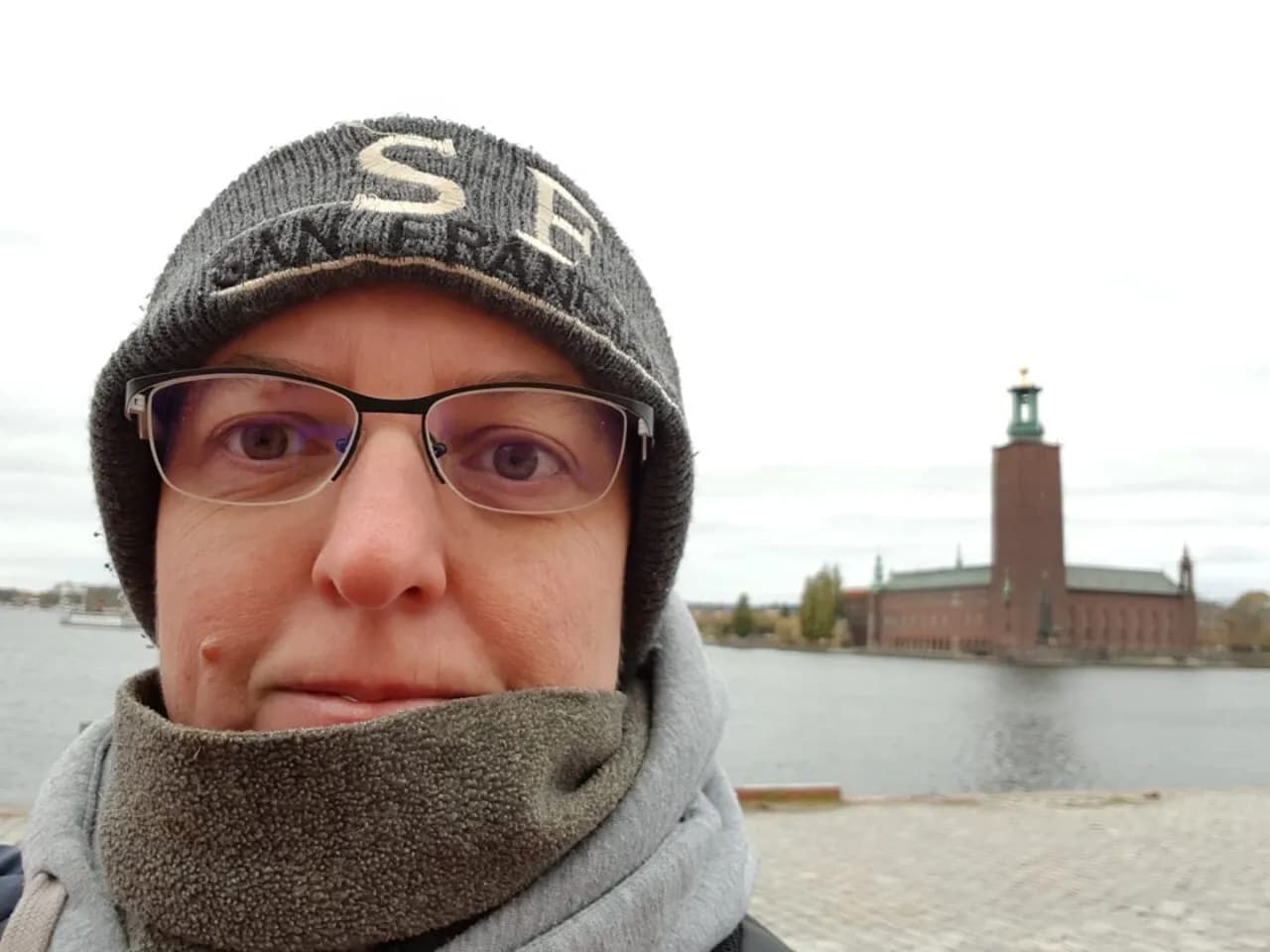
Chantal Piessens is 55, has a dog, two cats, and nearly 35 years in IT behind her. For four years, she traveled across France in a campervan, alone with her animals, while working full-time as IT support for a group of private hospitals. Her office: a supermarket parking lot during the week, a forest or the seaside on weekends. Her schedule: dictated every four weeks by a chemotherapy treatment she will never be able to stop. This is perhaps the least expected face of digital nomadism: a senior digital nomad, in a parking lot, with cancer. And that is precisely what makes her story powerful.
When staying is no longer bearable
Chantal doesn't talk about a turning point. She talks about saturation. Six years caring for her elderly parents, her own life put on hold, then lockdown. When her parents were placed in a care home, the need to leave was no longer up for discussion.
«I felt the need to leave everything behind — my home and my job — to recharge and find myself again.»
No partner, no children. But animals, whom she considers her own. A first converted van, bought with her parents' help, to test the waters. Then a second-hand campervan, larger, so the two cats wouldn't live confined in too small a space. And then departure. Four years on the roads of France, from one region to another, from a free parking spot to a France Passion winemaker's estate, via authorized rest areas that are becoming increasingly rare.
Nomad and sick: organizing freedom around a constraint
What makes Chantal's journey unique in this series is that she didn't choose nomadism despite her illness — she chose it with it. Cancer, lifelong chemotherapy, a treatment every four weeks that lasts fifteen minutes but dictates the rhythm of everything else.
«It requires a certain level of organization. Unlike other nomads, I have to plan most of my trips in advance. That mainly means coming back for my treatment. You have to calculate everything ahead of time.»
In practice, it looks like this: on weekends, she heads to a new region. For three weeks, she navigates that area, working eight hours a day from her campervan. Then the weekend before treatment, she makes the return trip to the hospital. Once a year, she can skip a treatment — that's her window to go a little further.
Sweden is her dream. The Nordic countries are her paradise — the right to park anywhere, accessible nature, the Swedish law that says nature belongs to everyone. But with a treatment costing 10,000 euros per session, settling there is administratively and financially impossible. Chantal is stuck in France. She says it plainly: it's frustrating.
Supermarket parking lot, 8 hours a day, and that's perfectly fine
Chantal's nomadism has nothing to do with Instagram Reels. She knows it, and it doesn't bother her at all.
«People see the Instagram photos and think 'this life is amazing.' It's true, there are stunning places. But the photos don't show what's behind the scenes: a busy road right next to you, trash everywhere, the daily management — water, gas, laundry, groceries, repairs. I'd say the posted photos represent about five minutes out of much less glamorous days.»
Chantal's daily life is practical: finding an authorized parking spot, managing electrical autonomy (solar panels, batteries), filling up water for two euros per hundred liters or for free at a cemetery, and fixing things. Lots of fixing. Vehicles vibrate, furniture breaks, and if you're not handy, the bill adds up fast.
Cheaper than settled life
This is the most counterintuitive aspect of Chantal's journey: nomadism in a campervan cost her less than settled life. No more rent, no running water to pay for, no electricity if the vehicle is well-equipped, and far fewer kilometers than you might imagine.
«You end up realizing that you can make do with very little and that you overconsume without even noticing.»
On one condition: buying the vehicle outright. And accepting that it's not like being at home — no three showers a day, no lights on all the time, no overconsumption by default. For Chantal, who comes from a frugal relationship with money, it's more of an obvious choice than a sacrifice.
Solitary, not antisocial
Loneliness? Chantal brushes it off with a wave of her hand. She has always been solitary — not antisocial, she clarifies, but solitary. She enjoys her peace and quiet. She can settle somewhere and not see anyone for two weeks without it bothering her in the slightest.
«I've always preferred the company of animals to that of humans. They're more genuine.»
But nomadism also brought her what she would never have found by staying settled: unexpected encounters. In a parking lot near Salon-de-Provence, made available for free by the city, she made a group of campervan friends she's still in touch with. Some still come to visit her at the barn she now rents in Vendée, in the middle of the fields. The campervan community works like that: a solidarity of shared experience, without pretense.
The golden rule
On safety as a woman alone, Chantal has a simple, non-negotiable rule that she gives to every woman considering vehicle-based nomadism:
«If you arrive somewhere and it doesn't feel right — there might be nothing visible, just a bad feeling — you have to leave. That's the advantage of being a nomad: you're not stuck.»
She has applied it herself. A place that looked perfect, but a vague unease when evening came. She left. No drama, no incident. Just an instinct respected. Having a dog helps too, she adds — both for company and as a deterrent.
And now?
Chantal had to resign herself to selling her campervan — too many breakdowns, too many risks for her animals. She now lives in a converted barn in Vendée, 45 minutes from Les Sables-d'Olonne, in the heart of nature. It's no longer nomadism in the strict sense, but the spirit is intact: the dog, the walks, the Charente not far away, the Marais Poitevin within driving distance.
Her treatment is causing more and more complications, especially in terms of pain. For now, she makes do with the occasional camping trip by car, with a tent and the dog. She is becoming settled again to better care for herself — and perhaps, one day, to set off again.
If she had to give advice to a woman her age who is hesitating? Chantal doesn't sell dreams. She asks questions: «Is loneliness hard for you? Are you ready to give up overconsumption? Are you handy?» And if the answers hold up — then go for it.
This article is part of our series published for International Women's Rights Day 2026. At Hello Mira, we believe that digital nomadism is best experienced when shared — with locals, with other nomads, with those who dare. That's why we give a voice to women who live this adventure every day, with their doubts, their struggles, and their vision.
Find Chantal
This article is part of the Hello Mira series for International Women's Rights Day 2026. Discover our full investigation: our female nomadism investigation.
Discover more portraits of nomad women
Join the Hello Mira community to discover more inspiring portraits of women living digital nomadism their own way. [Meet all the women →](/en/blog/7-inspiring-women-digital-nomads)
Join Our Community