Spending a few weeks in a city before settling there lets you check a choice that looks obvious on paper. This article helps you tell apart what a tourist stay allows from what it does not, shows you the legal length of stay in the Schengen Area, and points out the pitfalls of this kind of stay. It also tells you what to verify, and from which source, before you turn the trial into a move.
Why a trial stay before settling
A trial stay lets you compare the idea you have of a place with reality: the neighborhood, the housing, the rhythm of the days, the language. It is a good method, as long as you don't ask it for more than it can give.
First point: a tourist stay does not, by itself, give you the right to settle. A Schengen short-stay visa, for example, does not allow you to settle in France, unlike a national long-stay visa (type D)[1]. A trial stay remains a trial stay, however good the place turns out to be.
Second point: a few weeks only show part of the year. If you can, plan to come back, or to stay, during the least pleasant season of the place (heat, rain, winter, peak tourist season) before you decide.
Legal framework of a trial stay: duration, entry, what it allows
Before you leave, check the documents required to enter and stay in the country you are targeting (ID card, passport, visa) on the country page, under "Travel Advice," tab "Entry/Stay"[2]. Outside the European Union, most states require a passport that remains valid for several months after your planned return to France[2].
In the Schengen Area, a third-country national may in principle enter for a maximum of 90 days within any 180-day period[3]. These 180 days form a "rolling" period: each day, you look back at how many days you have spent in the Schengen Area over the previous 180[3].
The day of entry counts as the first day, and the day of exit as the last[3]. If you make several short stays, each one adds up to the same 90-day total[3].
This rule does not apply to everyone. A European Union residence permit or a long-stay visa is outside the 90/180-day rule, since these documents allow you to stay more than 90 days[4]. A trial stay in a non-Schengen country follows its own rules: depending on the destination, the country page, under "Travel Advice," tab "Entry/Stay," is the authoritative source.

Exploring a neighborhood on foot: the evaluation grid
There is no single method for exploring a neighborhood, nor universal criteria for judging a place as safe, clean and pleasant. This section therefore offers a set of questions to ask yourself, not established rules: adapt them to your situation.
- Everyday services: where are the shops, healthcare providers, transport, and schools if you have children?
- Real distances: how many minutes on foot between your home, the transport stop, and the services you need?
- Cleanliness and noise: is the neighborhood the same in the morning, in the evening, on weekdays and on weekends? Go back at several different times.
- Perceived safety: do you feel comfortable walking home in the evening? For official alerts about a country, consult the "Travel Advice" page on diplomatie.gouv.fr.
- Nature and communities: is there a green space, a place to practice sports, somewhere to meet other people?
To complete your impression on the ground, look up the public data for the area (local statistics, facilities, natural hazards). Find the statistics or urban planning website of the municipality or country you are targeting, and check what it publishes.
Language, local communities and daily life
Language weighs on daily life quickly, and the answer varies widely from country to country. In Mauritius, English is the official language, spoken in government and business, but everyday exchanges happen mostly in Mauritian Creole or French[5]. In Spain, English proficiency is moderate: you'll hear it in international companies, tourist areas and among young urban residents, but it is not widespread[6].
In regions where co-official languages coexist (Catalan, Basque, Galician in Spain), using a few words of the regional language is greatly appreciated locally[6]. During your test stay, note the situations where you felt comfortable without speaking the language, and those where you got stuck: paperwork, the pharmacy, conversations with neighbors.
Also observe the local traditions of exchange. In Malaysia, the tradition of the "open house" (rumah terbuka) means opening your home to friends, family and neighbors during the holidays, especially Hari Raya; it is a moment of intercultural exchange where each community shares its culinary specialties[7]. These examples apply only to the countries cited: they show the type of clue to look for, not a rule to transpose.
Working Remotely From Your Test Location
Remote work from a test stay location is not a given. With a Schengen short-stay visa, working requires holding a work authorization for a paid activity[1]. This page describes the case of France; for another country, check the rule with its authorities.
Some countries offer a visa designed for remote workers. Mauritius, for example, offered, according to our last check, a one-year renewable Premium Travel Visa compatible with long-term rentals[8]; this scheme may have changed, so confirm with the Mauritian authorities. If the location you are testing has a comparable scheme, check its conditions on the country's official website before booking.
To look for online work compatible with remote work in a new region, check with the official employment services of the target country.

Pitfalls, Scams and Points of Vigilance
Counting Your Days in Schengen
Every day counts in the rolling 180-day period. Once you have used 90 days, you must stay out of the Schengen area until the earliest days drop out of the 180-day window[3]. An example published by the Swiss State Secretariat for Migration: 90 days of stay starting March 1, 2025 push the first possible return date to August 28, 2025[3]. An official European Commission calculator lets you check a past stay or plan a future one[4].
A Visa Shorter Than 90 Days Takes Precedence
If you hold a short-stay visa, check the authorized length of stay printed on the sticker: if it is less than 90 days, do not use the 90/180 calculator[4].
Non-Refundable Visa Fees
If your visa is refused or your stay is cancelled, the amount paid is not refunded[1]. The same page also notes that the private provider collecting applications abroad may charge additional service fees[1].
Mixing Up Statuses
Staying, working, renting long-term and becoming a tax resident fall under separate regimes. Tourist status alone does not grant the right to settle: a short-stay visa does not authorize you to settle[1]. Taxation and social protection depend on the country: do not assume anything without advice from a professional.
Remote Rentals
Before paying anything for a remote long-term rental, consult the advice of the consumer protection authority of the country concerned (in France, the DGCCRF).
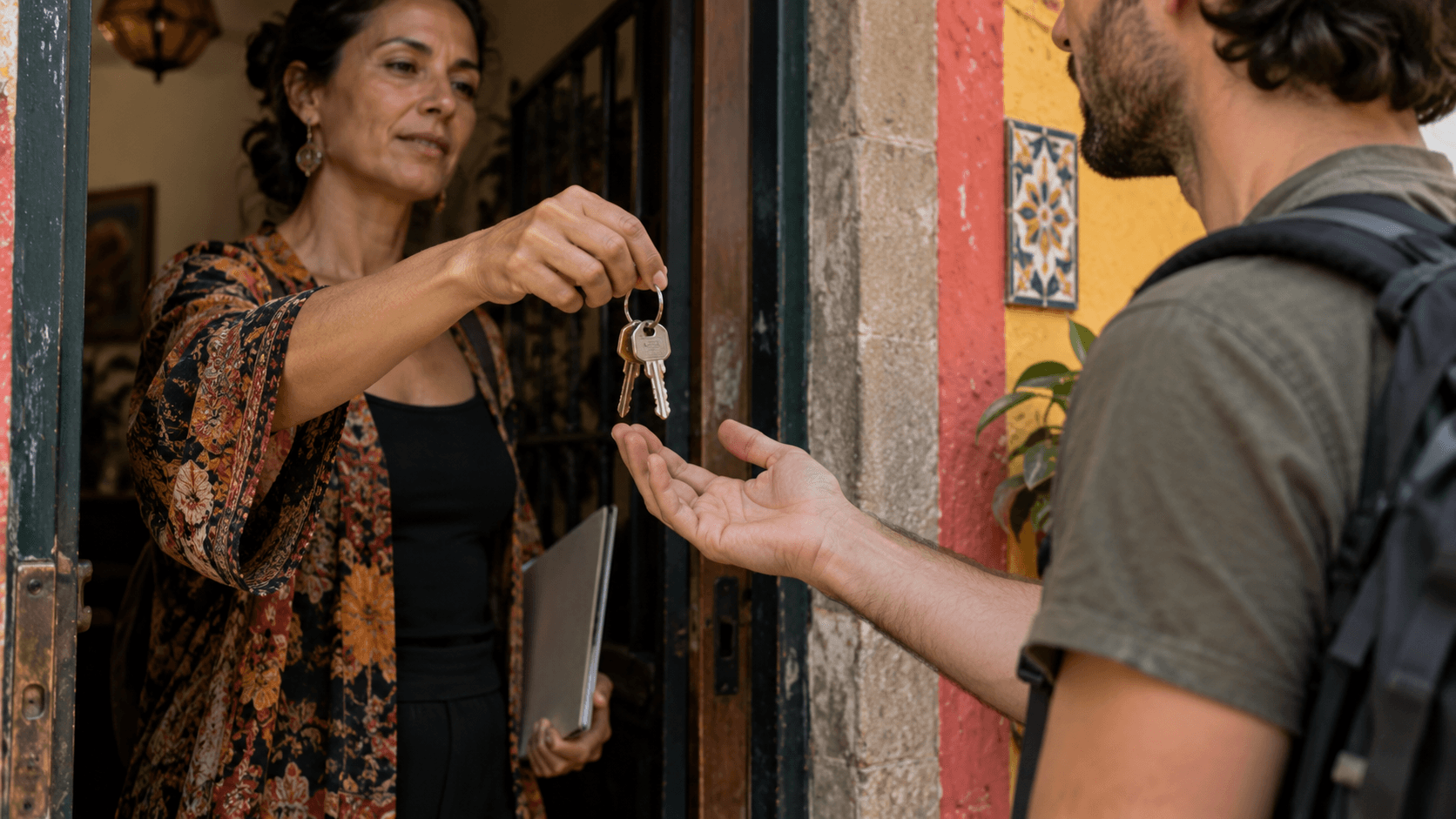
Deciding After the Test Stay
When you get back, review your results against the grid's criteria: housing, services, perceived safety, language, community, and work. Then move on to the administrative checks, in this order:
- Residence status: which visa or permit would let you settle there, and for how long?
- Remote work: does the status you're aiming for allow it, or do you need a dedicated visa?
- Tax obligations: confirm with a professional or the destination country's tax authority, and don't jump to conclusions.
- Official confirmation: contact the embassy or consulate of the destination country, which you can reach from abroad[2].
Sources
- 1.^ abcdeservice-public.gouv.fr — Schengen short-stay visa (foreigner in France for 3 months maximum) | Service Public: “Unlike a national long-stay visa (type D), a Schengen visa does not authorize you to settle in France.”; “To work during your short stay, you must hold a work authorization obtained for a paid activity.”; “If your visa is refused or your stay is cancelled, the amount paid is not refunded.” https://www.service-public.gouv.fr/particuliers/vosdroits/F16146?lang=en (accessed October 10, 2026)
- 2.^ abcdiplomatie.gouv.fr — Travel | France Diplomatie: “Check the travel documents required (identity card, passport, visa) for entry and stay in your destination country under the Travel Advice section (Entry/Stay tab).”; “Outside the European Union, most countries require a passport valid for several months beyond your planned return date to France.”; “From abroad, you can contact the embassy or consulate of your destination country.” https://www.diplomatie.gouv.fr/en/services/faq/voyage (accessed October 10, 2026)
- 3.^ abcdefsem.admin.ch — Rules for calculating the length of stay: “As a third-country national, you may in principle enter the Schengen area for a maximum of 90 days within any 180-day period.”; “A rolling 180-day period applies to the calculation. This means that each day, the number of days you have spent in the Schengen area during the preceding 180 days is checked retrospectively.”; “The day of entry counts as the first day in the Schengen area, and the day of exit as the last.” https://www.sem.admin.ch/sem/en/home/themen/einreise/info-einreise/voraussetzungen-nach-staat/mit-visum/aufenthaltsrechner.html (accessed October 10, 2026)
Show 5 more sourcesShow less
- 4.^ abchome-affairs.ec.europa.eu — Short-stay calculator - Migration and Home Affairs - European Commission: “If you hold an EU residence permit or a long-stay visa, you are not subject to the 90/180-day rule, as these documents allow you to stay more than 90 days.”; “If you hold a short-stay visa, check the authorized length of stay printed on the visa sticker. If it is less than 90 days, do not use this calculator.”; “The verification mode calculates the duration of past or current stays to check that the stay complies with the 90/180-day rule (on the day of the check).” https://home-affairs.ec.europa.eu/policies/schengen/border-crossing/short-stay-calculator_en (accessed October 10, 2026)
- 5.^Mira Knowledge — In Mauritius, English is the official language, used in government and business, but daily conversation is mostly in Creole or French. Verified June 11, 2026: reference source en.wikipedia.org. https://en.wikipedia.org/wiki/Mauritius (accessed June 11, 2026)
- 6.^ abMira Knowledge — In Spain, English proficiency is moderate: it is spoken in international companies, tourist areas, and among young urban residents, but not across the whole population. Verified June 11, 2026: reference source commisceo-global.com. https://commisceo-global.com/country-guides/spain-guide (accessed June 11, 2026)
- 7.^Mira Knowledge — In Malaysia, the “open house” (rumah terbuka) means opening your home to friends, family, and neighbors during the holidays, notably Hari Raya, and it is a moment of intercultural exchange where each community shares its culinary specialties. Verified June 11, 2026: reference source wikitravel.org. https://wikitravel.org/en/Malaysia (accessed June 11, 2026)
- 8.^Mira Knowledge — Mauritius offers a one-year, renewable Premium Travel Visa for remote workers, compatible with long-term rentals. Verified June 11, 2026: official source edbmauritius.org. https://www.edbmauritius.org/premium-travel-visa (accessed June 11, 2026)