You're planning a trip to Bali and wondering what to protect yourself from, what to declare on arrival, and how to stay reachable. This article covers the diseases spread by mosquitoes and the official precautions, the Indonesian customs declaration, IMEI registration for phones brought from abroad, and roaming overcharges. You'll know what to check before you finish packing.
Mosquitoes in Bali: What Official Sources Recommend
Mosquitoes transmit several diseases in Indonesia. The French Ministry of Foreign Affairs reports dengue, chikungunya, and Japanese encephalitis, and advises consulting your general practitioner or an international vaccination center well before departure[1].
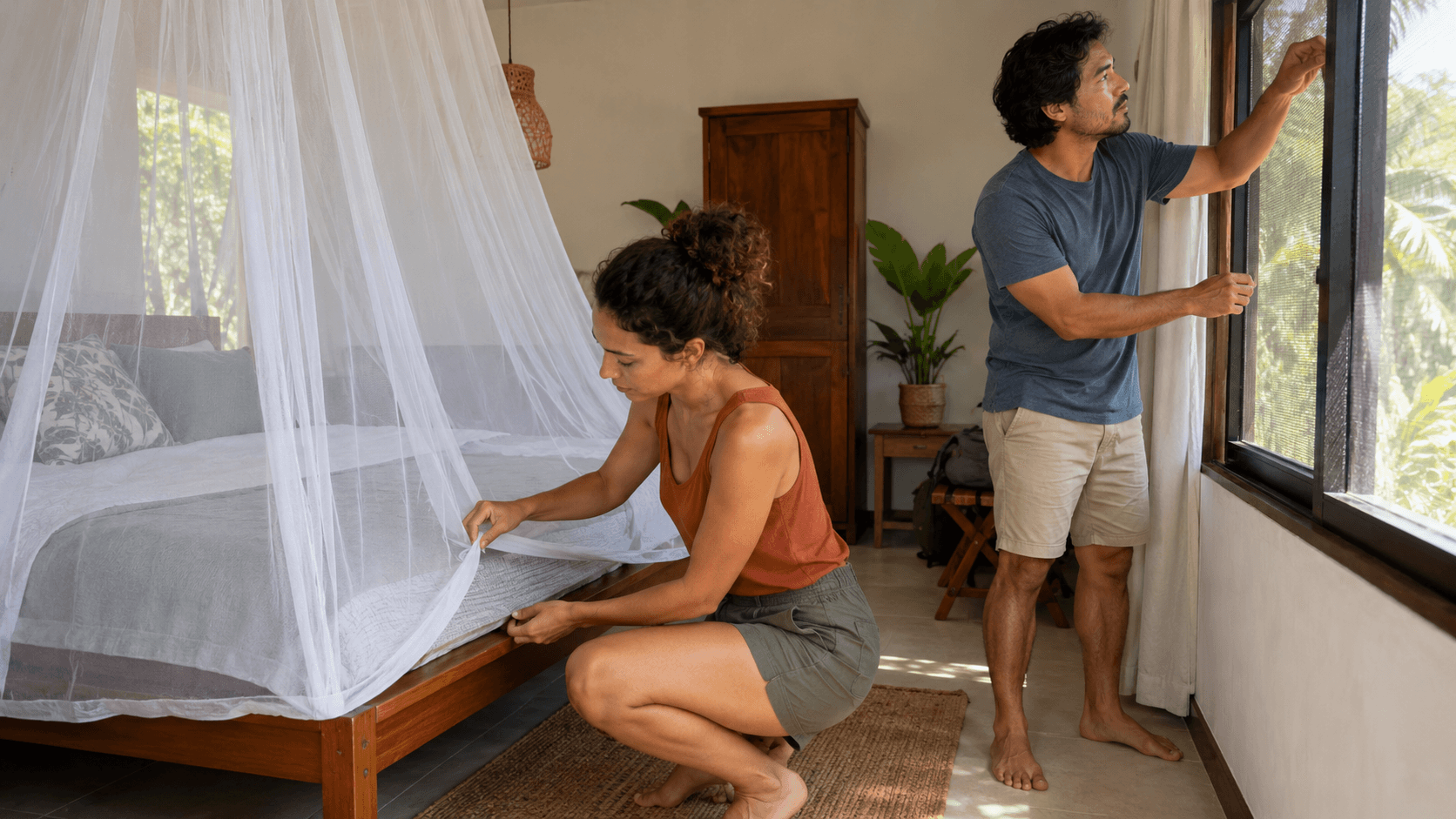
For dengue, individual prevention relies mainly on measures against mosquito bites[1]. There is no curative treatment: care only addresses symptoms, and you must absolutely avoid taking anti-inflammatory drugs[1]. If you develop fever, headaches, or body aches, see a doctor immediately[1].
Chikungunya causes flu-like symptoms (fever, muscle and joint pain), and its prevention relies on vaccination and protection against bites[1]. Japanese encephalitis, a serious viral infection, is transmitted by mosquitoes that breed in rural areas, especially rice paddies; prevention relies on protection against bites and vaccination[1].
Should You Worry About Malaria in Bali?
No, not for Bali: there is no malaria risk on the island of Bali or in the city of Jakarta[1]. That is not true for the whole country. The risk is present year-round in the islands of Papua, East Nusa Tenggara, and the Moluccas, and confirmed in rural areas of Sumatra, Java, Lombok, West Nusa Tenggara, Sulawesi, and Kalimantan[1]. If your trip includes one of these islands, talk to your doctor before you leave, because malaria prevention then also involves preventive treatment[1].
Pregnant women, or those planning a pregnancy, are advised to consult a doctor before any trip to an affected area[1].
Choosing Your Insect Repellent and Comparing It to European Brands
Since protection against bites is the main way to prevent dengue and other mosquito-borne diseases[1], the choice of repellent matters. A simple benchmark for comparing a product bought locally with the one you use in Europe: read the label and note the active ingredient, its concentration, the stated duration of protection, the minimum age of use, and the usage precautions.
- Photograph the label of your usual product before you leave so you can compare its composition and concentration with a local one.
- An essential oil or a "natural" bracelet is not the same as a repellent with documented effectiveness: when in doubt, ask your doctor or a travel medicine center.
- If you are pregnant or traveling with young children, have a healthcare professional confirm your choice of product.
Essential Oils and Products in Luggage: Where to Find the Rules
The rules for transporting aerosols, essential oils, and repellents depend on the airline operating your flight and the departure airport: read their guidelines before you finish packing.
On arrival, Indonesia uses a customs declaration, the Customs Declaration, which is the core document officers rely on to check passengers' baggage[2]. The authorities ask that you fill it out honestly[2].
The electronic form can be completed in advance: the page dedicated to passenger baggage mentions two days before arrival[2], while the customs homepage states three days, via the "All Indonesia" service that brings immigration, customs, health, and quarantine together in one link[3]. Complete it as early as possible within that window, checking the deadline displayed when you depart.
Be careful with what you carry for others: customs advises against accepting a package from someone you don't know, because you are fully responsible for your baggage[3].
Local SIM card and IMEI registration of your phone
Two separate elements come into play to get mobile network access: the SIM card, which identifies you as a subscriber, and the IMEI, which identifies the device itself. The latter is subject to a specific Indonesian rule.
A phone, tablet or handheld computer obtained abroad and brought into Indonesia in a passenger's luggage, or sent by parcel, must have its IMEI registered to obtain Indonesian mobile network access[4]. Indonesian Customs specifies that the device must be a personal effect of the traveler, not intended for sale or commercial use[4].
For travelers who plan to use their phone long-term in Indonesia, Customs reminds you to have the IMEI registered by flagging it on the Customs Declaration[3]. Registration applies to devices that will use an Indonesian operator[2].
The Customs page dedicated to the IMEI also provides for an exemption from import duties, on condition that the device is declared on arrival: if it is not declared, the exemption cannot be granted[4]. So check the current limit and conditions on the Indonesian Customs website before departure.
Pitfalls, scams and points to watch
- A phone bought abroad must have its IMEI registered to obtain Indonesian mobile network access[4]; this registration applies to devices that will use an Indonesian operator.
- Never buy medication from street vendors: the French Ministry of Foreign Affairs flags the risk of counterfeits[1].
- If you bring medication, take only what you strictly need, in its original packaging with the original labels, together with a prescription listing the medicines by their International Nonproprietary Name; check that they are authorized in the country you are visiting[1].
- Medication carried by travelers is frequently checked; psychotropic drugs, including anxiolytics, are treated as narcotics in Indonesia and receive особое attention. Carry the prescription and a supply matching the dosage, plus a few extra tablets in case your stay is extended[1].
- Your mobile plan may overcharge you abroad: your phone can connect to a network in a country not included in your plan (outside the EEA)[5]. Make sure the network is the one you want before making any call[5].
To limit these risks, the French National Consumer Institute advises turning off “data roaming,” selecting the network manually in your phone's settings, or using a Wi-Fi network, preferably a non-public one[5]. Also consider airplane mode: your phone may then connect to the satellite network, which carries fees[5].
Pre-departure checklist
- Consult your doctor or an international vaccination center well before your departure date[1].
- Take out travel insurance or an assistance plan covering medical costs, hospitalization and medical repatriation[1].
- Photograph the label of your usual insect repellent so you can compare it with a product bought locally.
- Read your airline's and departure airport's rules on products carried in hand luggage.
- Complete the electronic customs declaration in the window provided before arrival[3].
- If you bring a phone bought abroad and want to use an Indonesian network, prepare the registration of its IMEI and declare it to Customs[3].
- Set up your phone before takeoff: data roaming turned off, network selected manually[5].
This article does not detail the step-by-step process for activating a SIM card, the prices, or a precise comparison of insect repellents: to really settle in Bali, these points require going further with operators, pharmacies and the relevant authorities.
Sources
- 1.^ abcdefghijklmnopdiplomatie.gouv.fr — Indonesia - Health | France Diplomatie: “Dengue is a viral disease transmitted by mosquito bites.”; “Individual prevention relies mainly on means of protection against mosquito bites.”; “There is no curative treatment. Medical care relies solely on treating the symptoms. It is essential to avoid taking anti-inflammatory drugs.” https://www.diplomatie.gouv.fr/fr/information-par-pays/indonesie/conseils-aux-voyageurs-sante (accessed October 25, 2026)
- 2.^ abcdbeacukai.go.id — Passenger Goods Customs | Rules on Personal Baggage and Import Duty Exemption: “The Customs Declaration is the basic document used by officers to inspect passengers’ baggage.”; “That is why we ask you to fill out the Customs Declaration honestly, for everyone’s comfort.”; “You can complete the electronic customs declaration starting two days before arriving in Indonesia.” https://www.beacukai.go.id/barang-penumpang (accessed October 25, 2026)
- 3.^ abcdebeacukai.go.id — Bea Cukai Indonesia | Welcome to the Official Portal of the Directorate General of Customs and Excise: “For permanent use, don’t forget to register your IMEI by declaring it on the available Customs Declaration.”; “When to fill it out: the form can be completed up to 3 days before the expected arrival date in Indonesia.”; “Indonesia currently applies a single-window system through the All Indonesia service, which combines immigration, customs (Customs Declaration), health and quarantine in a single link.” https://www.beacukai.go.id/selamat-datang (accessed October 25, 2026)
Show 2 more sourcesShow less
- 4.^ abcdbeacukai.go.id — IMEI: “The IMEI (International Mobile Equipment Identity) must be registered to get an Indonesian mobile network.”; “Under current regulations, phones, handheld computers and tablets bought abroad, brought in a passenger’s baggage and/or sent by parcel from abroad are covered.”; “The device brought in must be a personal effect of the passenger or crew member, and not intended for sale or commercial activity.” https://www.beacukai.go.id/imei (accessed October 25, 2026)
- 5.^ abcdeinc-conso.fr — International Roaming and Overcharging | National Consumer Institute: “Make sure this network is the one you want before making any call: your phone may connect to a network in a country that is not included in your plan (outside the EEA), which will lead to overcharging.”; “Our advice: when travelling abroad (EEA and international), turn off the function (in particular roaming data) that lets your phone connect automatically to the local network. It is better to select the network manually in your phone settings so you connect to the network you want. You can also use a Wi-Fi network, preferably a non-public one.”; “Be careful too when using your phone on a plane. You will connect via the satellite network, and fees apply.” https://www.inc-conso.fr/content/itinerance-internationale-roaming-et-surfacturation (accessed October 25, 2026)